 pressug.com News 24 7

Related Articles



Ugandans are asking one burning question: what exactly is going on at Uganda Electricity Distribution Company Limited?
Ever since Umeme exited and UEDCL officially took over power distribution on April 1, 2025, complaints of persistent blackouts, delayed meter replacements, sluggish customer response and erratic service have exploded. Now, the Auditor General’s December 2025 report has poured fuel on the fire, revealing a trail of operational lapses, financial red flags and governance questions that have shaken confidence in the state-owned distributor.
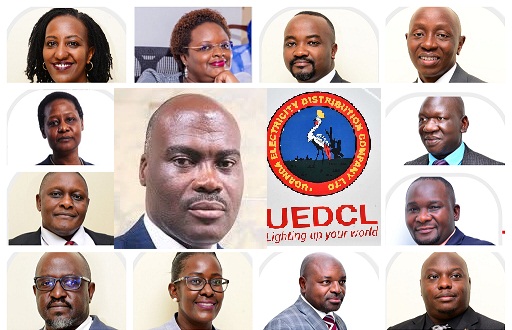
At the centre of it all is Managing Director and Chief Executive Officer Paul Mwesigwa, who has been at the helm since July 2019 and is now steering UEDCL through the high-stakes post-Umeme transition. His contract was extended last year into what is understood to be his second and final five-year term, expected to end around 2029. But insiders say the knives are already out.
Sources whisper that Eng. Tibyakinura Protaze, the Chief Engineering & Technical Services Officer, and Eng. Joselynne Rwabwogo, Chief Commercial and Operations Officer, are spending sleepless nights as quiet lobbying intensifies. Chief Finance Officer Jacqueline Kiwanuka and Chief Logistics & Production Officer Awateh Moses are also said to be watching events closely. In the boardroom, Chairperson Lydia Ochieng Obbo and members including Dr. Brian Isabirye, Mugisha Christopher, Stella Marie Biwaga, Florence Namatta Mawejje and Ben Ojok now find themselves under intense scrutiny.
But what did the Auditor General actually uncover?
The report shows that after Umeme’s concession expired on 31st March 2025, UEDCL’s asset base ballooned from UGX 113 billion to UGX 2 trillion. Customers skyrocketed from 165,937 to 2.2 million. Staff numbers jumped from 480 to 2,489. Annual revenue surged from UGX 111 billion to UGX 661 billion. It was a massive institutional scale-up almost overnight.
Yet, instead of stability, the transition has been marred by serious service delivery challenges in network reliability, outage management, complaint resolution and metering services.
The numbers are damning.
UEDCL failed to meet the distribution loss target of 14.59 percent set by the Electricity Regulatory Authority. Losses averaged 25 percent before retransfer and 20 percent after takeover. That is billions of shillings evaporating into technical and commercial leakages.
Customers endured an average of 31.78 hours of outage between April and June 2025, above the 28.87-hour target. Thirty-two percent of defective meters withdrawn were returned after more than five working days, breaching standards. Nearly 40,000 meters have been replaced, but that is only half of a backlog of almost 80,000 faulty meters.
Trade and other receivables exploded from UGX 5.92 billion to UGX 238.49 billion, a shocking 3,928 percent increase. Budget overruns hit UGX 22.2 billion. Ten procurements worth UGX 7 billion and USD 779,124 were undertaken without documented market price assessments. Two contracts worth UGX 807 million were varied without Contracts Committee approval.
And it doesn’t stop there.
Twelve parcels of land are held under expired leases, meaning the company has no valid legal interest. Thirty-five properties are not in active use. Seven are not titled. Some properties are encroached upon, while in other cases UEDCL developments are encroaching on neighbouring land.
Then comes the transmission nightmare. Multiple Independent Power Producers cannot evacuate power due to grid interruptions caused by line faults, equipment failures, transformer outages, vandalism and SCADA limitations. The result? UGX 26.94 billion in deemed energy costs recognized in just four quarters.
Major transformers have remained idle for months and even years. At Lugazi, two 14 MVA transformers have been idle for over 40 months due to faulty tap changers. At Namanve, a 40 MVA unit has been out for 27 months due to an inter-turn fault. At Owen Falls, transformers were bypassed temporarily and never fully restored. These long-term outages signal underutilised assets and reliance on interim fixes, the report notes.
Management attributes the mess to a deteriorated network inherited from prolonged underinvestment during the final years of the concession, regulatory budget cuts, vandalism, electricity theft and procurement bottlenecks. They insist corrective measures are underway, including a five-year rehabilitation plan and the “Wetereze” loss-reduction campaign.
But even as UEDCL insists it is fixing inherited problems, tensions with the regulator have escalated.
Following concerns raised by ERA over operational and management lapses, the Ministry of Energy recently ordered an internal administrative review into UEDCL’s performance. Reports emerged that Energy Minister Ruth Nankabirwa had planned to sack some senior managers, only for Prime Minister Robinah Nabbanja to reportedly block the move.
The Ministry spoxy Dr. Patricia Litho has since confirmed that the UEDCL Board had been directed to conduct a thorough investigation into the issues highlighted by ERA and to report back in “a clear, actionable, and time-bound manner.” She stressed, “To date, no staff member has been dismissed from UEDCL as a result of the internal inquiry,” and urged the public to allow the process to conclude without speculation.
Behind closed doors, however, sources say officials within the Ministry of Energy and even some at ERA are quietly backbiting UEDCL executives while positioning themselves strategically in case leadership changes occur.
A senior government official familiar with the matter warned, “UEDCL manages strategic national infrastructure. Any abrupt leadership changes can disrupt service delivery and create gaps in oversight, especially at a time when the sector is undergoing transitions.”
Yet the bigger question remains: are the top bosses at UEDCL competent enough to handle the full takeover from Umeme Limited without plunging the country into prolonged darkness?
UEDCL was established under the Electricity Act, 1999 to own, operate and manage the national distribution network outside concession areas. It supervises private concessionaires and oversees rural networks. With the Umeme concession expired, the entire national spotlight is now fixed on UEDCL’s capacity.
Government insists that “The consumer must receive a reliable and continuous power supply,” and that “Accountability, due process, and professionalism remain central to managing Uganda’s distribution network.”
But with rising outages, ballooning receivables, idle transformers, procurement irregularities and an internal review hanging over top management, Ugandans are demanding more than statements.
Is it time to crack the whip on the top bosses? Should the Board act decisively? Or should stability prevail during transition?
As power flickers across homes and businesses, one thing is clear: UEDCL’s performance is no longer just a corporate issue. It is a national test of leadership, competence and accountability in managing Uganda’s most strategic infrastructure.
And the lights are still blinking.
GOT A HOT STORY? EMAIL: redpeppertips@gmail.
SOURCE PROTECTION/CONFIDENTIALITY IS OUR NO.1 PRIORITY.