 pressug.com News 24 7

Related Articles



A storm is gathering around the Office of the Prime Minister of Uganda after a devastating Value for Money audit exposed deep cracks in the government’s flagship affirmative action programmes meant to uplift some of the country’s most marginalized communities.
The explosive findings from the December 2025 report by the Auditor General paint a troubling picture of poor planning, weak monitoring, delayed funding and questionable implementation that has left goats dead, iron sheets unused and entire projects drifting off course.
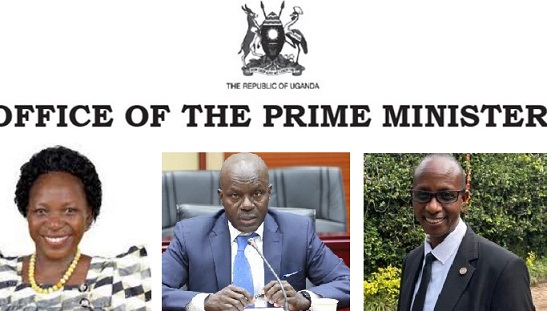
At the centre is Permanent Secretary Alex Kakooza, the administrative head of the Office of the Prime Minister who took over the powerful position from Dunstan Balaba. As the accounting officer responsible for coordinating government policies and managing resources in the Prime Minister’s office, Kakooza now finds himself facing uncomfortable questions about whether the system under his watch is truly delivering results for the poor.
Working under the PS is Under Secretary for Pacification and Development Dorothy Nsereko, the official directly responsible for initiating, designing and coordinating these affirmative action programmes aimed at transforming the lives of vulnerable communities in regions such as Karamoja, Northern Uganda, Bunyoro, Teso and the Luwero-Rwenzori triangle.
Also firmly in the spotlight is Nobert Katsirabo, the Commissioner for the Affirmative Action Programme, whose office oversees initiatives intended to support marginalized regions across the country.
Together, these officials sit at the nerve centre of a programme designed to correct historical imbalances and expand opportunities for disadvantaged communities.
But according to the Auditor General, the reality on the ground tells a far more troubling story.
The audit revealed that out of thirty-six key activities under the affirmative action programme, only eleven were fully implemented. Twelve were partially implemented, another eleven were not implemented at all, while two activities could not even be assessed due to lack of proper performance indicators.
In blunt terms, nearly two-thirds of the programme activities failed to achieve full implementation.
“How can programmes designed to uplift the poorest communities fail to be fully implemented?” asked one government insider familiar with the findings. “Someone must explain what went wrong.”
The report indicates that poor planning sits at the heart of the problem.
Despite spending UGX75 million in the 2022/2023 financial year on development planning activities—including progress tracking and validation of the Busoga Development Plan—the Office of the Prime Minister had no approved programme plans from the National Planning Authority for implementation during the National Development Planning period covering 2020/2021 to 2024/2025.
Without approved programme plans, experts warn, the interventions risk being executed blindly without clear strategic direction.
Even more worrying was the failure by OPM to conduct comprehensive needs assessments involving the very communities the programmes are supposed to help.
Instead of using participatory approaches to identify real needs, interventions were designed without adequate consultation with the beneficiaries themselves across thirty-two sampled local governments.
The result? Projects that communities could neither sustain nor effectively utilize.
“What you see here is a classic top-down planning failure,” an audit analyst said. “Projects were designed without properly asking communities what they actually needed.”
The consequences soon became visible on the ground.
Out of 137 sampled beneficiaries who received funding worth UGX229.2 million, fifty-one groups simply abandoned their original project plans and shifted to entirely different activities after receiving the money.
These changes were made without undergoing financial evaluation, technical assessments or economic viability studies.
Such deviations, the audit warns, threaten the long-term sustainability of the programme.
Meanwhile, delays in funding disbursements created another layer of chaos.
Beneficiary groups across the Luwero-Rwenzori Triangle, Teso and Bunyoro regions were unable to begin implementing their micro grant projects until after the financial year had already ended on 30 June 2024.
The reason? The Office of the Prime Minister failed to transfer funds to local governments on a quarterly basis as required by approved work plans.
Local governments then delayed sending funds to the beneficiaries, creating a domino effect of stalled projects.
Livestock distribution programmes—another flagship intervention meant to boost household incomes—also ran into serious trouble.
Out of the 236 heifers distributed in Northern Uganda and West Nile, sixty-seven animals worth UGX184 million were found not to be pregnant despite programme requirements that they should have been in-calf.
This completely undermined the anticipated multiplier effect where calves would be distributed to other households, spreading economic benefits across communities.
The situation was even worse when auditors inspected the animals two years later.
Forty-five of the sampled heifers had died.
Among the goats distributed to beneficiaries, the losses were even more staggering.
Out of 266 goats inspected, 221 had died by September 2024.
The mass livestock deaths dealt a devastating blow to the programme’s objective of improving household incomes and strengthening peace and reconciliation in post-conflict areas.
“Imagine distributing animals to vulnerable households and within two years most of them are dead,” one government official lamented. “That is not just poor implementation—it is a tragic waste of resources.”
Another embarrassment came from the distribution of iron sheets intended to support infrastructure projects in beneficiary institutions.
During the financial years 2021/2022 and 2022/2023, OPM distributed 18,921 iron sheets. But by the time of the audit, 9,761 iron sheets worth UGX673 million had not been used.
The unused materials simply sat idle in institutions that were supposed to benefit from them.
Such underutilization, the Auditor General warned, defeats the very purpose of the intervention.
Perhaps the most glaring weakness exposed by the audit was the near absence of proper monitoring and evaluation systems.
The Office of the Prime Minister had not prepared annual monitoring and evaluation work plans or budgets for the affirmative action programmes.
Even worse, there were no standard tools to collect data, analyse progress or report on programme performance.
Without proper monitoring mechanisms, government officials were essentially flying blind.
“How do you track success or failure of programmes if you don’t even have monitoring tools?” a governance expert asked. “It becomes impossible to measure impact.”
The Auditor General warned that such gaps prevent government from properly tracking programme indicators or evaluating whether interventions are improving the lives of beneficiaries.
Despite the troubling findings, the report acknowledged that some progress had been made.
A total of 63,944 iron sheets were distributed across Northern Uganda, Karamoja, Luwero-Rwenzori, Teso and Bunyoro.
More than 74,000 goats and 236 heifers were distributed in Karamoja and Northern Uganda.
A total of 1,239 micro-project groups received support aimed at improving livelihoods.
And 7,007 hand hoes were distributed to beneficiaries in the Bunyoro sub-region.
But critics say these achievements cannot overshadow the systemic weaknesses revealed by the audit.
“The problem is not whether something was done,” a policy analyst said. “The real question is whether it was done properly and whether it achieved the intended results.”
Now attention is turning to accountability.
As the Accounting Officer of the Office of the Prime Minister, Permanent Secretary Alex Kakooza bears the ultimate responsibility for ensuring proper planning, budgeting and implementation of government programmes.
At the operational level, Under Secretary Dorothy Nsereko and Commissioner Nobert Katsirabo are directly responsible for designing and overseeing these affirmative action initiatives.
With goats dying, iron sheets gathering dust and millions of shillings funding projects that never materialized, many observers are asking whether these officials exercised sufficient oversight.
What exactly went wrong?
Was it poor planning, weak supervision, bureaucratic delays or simply lack of coordination among stakeholders?
The Auditor General believes urgent reforms are needed.
Among the key recommendations is the establishment of a comprehensive monitoring and evaluation framework, stronger collaboration with local governments and improved needs assessments to ensure that future interventions align with the actual needs of communities.
Government officials responsible for procurement and distribution of livestock must also be held accountable for approving animals that did not meet quality specifications.
Experts also warn that failure to address the identified weaknesses could undermine the very purpose of affirmative action programmes.
“These initiatives were created to help marginalized communities recover from years of conflict and economic neglect,” said a development specialist. “If they are poorly implemented, the people who suffer most are the very citizens they were meant to uplift.”
For now, the spotlight remains firmly on the Office of the Prime Minister.
And as the dust from the Auditor General’s report settles, the question echoing across government corridors is simple but explosive.
Who is ultimately to blame for the failures—and will anyone be held accountable?
GOT A HOT STORY? EMAIL: redpeppertips@gmail.
SOURCE PROTECTION/CONFIDENTIALITY IS OUR NO.1 PRIORITY.
