 pressug.com News 24 7

Related Articles


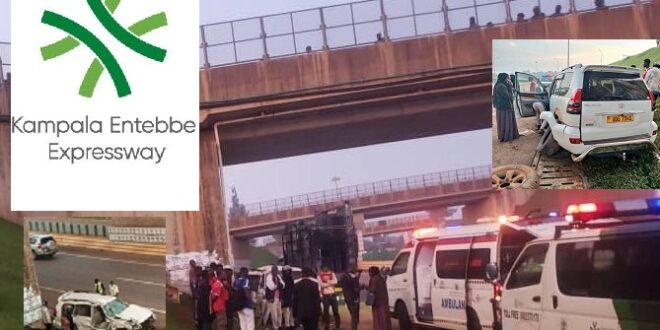
Grief has quickly turned into anger after a fatal crash on the Kampala–Entebbe Expressway on Monday exposed what critics are calling a dangerous mix of confusion, negligence and institutional complacency at the Kampala Entebbe Expressway (KEE).
According to the Directorate of Traffic and Road Safety, the crash happened at around 6:30am at the Mpala section and involved a Toyota Land Cruiser, registration number UBG 734S. The driver, Ssenyonjo Bosco, a businessman from Masaka, was travelling with his family towards Entebbe when he reportedly lost control of the vehicle. Three occupants, including the driver, died instantly, while two others were left with severe injuries.
But even before the wreckage was cleared, a different kind of crash had begun—this time between official narratives.
In its own statement, KEE offered a different explanation, saying the driver “reportedly dozed off due to fatigue after a long-distance journey.” The agency added that its incident response team worked with police to secure the scene and manage traffic, while urging motorists to rest and avoid driving while tired.
Yet that explanation has triggered sharp criticism, not just for what it says—but for what it avoids.
“How do two agencies that were on the same scene end up with conflicting accounts?” one critic questioned, pointing out that police suggested loss of control while KEE leaned on fatigue. “Can an entity contracted to manage the Expressway rely on ‘reportedly’ when lives have been lost?”
That single word—“reportedly”—has become the centre of outrage, seen by many as a convenient shield rather than a factual conclusion.
“This is a textbook example of institutional complacency,” says Ronald Amanyire, A ministry of Works official. “Instead of addressing the facts, you rush to absolve yourselves.”
The criticism goes further, accusing KEE of failing to confront deeper safety concerns on the stretch where the crash occurred. Chief among them is the issue of lighting.
“The section you manage has no lighting. That is not speculation; it is a matter of public record,” Amanyire stated, adding that repeated warnings about darkness on that part of the expressway had gone ignored.
Even more troubling is the claim that KEE deliberately avoided stating the exact time of the crash in its communication—despite police indicating it occurred early in the morning when visibility would have been low.
“You have conveniently avoided stating the exact time the crash occurred—because acknowledging it would expose the consequences of your negligence,” he charged.
Road users have reportedly complained about the same stretch before, with some saying they eventually gave up raising concerns after receiving no meaningful response.
“When I raised it, not a single credible explanation was offered—not even the usual fallback of ‘funding constraints,’” he said, painting a picture of an agency unwilling to engage until tragedy strikes.
Now, with three lives lost, the silence is being interpreted as something far more serious than oversight.
“This crash is not an accident in the abstract. It is the predictable outcome of systemic failure.”
At the centre of the storm is a growing belief that the expressway, a toll road paid for by the public, is being managed without adequate regard for safety standards. The absence of lighting at Mpala section raises serious questions about why critical infrastructure is being neglected—and why.
“A road section that citizens pay to use remains in total darkness because someone benefits from keeping it that way. That is corruption, not misfortune,” Amanyire wonders, in one of the strongest indictments yet.
Beyond the physical conditions of the road, the incident has exposed a deeper crisis—one of credibility. When two institutions present conflicting explanations for the same fatal crash, public trust erodes.
“We cannot prevent future incidents if investigations and public statements are issued in such a disorganized and contradictory manner,” critics warned. “We need clarity, accountability, and a single evidence-based explanation—not guesswork.”
At its core, this is no longer just about one crash. It is about a system that appears reactive rather than preventive, defensive rather than transparent.
For the families who lost their loved ones, the official statements offer little comfort. What they—and the public—are demanding is not speculation, but truth.
“The public deserves transparency, not deflection. The families affected deserve truth, not convenient narratives.”
Until those answers are provided, the Kampala–Entebbe Expressway risks carrying more than just traffic—it carries growing doubt about whether those entrusted with its management are doing enough to keep Ugandans safe.
And as the debate intensifies, one question hangs heavily in the air: if the warnings had been taken seriously earlier, would three people still be alive today?