 pressug.com News 24 7

Related Articles

The draft memo prepared for Mr. Rubio says that getting the agreement signed would involve “the potential use of sticks” and warned that Zambia could not be allowed to backtrack because other countries are watching.
If Zambia won’t sign, “sharp public cuts to American foreign assistance would significantly demonstrate to aid-receiving countries the seriousness of our interest in collaboration and our insistence on tangible benefits under our America First foreign policy,” the draft memo says.
Zambia has been one of the largest recipients of PEPFAR assistance — more than $6 billion — in the past two decades. When the assistance began, during the administration of George W. Bush, some 90,000 people a year were dying of H.I.V. in Zambia and the health system was entirely overwhelmed.
The Zambian government has been taking over some of the H.I.V. programs since the Trump administration’s cuts to aid began last year. Nevertheless, everything from the essential medicines supply chain to the medications that stop babies from being infected with H.I.V. at birth still relies on American financial and logistical support.
The Trump administration has already wielded a heavy cudgel to advance the talks, according to the memo.
In December, the United States suspended the health funding talks when Zambia wasn’t engaging on the minerals issue, the memo says.
“At every point in the negotiation, we communicated what the G.R.Z. would lose if they failed to act,” the memo says, using an acronym for Government of the Republic of Zambia. “Repeatedly, we needed to threaten or actually withdraw assistance important to the GRZ to elicit progress on our priorities.”
More recently, the memo says, the State Department notified the Zambian government that it would cancel a planned deal that would have relieved Zambia of hundreds of millions of dollars in foreign debt payments, an amount roughly equivalent to half of what the country receives in health aid.
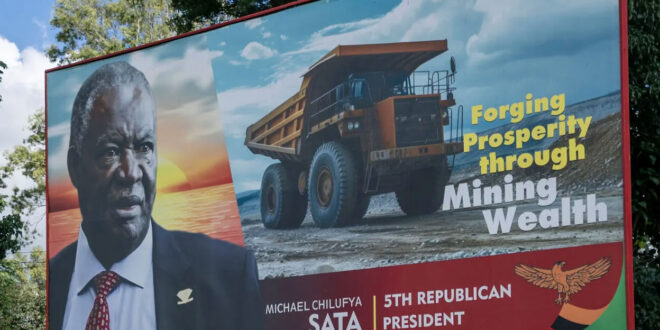
“Within days, the Zambian Mines Minister explicitly reversed course, telling USG officials the GRZ is amenable to negotiating preferential access, and the GRZ gave USG technical experts unprecedented access to their mining database,” the draft memo says.
Despite its extensive mineral wealth, and the longtime role of the United States as the country’s largest donor of foreign aid, there is only a limited presence of American companies in Zambia. Corruption levels are high — the official recently appointed by the president to lead a new anti-corruption effort was herself under investigation for graft — and the process of obtaining licenses and permits is onerous and convoluted.
Would-be investors from the United States, Canada and Europe have long complained that Chinese companies bribe senior officials to obtain mining licenses, and smuggle out much of what they produce without paying taxes, viewing the occasional small fine levied as a cost of doing business.
The proposed new bilateral compact would require Zambia to undertake significant reform of the governance of the minerals and other key sectors.
The draft memo notes that the health of Zambia’s democracy has frayed under President Hakainde Hichilema, and the silencing of opposition has limited the amount of public criticism. However, transparency and human rights organizations are using the country’s freedom of information system to try to make the proposed health agreement public.
They are chiefly concerned with a provision in the draft deal that requires Zambia to share its citizens’ health data with the United States for 10 years, although the United States pledges health funding for only five; and to share biological specimens collected through disease surveillance for 25 years, with no guarantee Zambia would have access to any product of research done with those samples, such as development of a vaccine.
Rumors about the negotiations have spread through Zambia, and they are wrenching for people dependent on the U.S.-supplied antiretroviral medications, or ARVs, they take each day.
“If they told me to be buying ARVs, the fifty kwacha, or a hundred, that’s four or five dollars per month, even three dollars, where am I going to get it?” asked Julius Kachidza, a 56-year-old advocate for people living with H.I.V. who lives in Chongwe, near the capital. “I barely eat a meal a day.”
Mr. Kachidza was diagnosed with H.I.V. in 2001, and was near death when he first got access to the drugs. His wife, who was also H.I.V.-positive, died 15 years ago. A son who was born with the virus is now in his 20s and also reliant on U.S.-financed medication.
“If this agreement is not signed, if the funding is not here for the next five years, government has got no capacity to respond to that immediate impact,” he said.
Perhaps, over five years, the government may successfully take over the program, but an abrupt slash in funds, like the country saw last year when the Trump administration took office, would be apocalyptic, he said. “It could be quite a disaster, especially to me. And the majority of people living with H.I.V. in Zambia.”