 pressug.com News 24 7

Related Articles



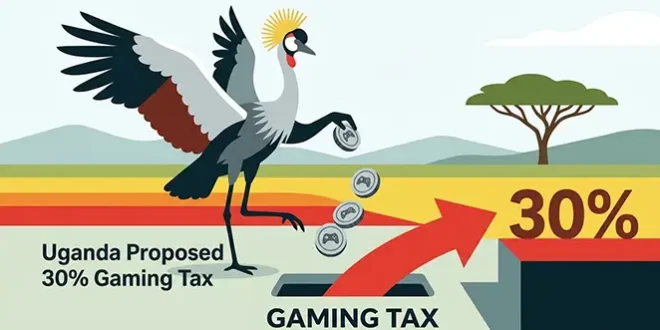
The Government of Uganda has introduced two bills in Parliament that could significantly reshape the tax landscape of the country’s gaming industry. The first document equalises the gross gaming revenue (GGR) tax for all operators to a single 30% rate, while the second introduces a mandatory 15% withholding tax on players’ net winnings. The expected date for both changes to take effect coincides with the start of the financial year and is set for 1 July 2026.
The key parameters of the reform are as follows:
30% of operators’ gross gaming revenue (GGR)
15% withholding on players’ net winnings
Effective from 1 July 2026, subject to parliamentary approval
Two bills before Parliament
The reform is set out in two separate documents, each of which covers its own specific area of taxation. Lotteries and Gaming (Amendment) Bill 2026 applies directly to operators and is aimed at standardising tax rates across all types of gambling. Income Tax (Amendment) Bill 2026, in turn, concerns players and introduces a mechanism for withholding tax from their winnings.
This separation is not accidental: lawmakers are distinguishing between taxpayers to avoid confusion between the fiscal burden on businesses and the obligations of individuals.
How the 30% rate for operators will work
Under the Lotteries and Gaming (Amendment) Bill 2026, all gambling operators are required to pay 30% of gross gaming revenue. The calculation base is defined as the difference between the total amount wagered and winnings paid out. In other words, GGR represents the operator’s net revenue, and it is this figure on which the tax is assessed.
This is not a corporate income tax in the usual sense, but a revenue-based levy, making the rate a significant burden for companies regardless of their operating costs.
What changes compared with the current rates
At present, there is a marked disparity in Uganda. Sports betting operators pay 20% GGR, whereas casinos and other gaming verticals are already taxed at 30%. The proposed measure eliminates this gap and raises the tax bar for the sports betting segment by 10 percentage points, bringing it into line with the other areas.
A 15% withholding tax on players’ winnings
The Income Tax (Amendment) Bill 2026 provides for the introduction of a 15% withholding tax on net winnings. The mechanism is simple: the operator withholds the tax before payout, and the player is paid the amount net of the mandatory charge. Subject to parliamentary approval, these changes are planned to be applied from 1 July 2026.
Two levels of taxation for one ecosystem
A fundamental feature of the reform is that it creates two parallel tax streams. One tax is levied on companies’ gross gaming revenue, while the second is withheld directly from players’ winnings. Thus, within a single ecosystem, two independent mechanisms begin to operate, each targeting its own revenue source.
Why the state is focusing on the sector right now
In the memorandum accompanying the bill, the aim is stated plainly: “to harmonise the gaming tax rate to 30% of total stakes minus payouts.” Behind this wording lies a straightforward context. Uganda’s betting market is experiencing a period of intensive growth, fuelled by smartphone penetration and the rapid expansion of mobile betting platforms. Sports betting accounts for a significant share of activity in the regulated segment.
This is not unique
A similar trend is observed in other developing countries across different regions of the world. Especially when it comes to the most populous states with dynamically developing economies — Brazil, China, and Indonesia.
A telling example is a country such as India. There, sports betting is made mainly through mobile betting platforms with international licences. This is also confirmed by the team behind a website listing online platforms offering betting apps in Andhra Pradesh, whom we contacted for comment. They pointed out that in India, as in Uganda, sports betting is mainly done via smartphones. Given India’s population size, the issue of taxation is even more pressing for it than for other developing countries. India’s tax system with regard to gambling is quite developed, so the Ugandan authorities partly used it as a reference when drafting the new legislative initiatives.
How the authorities expect to increase collections amid the sector’s expansion
The logic of the reform is built around two levers. Raising the rate for bookmakers from 20% to 30% increases tax revenues from the most dynamic segment of the market, while introducing withholding on winnings opens up a fundamentally new revenue stream. The state seeks to secure a larger volume of collections from a rapidly growing industry by increasing the fiscal burden simultaneously at two levels.
Related
, https://pmldaily.com/news/2026/04/uganda-proposes-a-uniform-30-tax-rate-for-gambling-and-a-15-withholding-tax-on-winnings.html