 pressug.com News 24 7

Related Articles



As anticipated, parliament on Tuesday night passed the contentious Protection of Sovereignty Bill, 2026, following nearly eight hours of heated debate.
The passage capped an unusually rapid legislative process, with the Bill enacted in just 20 days, raising concerns about parliament’s constitutional oversight role. Attention now shifts beyond parliament to a broader constitutional and political arena, with questions emerging over legislative integrity, executive influence, and the limits of state power in safeguarding sovereignty.
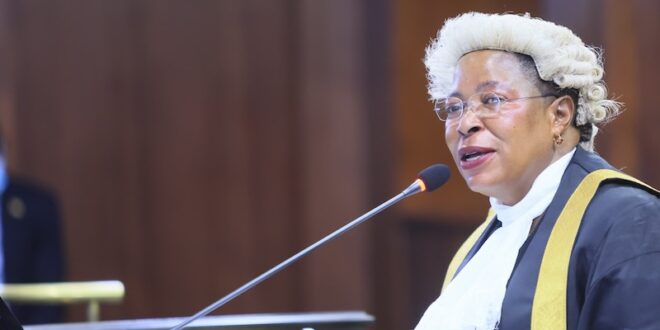
Introduced by the government through Attorney General Kiryowa Kiwanuka on April 15, the Bill advanced largely on the strength of the ruling National Resistance Movement’s numerical dominance and the backing of speaker Anita Annet Among.
Government legislators defended the Bill as a necessary legal instrument to shield Uganda from what they described as growing foreign interference in domestic political, civic and economic processes.
During the debate, Kiwanuka argued that “sovereignty is not an abstract concept; it must be actively protected in a global environment where foreign actors can shape internal political outcomes through funding and influence.”
However, opposition lawmakers, led by Nakawa West MP Joel Ssenyonyi, warned that the law risks entrenching state overreach under the guise of national protection.
“This Bill opens the door to criminalising legitimate civic engagement and dissent,” Ssenyonyi argued, cautioning that its broad provisions could be used to target civil society organisations, media actors and political opponents.
At the centre of the controversy are clauses critics describe as overly broad and susceptible to abuse. The Bill introduces sweeping definitions of “foreign interference,” potentially encompassing funding, partnerships or advocacy linked to international entities without clearly defined thresholds.
Individuals or organisations found in violation face stiff penalties, including heavy fines and possible imprisonment, raising concerns about proportionality and enforcement discretion.
The legislation also grants wide discretionary powers to government agencies to investigate and sanction actors deemed to undermine sovereignty, with limited judicial safeguards.
Some provisions further tighten oversight of NGOs and advocacy groups, particularly those receiving foreign funding, echoing concerns previously raised under the NGO Act, 2016. Busiro East MP Medard Lubega Ssegona warned that such provisions could tilt the balance in favour of the executive.
“Oversight is not retrospective; it is preventive. Parliament must ensure that laws do not create fertile ground for abuse,” Ssegona said, underscoring the legislature’s constitutional duty to rigorously scrutinise legislation.
A major flashpoint in the process was the suspension of Rule 170 of parliament’s rules of procedure, moved by Government Chief Whip Denis Hamson Obua. The rule ordinarily guarantees clause-by-clause consideration of Bills and requires scrutiny of public submissions at the committee level, a key pillar of participatory lawmaking.
Its suspension allowed parliament to fast-track the Bill, effectively limiting deeper scrutiny and stakeholder input. Presiding over the proceedings, speaker Among called for two division votes following procedural objections, an unusual step that reflected the depth of disagreement.
Both votes affirmed the NRM’s majority, ultimately sealing the Bill’s passage. The process also drew attention after President Yoweri Museveni distanced himself from aspects of the Bill, cautioning against provisions that could be interpreted as curtailing legitimate freedoms or harming Uganda’s international standing.
Sources within government indicated that Museveni was particularly concerned about clauses that could strain diplomatic relations with development partners, undermine Uganda’s commitments under international law, including human rights frameworks, and reinforce perceptions of shrinking civic space.
His initial reservations have fuelled speculation over whether the final version reflects his concerns, or whether parliament proceeded largely under party pressure. The President now faces a constitutional decision under Article 91 of the 1995 Constitution: assent to the Bill, return it to parliament for reconsideration, or decline to sign it into law.
Legal and governance experts argue that the manner of the Bill’s passage raises fundamental questions about Parliament’s role under Article 79, which vests legislative authority in the House while implicitly requiring scrutiny, accountability and public participation.
Hamson Obua with Anita Among in parliament
Constitutional governance expert Dr Sarah Bireete criticised the procedural shortcuts, saying: “Oversight begins at the lawmaking stage. When Parliament curtails scrutiny, it risks transforming itself from a watchdog into a conveyor belt for executive priorities.”
The speed of passage, particularly at the tail end of the 11th Parliament, has heightened concerns that legislative urgency may have overridden due diligence. The Bill’s legality could soon be tested in court.
Uganda’s judiciary has, in past rulings, nullified legislation or specific provisions where procedural irregularities or constitutional violations were established. Ndorwa East MP Wilfred Niwagaba signalled the likelihood of legal challenges, noting that both the substance of the law and the process of its enactment could form grounds for litigation.
Ultimately, the debate surrounding the Protection of Sovereignty Bill reflects a broader tension in modern governance: balancing national sovereignty with democratic freedoms in an increasingly interconnected world.
While the principle of sovereignty commands broad acceptance, its operationalisation—particularly through expansive state powers, remains deeply contested. As speaker Among adjourned parliament sine die ahead of the swearing-in of the 12th parliament scheduled for May 13–15, the legacy of the 11th parliament may well be defined by how it navigated, or failed to navigate, this delicate balance.
Whether the Bill becomes law, is revised, or is struck down, its passage has already ignited a national conversation likely to shape Uganda’s legislative culture, civic space and constitutional order for years to come.
Related
, https://observer.ug/news/parliament-passes-sovereignty-bill-after-seven-hour-showdown/