 pressug.com News 24 7

Related Articles


Viewers: 120,007
By Andrew Irumba Katusabe
Kampala-The Department of Mines under the Ministry of Energy and Mineral Development (MEMD) has been widely commended for spearheading what stakeholders described as one of the most comprehensive reform engagements aimed at restructuring Uganda’s mineral trade governance system.
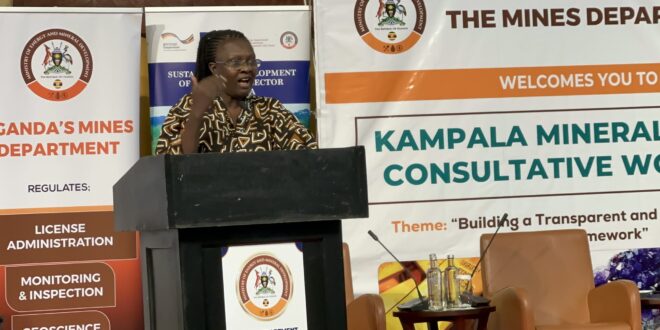
The commendation followed the successful conclusion of a two-day high-level stakeholders’ consultative workshop organized by the Mines Department at Speke Resort Munyonyo on Friday, where key actors across Uganda’s mineral value chain deliberated on proposed amendments to laws regulating the country’s rapidly expanding mining sector.
The workshop, convened under the leadership of the ministry’s permanent secretary Eng. Irene Pauline Bateebe and Commissioner for Mines Eng. Agnes Alaba, attracted officials from government ministries, departments and agencies, security institutions, local governments, refiners, dealers, miners, processors and international development partners led by GIZ.
Observers noted that the Mines Department has increasingly positioned itself at the center of government’s broader agenda to formalize mineral trade, eliminate illicit dealings and strengthen investor confidence within Uganda’s extractives industry.
Throughout the two-day engagement, participants reviewed regulatory gaps, enforcement challenges and operational bottlenecks that continue to affect the mineral sector despite its growing contribution to the national economy.
Stakeholders Form Four Technical Clusters
On the final day of the workshop, stakeholders were divided into four specialized technical groups tasked with generating proposals and recommendations expected to feed into the forthcoming amendments to Uganda’s mining laws.
One cluster brought together Ministries, Departments and Agencies (MDAs) alongside development partners led by GIZ. Institutions represented included MEMD, National Environment Management Authority (NEMA), Uganda Revenue Authority (URA), Bank of Uganda (BoU), Uganda National Mining Company and GIZ.
This team proposed several interventions aimed at removing barriers limiting miners and licensed dealers from accessing mineral markets, financing, licensing systems and government-recognized mineral buying centres.
Another group comprised local government leaders who discussed how district authorities would facilitate implementation of Mineral Market and Buying Centres (MMBCs) at community level and support enforcement mechanisms once the reforms are operationalized.
The security cluster brought together the Police Mineral Protection Unit (PMPU), Interpol, Internal Security Organisation (ISO) and Resident District Commissioners (RDCs), who focused on designing security frameworks intended to protect mineral markets from criminal infiltration, smuggling and fraud.
Meanwhile, refiners, processors, dealers and miners discussed operational realities affecting mineral trade and proposed practical reforms aimed at formalizing transactions and improving traceability within the sector.
Government Tightens Grip On Mineral Transactions
During the workshop, officials from the Mines Department emphasized government’s intention to tighten regulation of mineral transactions by restricting business operations to officially gazetted trading centres supervised by the state.
In an exclusive interview with this publication at Speke Resort Munyonyo, Senior Legal Officer Loyola Rwabose Karobwa warned investors against conducting mineral business from hotel lobbies and unauthorized locations.
“Some foreign investors have been crying that some unscrupulous dealers defraud them from hotel lobbies. Now we shall only protect those who transact in gazetted market places. If they defraud you from the hotel lobby, don’t cry to government because you now know where to do legal business from,” she stated.
She further revealed that the proposed amendments seek to criminalize mineral transactions conducted outside authorized trading centres.
Under the proposals, offenders could face fines of up to Shs100 million, a maximum prison sentence of two years or both upon conviction.
Sector Reforms Driven By Mines Department
Industry observers credited the Mines Department for taking a more proactive role in recent years in reshaping Uganda’s mining landscape through policy reforms, stakeholder engagement and institutional coordination.
The department has been central in promoting formalization of artisanal miners, strengthening mineral traceability systems, supporting establishment of mineral buying centres and combating illegal mineral exports that have historically undermined government revenue collection.
Many participants at the Munyonyo workshop specifically applauded Commissioner for Mines Eng. Agnes Alaba for providing technical leadership and creating a platform that brought together both regulators and private sector players to openly debate reforms affecting the future of Uganda’s mineral industry.
While officially closing the workshop, Eng. Alaba thanked stakeholders for their participation and assured them that the Mines Department would carefully study and incorporate viable recommendations into the forthcoming legal amendments.
She reaffirmed the department’s commitment, under the broader supervision of MEMD, to building a transparent, secure and internationally credible mineral sector capable of driving Uganda’s industrialization and economic transformation agenda.
The consultative engagement builds on Thursday’s earlier deliberations where participants assessed weaknesses within the current legal framework and explored strategies for strengthening regulation, investor protection, mineral traceability and sector governance.
, https://www.spyuganda.com/memd-steers-bold-mineral-sector-reforms-as-two-day-high-level-consultative-workshop-closes-at-spekeresort-munyonyo/