 pressug.com News 24 7

Related Articles


There is a video that occasionally surfaces on the internet.
Delivered using his impeccable oratory prowess, Katikkiro Charles Peter Mayiga, while speaking at a function in the Bulange compound, is heard telling young people that real success takes time.
The success he was talking about that day was about being rich. He says that it is challenging for anyone to become wealthy before the age of 50. By being rich, he emphasised, he didn’t mean owning a Toyota Spacio or building a small, three-bedroom bungalow.
He would repeat that message again on a morning TV show. When the presenter mentioned a few rich people who had made it before 50, he acknowledged that he didn’t mean those don’t exist; rather, they are the exception. Not the norm.
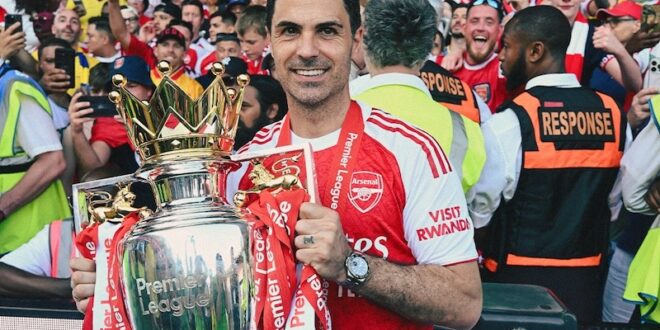
Some people call them outliers. I recalled this video last week when Arsenal, the English club with a huge global fanbase, finally won the Premier League title that had eluded them for 22 years.
Arsenal had raised the bar to unbelievable levels when they went through a season unbeaten, culminating in their triumph in 2004. No other English club has ever achieved that to date.
The expectations for Arsenal to dominate were high, and indeed, in 2006, they reached the Uefa Champions League final only to lose to Barcelona through two late goals. Since then, Arsenal has won a few trophies, particularly the FA Cup and the Community Shield, but ultimate success in England is measured by winning the premiership.
Even if you win the Champions League, like Liverpool did, if the Premier League is missing, you are always reminded of that failure. Liverpool were reminded of their failure to do so until they did recently by breaking a 30-year wait. It is remarkable what Mikel Arteta has been able to achieve.
He came in without any experience of managing even a village club. He had been an assistant to the legendary Pep Guardiola at Manchester City after he retired from playing football as Arsenal captain.
But being an assistant and manager or head coach is entirely different. Arteta had early success, winning the FA Cup a few months after his appointment, but the Premier League is where you are judged.
The Arsenal board knew that they had hired a rookie manager, and they didn’t panic when things didn’t go their way. They understood that success takes time. In the past three years, Arteta’s Arsenal had finished second to Manchester City and Liverpool.
Rival fans labelled Arteta a perpetual bridesmaid. The pundits, largely former players in the Premier League, trolled Arsenal for bottling the league. Some of those pundits never won the league while others failed miserably as managers.
However, pundits are compensated for their commentary. In an era of podcasts, trolling attracts many likes and reposts. Despite some fans advocating for Arteta’s dismissal, the board chose to retain him.
They analysed the progress being made, especially over the last three years, and decided not to panic. Arsenal had been competitive not only in the Premier League but also in Europe, beating giants like Real Madrid and Bayern Munich.
The decision to hire a novice manager and maintain his position has ultimately resulted in Arsenal lifting the premiership title and reaching the Champions League final for only the second time in history.
If Arsenal triumphs in the final scheduled for Budapest on 31 May, they will etch their name in club history. Arteta would become legendary at the club and as one of the world’s most sought-after managers.
The Arsenal with Arteta story tells us a lot about life. Do we provide the people who join us the time they need to succeed? I know people who hire a domestic worker (maid) straight from the village and expect them to be able to make a sandwich within hours.
How would they expect a young girl who has never seen a sandwich to be able to make one within days? At work, we emphasise experience. We want to hire skilled people, but where will they get experience if we don’t give them a chance??
Do we see the potential of someone who doesn’t have a glowing CV and take a chance on them in key leadership positions? If they falter, do we continue backing them up? Do we give them the tools they need to succeed?
The Arsenal-Arteta story this season offers us a lot of stuff to learn from. Patience is important. Sometimes, it is the right decision to ignore external distractions. Failure is part of life. Experiences from it can eventually lead to success. Success takes time as long as we keep progressing.
djjuuko@gmail.com
The writer is a communication and visibility consultant.
Related
, https://observer.ug/business/the-arsenal-arteta-story-its-lessons-for-business/