 pressug.com News 24 7

Related Articles



By Ben Musanje
The Ministry of Education and Sports has praised the Uganda Bureau of Statistics (UBOS) for releasing the Baseline Education Census 2025 Report, describing it as a timely and transformative tool that will strengthen planning, improve service delivery and guide government investment in Uganda’s education sector.
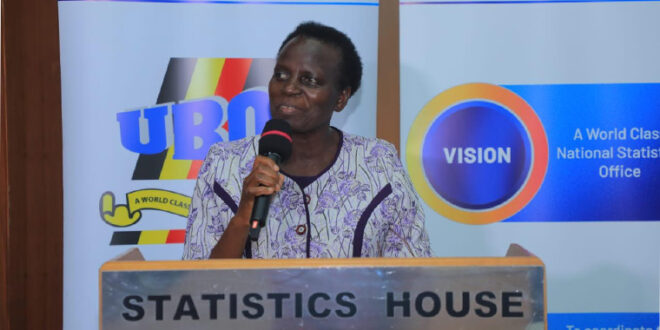
Speaking during the dissemination of the report at Statistics House in Kampala on Thursday, Permanent Secretary Dr. Kedrace Turyagyenda commended UBOS for conducting what she described as a comprehensive and much-needed exercise that will support evidence-based decision-making across all levels of education.
“Great work they’ve done,” Dr Turyagyenda said while applauding the UBOS technical team.
“This baseline data, as the Executive Director has just mentioned, we thought we would have it by 2021. We have been needing it yesterday and we cannot say how much we are excited to have it today,” she added.
The Baseline Education Census 2025 Report presents a detailed picture of Uganda’s education landscape, covering pre-primary, primary, secondary and non-tertiary institutions across the country.
According to the report, Uganda has 38,347 pre-primary schools, the majority of which are privately owned. Of these, 35,154 are private schools while only 3,193 are attached to public schools.
The census also established that the country has 2,374,674 learners enrolled at pre-primary level, including 1,207,966 boys and 1,166,708 girls.
At primary level, UBOS recorded 43,567 schools serving 9,118,314 learners nationwide. Female learners slightly outnumber males, with 4,586,970 girls compared to 4,531,344 boys.
The report further found that Uganda has 5,498 secondary schools, of which 4,014 are privately owned while 1,484 are public schools.
A total of 2,008,133 learners are enrolled at secondary level, including 1,069,855 girls and 938,278 boys, indicating that female learners constitute the majority of secondary school enrolment.
Dr. Turyagyenda said the report comes at a critical time when government is intensifying efforts to improve access, quality and equity in education as part of Uganda’s Vision 2040 development agenda.
“You cannot plan and execute unless you have real data and you have it in good time,” she said.
“So we are grateful that together we can now move and see where the services are needed most.”
She explained that the findings will help the Ministry of Education and Sports identify underserved communities, determine infrastructure gaps and prioritize resources based on actual population and learner data.
“The government is committed to the whole-of-government approach and so having UBOS undertake the basic data collection is just part and parcel of what government is now doing,” she noted.
Dr. Turyagyenda particularly highlighted findings showing the important role public schools continue to play despite being fewer in number compared to private institutions.
Although public secondary schools account for only 27 percent of all secondary schools in Uganda, they accommodate nearly 45 percent of all learners at that level.
“To me that was a very interesting statistic showing that government is doing a lot,” she said.
“They don’t yet have enough schools, but they have a lot of accommodation in terms of access for students who access government schools.”
The report also highlighted areas where government intervention is still required.
At secondary level, the student-teacher ratio stands at 40 learners per teacher, which is above the recommended standard of 25 to 30 students per teacher.
Government schools were found to have an average of 41 students per teacher while private schools average 40 learners per teacher.
Classroom congestion also remains a concern, with the national student-classroom ratio standing at 45:1. In some public schools, a single classroom accommodates up to 60 learners.
The report further established that many parts of the country still lack public education institutions.
According to the findings, 3,087 parishes do not have a public primary school, while 1,007 sub-counties lack a public secondary school.
Dr. Turyagyenda, however, said the availability of detailed data now gives government the opportunity to make more strategic decisions regarding school construction and service delivery.
“This data is going to help us because we can now zoom in and see what’s the population in this sub-county and the population in the next sub-county,” she explained.
“So that we target those ones to first put a school there before we can look at just a sub-county in general.”
She also praised UBOS for introducing the e-Dissemination platform, saying it demonstrates the increasing importance of technology, science and information systems in governance and national development.
“We greatly appreciate the e-Dissemination platform,” she said.
“We are in the 21st century that is governed by knowledge, by science, by information and technology, and we just have to use that to enable us to progress.”
The Permanent Secretary said the findings would support implementation of the Ministry’s upcoming Strategic Plan for 2025/26 to 2030/31 and strengthen government programmes aimed at expanding education and skills development.
She noted that the recently enacted Technical and Vocational Education and Training (TVET) law will also benefit from the data generated through the census.
The report found that Uganda currently has 830 non-tertiary institutions, including technical and vocational centres, of which 693 are private and 137 are public.
These institutions enroll 74,024 learners, comprising 38,906 males and 35,118 females.
Dr. Turyagyenda concluded by thanking UBOS for producing a detailed and highly analytical report that she said will help Uganda move closer to achieving its national transformation goals.
“I harassed the Executive Director last year, but he forgave me,” she said jokingly.
“He promised me that when the results come, I would be happy. That it has come and it is this detailed and this analyzed, so thank you very much once again, UBOS.” (For comments on this story, get back to us on 0705579994 [WhatsApp line], 0779411734 & 041 4674611 or email us at mulengeranews@gmail.com).
Post Views: 675
, https://mulengeranews.com/ministry-of-education-applauds-ubos-for-baseline-education-census-report-set-to-shape-ugandas-education-planning/