 pressug.com News 24 7

Related Articles

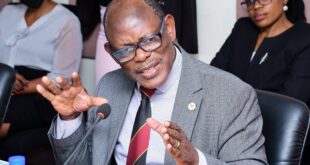
KAMPALA — The decision by Parliament’s Appointments Committee to decline the nomination of Dr. Lawrence Muganga for the position of Minister of State for Internal Affairs has evolved into more than a question of one individual’s eligibility. It has opened a wider national conversation about citizenship, constitutional requirements for public office, institutional transparency, and the relationship between talent mobility and state governance in an increasingly globalized world.
Officially, Parliament’s leadership has indicated that concerns emerged during the vetting process regarding matters that required referral back to the appointing authority. While Deputy Speaker Thomas Tayebwa did not publicly identify the nominee involved, multiple sources familiar with the proceedings have pointed to Dr. Muganga, the Vice Chancellor of Victoria University.
At the center of the debate are questions surrounding citizenship status and compliance with legal provisions governing eligibility for certain public offices. According to individuals familiar with the committee proceedings, members sought clarity regarding reports linking Muganga to Ugandan, Canadian, and alleged Rwandan citizenship affiliations. The committee reportedly examined whether all legal requirements regarding renunciation of foreign citizenship had been fully satisfied.
The controversy touches on a policy issue that extends beyond Uganda. Across the world, governments are increasingly grappling with how to balance the benefits of global mobility against legal requirements attached to sensitive public offices. Countries seeking to attract highly skilled professionals from the diaspora often face complex questions regarding dual nationality, national loyalty, and constitutional eligibility.
In Uganda, those questions carry particular significance when applied to institutions responsible for citizenship, immigration, passports, border management, and national identification systems. The Internal Affairs portfolio sits at the center of these responsibilities, making vetting standards especially stringent.
Yet the Muganga case also intersects with a longer and more sensitive national conversation. Years before his ministerial nomination, Muganga attracted public attention following his arrest by security agencies under circumstances that generated widespread debate. Security officials at the time stated that he was arrested in connection with allegations involving immigration and security-related matters. Muganga’s supporters, however, argued that the operation raised concerns regarding due process and treatment of public figures.
The incident drew attention because Muganga had become a visible voice within sections of Uganda’s Banyarwanda community, a population that has periodically raised concerns regarding citizenship documentation and national identification processes. Discussions surrounding identity, belonging, and citizenship have historically remained sensitive issues within the Great Lakes region, where colonial borders, migration patterns, refugee movements, and historical conflicts have shaped modern citizenship debates.
Today, those historical questions appear to have resurfaced in a different form. What makes the latest developments particularly significant is not merely the committee’s reported decision but the broader implications for public confidence in state institutions. In democratic systems, parliamentary vetting processes serve two functions: determining eligibility and reinforcing public trust that appointments meet legal and ethical standards.
Political analysts argue that transparency becomes especially important whenever citizenship-related concerns arise. Where procedures are perceived as unclear or inconsistently applied, public confidence can quickly erode, creating space for speculation and political polarization.
Adding another dimension to the controversy are reports of an audio recording allegedly involving discussions between Muganga and Deputy Speaker Thomas Tayebwa that has circulated on social media platforms following comments reportedly made by Muganga on his official X account. In those remarks, he suggested that he may in the future share additional information relating to his interaction with the committee.
At the time of publication, Daily Thinkers had not independently verified the authenticity of the circulating audio recording. Neither Parliament nor the individuals reportedly featured in the recording had publicly authenticated its contents. As such, the material remains the subject of public discussion rather than verified evidence. The emergence of such recordings nonetheless highlights a growing governance challenge confronting institutions worldwide: the influence of digital leaks, social media narratives, and unofficial disclosures on public perceptions of accountability.
For Uganda, the larger policy question extends beyond the fate of a single nominee. The episode raises fundamental issues regarding the interpretation of citizenship laws, the role of parliamentary oversight, and the place of globally experienced professionals within national leadership structures.
As African countries increasingly compete for diaspora expertise and international talent, governments will continue to face difficult questions. How should states balance constitutional safeguards with the realities of globalization? What standards should apply uniformly to all public officials? And how can institutions ensure that vetting processes remain both rigorous and transparent?
The answers may ultimately shape not only the outcome of individual appointments but also the credibility of the institutions responsible for making them. For now, the Muganga nomination remains a test case in the intersection of citizenship, governance, and public trust three pillars that continue to define the strength of modern democratic systems.
Post navigation
, https://dailythinkersug.com/dr-lawrence-mugangas-rejected-nomination-sparks-national-debate-on-citizenship-governance-and-public-trust/