 pressug.com News 24 7

Related Articles

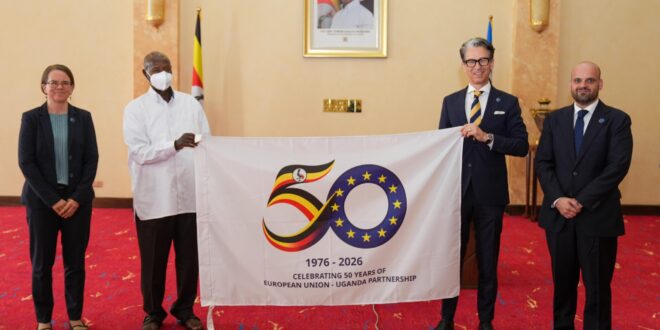
ENTEBBE, Uganda — As Uganda and the European Union commemorate 50 years of diplomatic engagement, President Yoweri Kaguta Museveni has used the milestone to advance a message that has increasingly defined his engagement with international partners: Africa’s future lies not in exporting raw materials, but in building industries capable of transforming those resources into higher-value products.
During a meeting at State House Entebbe with European Union Ambassador Jan Sadek and members of the EU delegation, Museveni framed the anniversary not merely as a celebration of past cooperation, but as an opportunity to rethink the economic foundations of Africa-Europe relations in a rapidly changing global order. His remarks come at a time when the international economic system is undergoing significant restructuring. Global supply chains are being reconsidered, geopolitical competition is reshaping trade partnerships, and developing economies are increasingly demanding a greater share of value from their natural resources.
For Uganda, and much of Africa, the central question remains whether political independence can be matched by economic transformation. “The total GDP of Africa is only $3.6 trillion for a population of approximately 1.5 billion people,” Museveni observed. His argument was straightforward: despite possessing vast natural resources, Africa continues to earn relatively little because much of its wealth leaves the continent in raw form. The President’s position reflects a long-standing development debate that has occupied economists and policymakers for decades. Countries that successfully transitioned from low-income to middle- and high-income economies including South Korea, China, Malaysia, and Singapore did so largely through industrialization, manufacturing expansion, technological upgrading, and value addition.
Many African economies, however, continue to depend heavily on exports of unprocessed commodities such as coffee, cocoa, minerals, cotton, and crude oil. The result is a structural imbalance in which the highest-value stages of production often occur elsewhere, while producing countries capture only a fraction of the final market value. The discussion is particularly relevant to Uganda, Coffee remains one of the country’s leading exports, yet a significant proportion of Ugandan coffee reaches international markets in raw or semi-processed form. While exports have grown substantially over the years, policymakers increasingly argue that roasting, packaging, branding, and distribution should increasingly occur within Uganda to maximize earnings, create jobs, and strengthen domestic industries.
Ambassador Jan Sadek’s presentation of roasted coffee produced in Kisoro during the meeting symbolized precisely the type of economic transition Museveni advocates. Rather than exporting beans alone, Uganda is increasingly seeking to export finished products capable of competing in international markets. The issue extends beyond agriculture, Uganda’s ongoing investments in mineral development, oil production, manufacturing parks, and agro-industrialization are part of a broader strategy aimed at moving the economy up the value chain. Similar conversations are unfolding across Africa under the framework of the African Continental Free Trade Area (AfCFTA), which seeks to create a larger integrated market capable of supporting industrial growth. Yet industrialization requires more than political commitment.
Museveni emphasized infrastructure as a critical component of competitiveness, highlighting transport systems, affordable energy, financing costs, and logistics efficiency. These factors have historically constrained industrial development across much of the continent. In this regard, the European Union’s role may prove increasingly important. According to Ambassador Sadek, EU support in Uganda has expanded far beyond traditional development assistance into sectors such as infrastructure, hydropower, trade, education, tourism, and investment. Trade between Uganda and the EU has reportedly tripled from approximately 500 million euros to 1.5 billion euros over recent years, reflecting a relationship that is becoming more commercially driven.
This shift mirrors a broader transformation in international development policy. Increasingly, African governments are seeking partnerships based on investment, technology transfer, market access, and industrial cooperation rather than aid dependency. For Europe, the strategic rationale is equally compelling, africa possesses the world’s youngest population, vast untapped consumer markets, critical minerals required for the green energy transition, and growing urban economies. Supporting African industrialization could expand future markets for European businesses while contributing to greater economic stability and job creation across the continent.
However, experts caution that industrialization must also be accompanied by governance reforms, skills development, technological innovation, environmental sustainability, and regional integration. Without these foundations, industrial growth risks remaining uneven and exclusionary. The significance of the Uganda-EU Golden Jubilee therefore extends beyond diplomatic symbolism. It reflects a broader conversation about the future architecture of Africa-Europe relations.
The central question is no longer whether cooperation should continue, but what form that cooperation should take in the next fifty years. If the first half-century was defined largely by development assistance and institutional support, the next may increasingly be measured by investment partnerships, industrial growth, value-added exports, and shared prosperity. For Uganda, Museveni’s message was clear: Africa’s economic transformation will require partners willing to support production rather than merely consumption, manufacturing rather than extraction, and wealth creation rather than dependency. Whether Europe fully embraces that vision may help determine the trajectory of one of the world’s most consequential partnerships in the decades ahead.
Post navigation
, https://dailythinkersug.com/musevenis-call-for-industrialization-signals-a-new-phase-in-uganda-eu-relations/