 pressug.com News 24 7

Related Articles



×
Environmental advocates have called for urgent strengthening of Uganda’s environmental laws, urging government to make tree planting a mandatory requirement in all development approvals and to enforce tougher penalties against wetland destruction, amid growing concerns over unchecked urban expansion and weakening ecological protection systems.
My Tree Initiative Executive Director, Ashiraf Enjer Ddumba, said existing policies are insufficient to protect Uganda’s rapidly declining green cover, warning that continued weak enforcement is allowing construction projects to proceed without adequate environmental safeguards.
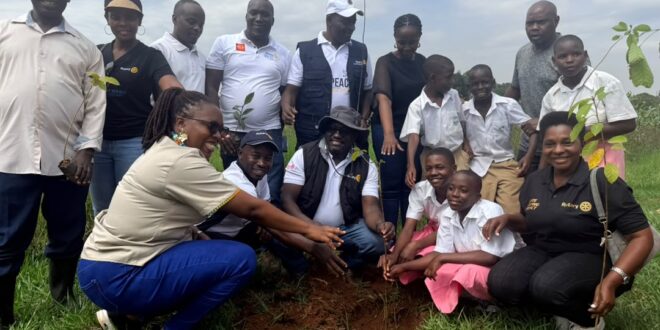
Speaking during a tree-planting exercise at Kitukutwe Primary School in Gayaza, Ddumba said environmental protection must shift from awareness campaigns and voluntary action to legally binding obligations embedded in national development planning and approval systems.
He argued that all infrastructure projects—including roads, schools, hospitals and private developments—should be required by law to allocate designated space for tree planting as part of approved building plans.
“We need stronger legal frameworks so that anyone constructing must also protect the environment and allocate space for trees,” Ddumba said.
He warned that failure to enforce such requirements is accelerating environmental degradation, particularly in urban areas where rapid construction is replacing natural green spaces with concrete infrastructure.
Ddumba said many approved developments do not include environmental buffers or greening plans, a gap he said is undermining long-term sustainability and increasing vulnerability to climate change impacts such as flooding, heat stress and unpredictable rainfall.
He further raised concern over continued wetland encroachment, saying some developers are deliberately reclaiming protected ecosystems for construction purposes despite existing legal protections.
According to him, wetlands continue to be filled with soil and converted into building land, weakening their role in flood control, water purification, carbon storage and overall climate regulation.
Ddumba called for stricter enforcement measures against illegal wetland destruction, including heavier penalties, consistent monitoring, and stronger coordination between environmental regulators and local authorities.
He said enforcement agencies must be empowered to act decisively without delays, exemptions or political interference if Uganda is to reverse ongoing ecological losses.
“Wetlands are being destroyed for construction, yet they are critical to our survival. Enforcement must be strict, consistent, and non-negotiable,” he said.
Ddumba added that environmental regulation should be integrated into all stages of project approval, including land-use assessments, building permits, and post-construction compliance audits to ensure developers adhere to ecological requirements.
He also urged government to strengthen inter-agency coordination so that environmental standards are applied uniformly across all districts, regardless of location or development pressure.
The environmentalist noted that My Tree Initiative has planted close to 3 million trees over the past six years in collaboration with private sector partners, including Diamond Trust Bank, and government institutions such as the Ministry of Water and Environment.
He said the organisation prioritises schools as key centres for environmental education, aiming to build long-term behavioural change among young people who will later become decision-makers and land users.
At Kitukutwe Primary School, 300 fruit trees—including mango, jackfruit and soursop—were planted in collaboration with the Rotary Club of Namugongo and other partners.
“We engage communities, especially schools, to help learners understand the importance of planting and protecting trees so they can carry the message forward,” Ddumba said.
However, he warned that despite such interventions, Uganda continues to lose green spaces due to unregulated development patterns, particularly in fast-growing urban areas where land pressure is intense.
Ddumba said tree-planting activities are increasingly shifting away from cities because of limited available land, a trend he described as evidence of shrinking ecological space within urban planning systems.
He maintained that without legal reforms and stronger enforcement, ongoing reforestation efforts risk being overwhelmed by the scale of environmental destruction driven by construction expansion and wetland conversion.
Kitukutwe Church of Uganda Primary School head teacher, Sarah Kabonge, who welcomed a separate donation of 600 trees in a related initiative, said such programmes are vital in improving school environments and learner wellbeing.
, https://eastafricanwatch.net/environmentalist-want-stricter-laws-on-construction-mandatory-tree-planting-to-curb-ecological-loss/?utm_source=rss&utm_medium=rss&utm_campaign=environmentalist-want-stricter-laws-on-construction-mandatory-tree-planting-to-curb-ecological-loss