 pressug.com News 24 7

Related Articles

Critics say law will impede LGBTQI advocacy in Uganda
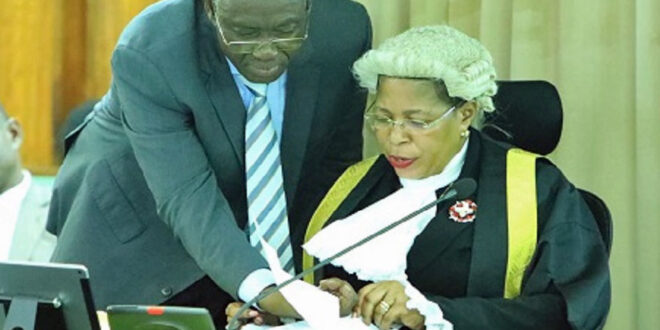
Patrick Isiagi, the chairperson of the parliamentary budget committee, confers with then Speaker Anita Among during 2024 budget deliberations. (Photo courtesy Parliament of Uganda)Uganda has enacted a new law giving the state far-reaching powers to go after whoever or whatever the regime deems unlawful foreign interference in the country’s political, security and economic affairs.Among other provisions, the Protection of Sovereignty Act 2026 requires any person or entity receiving money from outside the country to register as a foreign agent and disclose all incoming funds.The law is opposed both by LGBTQI+ activists, who receive funding from abroad, and from the head of the Bank of Uganda, who says it will disrupt the country’s economy.As of 2024, according to Parliament, only about 44 percent of the national budget of 72 trillion Ugandan shillings was paid for by taxes and other government revenues, with the rest supported by grants and project support (15 percent) and borrowing (41 percent).President Yoweri Museveni assented to the bill on May 17, just 11 days after it was passed by parliament under the guidance of former speaker Anita Among, who is now a prisoner in her own home over allegations of corruption.The authorities say the Protection of Sovereignty Act is expected to strengthen Uganda’s capacity to safeguard its independence in national decision-making processes, while further entrenching the constitutional principle that governance and development priorities remain anchored in national interest.“The new law is intended to provide for the protection of the sovereignty of the people of Uganda; designate the Department responsible for peace and security in the Ministry responsible for Internal Affairs as the implementing authority; provide for the registration and regulation of agents of foreign entities; regulate funding and other forms of assistance to such agents; and for related matters,” the State House said in a statement issued shortly after Mr. Museveni signed the bill.The signing of the bill drew criticism from human rights advocates, a cross section of politicians including allies of the regime and banking institutions including the World Bank.Museveni, who was once considered the darling of the West, has been in power since 1986. But in the last two decades, he has been slowly but surely turning against his former allies, branding them imperialists and negative forces.Recently, his government has been pushing the narrative that the civil society and opposition parties in Uganda, particularly the National Unity Platform (NUP) led by Robert Kyagulanyi Ssentamu, aka Bobi Wine, is funded by foreign powers who are also accused of promoting homosexuality.Prior to the Protection of Sovereignty Act 2026, the Ugandan authorities enacted the Anti-Homosexuality Act 2023 into law saying that it will protect families and children from homosexuality which they claim is funded and promoted by foreigners.Some Ugandans therefore believe that the Protection of Sovereignty Act 2026 is another ‘bad’ law aimed at curtailing civil society work, independent media, academia, research and political activism.Frank Mugisha, a human rights advocate who had previously voiced his opposition to the Protection of Sovereignty Law, says the Anti-Homosexuality Act 2023 set a very bad precedent in Uganda’s parliament.Most of the civil society work, especially that involving the LGBTQI+ community, is funded by foreign-based donors. As organizations come to terms with the disruptions caused by the Trump administration’s funding freezes, the Protection of Sovereignty Act 2026 will likely cause further disruptions.The law imposes heavy penalties of up to 2 billion Ugandan Shillings (approximately $530,000 USD) or long prison sentences of up to 20 years or both for those who will be found in violation of its provisions.Former Deputy Attorney-General and lawmaker Mwesigwa Rukutana, who also served as Museveni’s state minister for finance and state minister for labour, asked the government to withdraw the controversial law, saying that it risks the country’s hard-earned gains from economic liberalization.“We legislate for the people. If any law is contrary to the wishes and aspirations of the people, then it must not be enacted,” he said.Before President Museveni signed the bill, the Bank of Uganda Governor, Michael Atingi-Ego, warned that it is likely to destabilize Uganda’s financial system, disrupt banking operations, and isolate the country from the global economy. According to Atingi-Ego, the bill introduced what he described as radical uncertainty.See Also
In a letter to the Ugandan parliament dated April 23, the World Bank wrote that proposed legislation to regulate people and organizations that receive foreign funding will hinder its work in the country.The World Bank is a major donor to Uganda, and currently has a project portfolio in the country of about $4.57 billion.The bank halted new lending to Uganda in 2023 after the government enacted the harsh Anti-Homosexuality Act but resumed funding two years later after getting assurances from the authorities that World Bank projects would not be affected.The leadership of the National Unity Platform described the Protection of Sovereignty Act as unconstitutional and dangerous in its implications for democratic governance in Uganda.In a written memorandum to the parliament, the NUP leadership stated that since it regained independence in 1962, Uganda has greatly benefitted from the warmth and generosity selflessly extended its way by the international community.According to NUP, foreigners fund nearly half of Uganda’s national budget. In the memo, NUP leaders stated:“… the very system of government that Uganda is running today, and the architecture of its public service, are all largely the creatures of that same international community that the Bill dismisses as ‘foreigners’ and seeks to shut out from Uganda’s affairs.“Yet, if it were not for the intervention of ‘foreigners’ like the World Bank and the International Monetary Fund at the close of the 20th century, Uganda’s economy, for which the NRM government takes credit, would probably be doing far worse.“We are therefore convinced that the stated Objectives of the Protection of Sovereignty Bill, 2026 are not sincere and the Bill ought to be accordingly withdrawn in its entirety.”
Related
, https://hoimapost.co.ug/uganda-law-targets-funds-from-abroad/