 pressug.com News 24 7

Related Articles



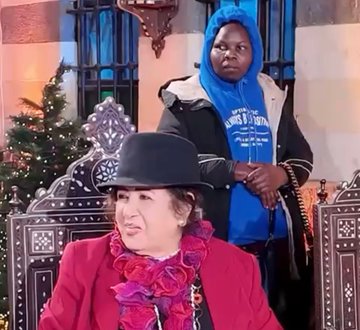
Syria—Damascus was still asleep when horror struck the home of legendary Syrian actress Huda Shaarawi, the woman millions knew as Umm Zaki. At around 5:00 a.m. last week Thursday morning, January 29, 2026, the 88-year-old star was bludgeoned to death while lying in her bed, her life ending violently after more than five decades of shaping Syrian drama.
According to the Syrian Interior Ministry, Shaarawi was attacked with a blunt metal object, later identified as a mortar, causing massive bleeding and a fractured skull. General Osama Atakeh, commander of internal security in Damascus, said in a statement: “The victim was struck with a blunt object, leading to severe hemorrhaging. The body has been transferred to forensic medicine pending the final report.”
By evening, authorities announced the arrest of the prime suspect: the actress’s Ugandan housekeeper identified as Vicky Ajok,who had worked in the home for only a few months. Security cameras reportedly showed her leaving the house at 6:10 a.m., less than an hour after the killing. She fled but was tracked and arrested the same day.
The ministry confirmed that a handwritten letter was found in the house, attributed to the maid, in which she confessed to killing the actress. In the letter, she claimed Shaarawi had been “trying to poison her,” a claim investigators say is not supported by any evidence so far. “The investigation is ongoing to determine the true motives,” an official source said.
As the news broke, devastating details emerged from inside the family. Ghassan Al-Hariri, Shaarawi’s son-in-law, revealed that one of her grandchildren was the first to discover the crime. “My son entered his grandmother’s room at around eleven at night,” Al-Hariri said. “As soon as he opened the door, he smelt something burning. He rushed inside and found her on the bed, blood everywhere. In moments like these, a person completely loses their balance.”
He added that the family had left the house at around 1:00 a.m. without noticing anything unusual. “She treated the maid very well,” he said. “She was not assigned to cleaning. Her role was only to keep my mother-in-law company and help her with daily needs. There were no disputes, no financial problems, nothing.”
The killing sent shockwaves through Syria and the Arab world. By Friday night, Huda Shaarawi’s name topped Google searches globally and dominated X and Facebook. Fans shared clips of her iconic roles in “Bab al-Hara,” “Ahl El Raya,” and “Ayam Shamiya,” mourning the woman who symbolized the Damascene mother and wise neighborhood midwife.
But grief quickly turned into anger and controversy. On social media, the suspect’s nationality became a flashpoint. Posts flooded timelines questioning the hiring of foreign domestic workers, with some users declaring, “What happened is a warning,” and others saying, “This crime will change how families think about bringing strangers into their homes.”
Suddenly, Uganda’s name has been dragged into headlines across Arabic platforms—attached to words like crime, betrayal, and danger.
“This is not a Ugandan crime,” wrote one Syrian human rights advocate.
“This is a murder committed by a single suspect who must face justice alone.”
The murder reignited an old, sensitive debate across the region: Are background checks sufficient? Are domestic workers properly screened, supported, and monitored? How did the Ugandan maid end up in Syria? Are families relying on workers without adequate systems of protection—for both sides?
Some politicians are now demanding tighter controls on foreign labor. Others warn such rhetoric could spiral into collective punishment, racism, and fear-based policy.
A labour expert RedPepper talked to emphasized an uncomfortable truth—Domestic workers—especially migrants—often live in isolation, under pressure, and without mental health support. Ignoring that reality, they warned, only creates more tragedies—not fewer.
As the investigation continues, the accused remains in custody, facing a murder charge that could carry the harshest penalties. The authorities insist that all circumstances will be uncovered, while the family waits for forensic results and the country struggles to process the loss.
Huda Shaarawi, born in Damascus in 1938 and a founding member of the Syrian Artists Syndicate, survived wars, political upheaval, and decades of change. In the end, her life was taken not on a stage or screen, but in the quiet of her own home—a brutal crime that has left a family shattered, a nation grieving, and a storm of fear and accusation raging far beyond Syria’s borders.