 pressug.com News 24 7

Related Articles


After ten years, millions in financing and bold promises to transform Uganda’s business and tourism competitiveness, the Competitiveness and Enterprise Development Project (CEDP) is now under an unforgiving spotlight.
The December 2025 Value for Money audit on CEDP has laid bare a troubling pattern of delayed works, underutilised facilities, partially implemented reforms and systems that exist on paper but struggle in practice. The project, implemented by the Private Sector Foundation Uganda under the watch of the Ministry of Finance Planning and Economic Development, was meant to streamline business registration and licensing while boosting tourism competitiveness.
Instead, the Auditor General’s findings raise uncomfortable questions. Was this sloppiness? Was it unseriousness? Or was it outright negligence in project oversight?
CEDP ran from the 2014/15 financial year to 2024/25. It covered both the Business Registration and Licensing Reforms component and the Tourism Competitiveness Development component. Beneficiary agencies included the Uganda Registration Services Bureau, the Ministry of Tourism Wildlife and Antiquities, the Uganda Wildlife Authority, the Uganda Tourism Board, the Uganda Wildlife Conservation and Education Centre, the Uganda Hotel and Tourism Training Institute, the Uganda Wildlife Research and Training Institute and the Uganda Museum.
On paper, the overall performance against four outcome indicators was “commendable” and targets were fully achieved by July 2024. But the audit warns that these results were achieved “despite several planned activities not being fully implemented,” indicating that some interventions and related expenditures were not critical to attaining the stated outcomes.
That is not a compliment. That is a red flag.
BUSINESS REGISTRATION AND LICENSING REFORMS
The report raises hard questions about whether officials charged with streamlining business registration and licensing simply failed to do their job.
The audit assessed how CEDP implemented business registration and licensing reforms to support competitiveness in Uganda. It was meant to establish a one-stop shop for business registration, create an e-registry as a virtual platform for licensing and streamline procedures to reduce the burden on entrepreneurs.
Instead, the Auditor General’s findings reveal underutilized infrastructure, incomplete reforms, malfunctioning digital systems and objectives only partially realized.
After a decade, the question many are now asking is simple: what exactly did taxpayers get for their money?
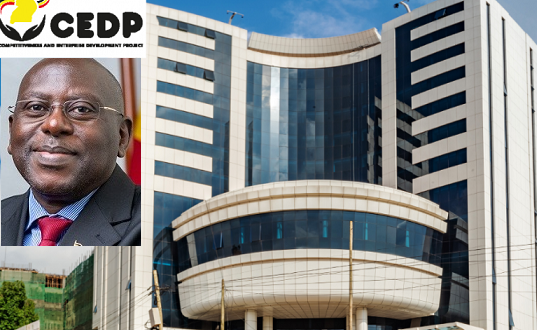
At the centre of the controversy is the Uganda Business Facilitation Centre (UBFC). Although construction was completed and key agencies occupied the building, it was done without formal commissioning and handover by the Ministry of Finance Planning and Economic Development. Worse still, there is underutilization of space by National Information Technology Authority-Uganda and the Presidential CEO Forum on the 9th and 10th floors.
The Auditor General notes that delays in rectifying defects and formally handing over the building have compromised its functionality and safety.
A construction governance expert described the situation to RedPepper bluntly: “Occupying a public building without formal commissioning and handover is administrative indiscipline. If defects are not addressed on time, you are inviting long-term structural and financial risk.”
The physical One Stop Business Centre at the UBFC has also been flagged as underutilized, raising serious concerns about planning. In an era dominated by digital platforms, investments were directed toward a physical facility with minimal impact instead of strengthening online systems that could have delivered sustainable benefits.
An economist familiar with ease-of-doing-business reforms told RedPepper, “It is astonishing that in a digital age, resources were locked into bricks and mortar while online systems remained weak. That points to poor prioritization.”
The business licensing reforms component tells a similar story. While the project initiated and partially implemented reforms, the failure by the Ministry of Finance to fully operationalize a transactional e-licensing platform and complete the rationalisation of licenses has hindered achievement of the core objective: reducing the business licensing burden.
After ten years, entrepreneurs are still grappling with fragmented licensing requirements and incomplete digital solutions.
The operationalisation of the Online Business Registration System has also been marred by persistent user challenges. Difficulties in account creation, payment processing problems, system errors and limited online support have reduced the convenience and effectiveness of the platform.
“These are not minor glitches,” said a digital governance specialist. “If users cannot create accounts easily, process payments smoothly or get timely support, the system becomes a barrier instead of a facilitator.”
The audit makes it clear that these weaknesses undermine the goal of reducing the cost and time burden of business registration and limit Uganda’s attractiveness as an investor-friendly destination.
Observers are now questioning whether this reflects sloppiness, unseriousness or outright negligence.
A former senior civil servant remarked, “When a project runs for a decade and still fails to fully operationalize core systems, that is not teething trouble. That is a leadership and accountability issue.”
The Competitiveness and Enterprise Development Project was supposed to transform Uganda’s business environment by making registration and licensing faster, cheaper and more efficient. Instead, it leaves behind an underutilized building, incomplete reforms and digital systems struggling with basic functionality.
With Uganda competing regionally for investment, inefficiencies in business registration and licensing are not just bureaucratic inconveniences. They are economic liabilities.
For a project designed to enhance competitiveness, the findings paint an uncomfortable picture of missed opportunities and management gaps that can no longer be brushed aside.
ON THE TOURISM SIDE, THE STORY IS EQUALLY TROUBLING
Construction and equipping of the Crested Crane Hotel in Jinja was delayed by approximately 38 months. By September 2025, installation of equipment, furniture and fixtures was still pending. Essential facilities originally within scope, including hostels, a health club and a spa, were not constructed despite their importance for achieving a three-star rating.
A tourism development consultant told RedPepper, “When you omit critical facilities necessary for a three-star classification, you are undermining your own project objectives.”
The sustainability of the Uganda Hotel and Tourism Training Institute as a Centre of Excellence is at risk due to funding shortfalls and shortage of qualified teaching staff. Without adequate staffing and diversified funding, delivery of practical, competency-based training is compromised.
At the Uganda Wildlife Education Centre, the chimpanzee enclosure’s protective moat was incomplete and unable to retain water, undermining its safety function. The upgraded animal hospital lacked a reliable electricity backup system, posing risks to veterinary services.
“Leaving a wildlife hospital without backup power is a basic oversight,” said a conservation specialist. “It risks animal health and damages visitor confidence.”
At the Uganda Wildlife Research and Training Institute, infrastructure was improved but the GIS laboratory remained unused because software had not been installed, and a research boat acquired in November 2024 had not been put to use due to connectivity and training gaps.
The Uganda Museum remained closed to the public due to delayed civil works caused by delayed payments, slow approval of design changes and delayed VAT exemption approvals. The result is delayed realization of increased visitor numbers and economic benefits.
The Tourism Information Management System was developed but not rolled out because it is still hosted on the developer’s domain and could not be hosted by NITA-U due to limited capacity. It is also not integrated with the Tourism Satellite Account.
An ICT governance expert notes, “Developing a system without ensuring hosting capacity and integration is a planning failure. Systems must be designed with sustainability in mind.”
The Auditor General warns that delayed completion of works, underutilization of facilities and partial reforms pose risks to sustaining project gains and achieving deeper long-term impacts such as higher tourist spending, improved service quality and strengthened competitiveness.
After ten years, the country is left asking hard questions. Were project implementers under CEDP ready for the task? Did the Ministry of Finance exercise sufficient oversight? Did the Private Sector Foundation Uganda effectively coordinate implementation? Who will take responsibility for delayed works and underutilised assets?
A governance analyst summed it up sharply: “When targets are achieved despite key activities not being implemented, it suggests either the targets were too narrow or resources were not optimally deployed. Either way, leadership must answer.”
The Auditor General has spoken. The evidence is on record. If CEDP was meant to strengthen competitiveness, the audit suggests that deeper systemic discipline is required.
Now the real question is whether top leadership will crack the whip, demand accountability and fix the gaps — or whether another decade will pass before the same issues resurface under a new project name.
SUSTAINABLE URBANISATION & HOUSING STORM
That’s not all, under the Sustainable Urbanisation & Housing project, implemented by the Ministry of Lands, Housing and Urban Development, serious implementation challenges, with funding shortfalls and project management weaknesses slowing progress on key urban development activities were discovered.
A review revealed that procurements worth UGX 2.577 Bn were awarded to suppliers not on the project’s prequalified list, raising questions about adherence to procurement guidelines.
While the project achieved a high absorption rate, spending UGX 54.987 Bn out of UGX 55.031 Bn allocated for FY 2024/25—representing 99.9% utilization—multiple extensions of the project timeline point to inefficiencies. Originally scheduled to end on 30th November 2024, the project was first extended by four months to March 2025 and later extended again to March 2026, increasing administrative costs and highlighting gaps in planning.
Watchers say these findings underscore the need for stricter procurement compliance, better project planning, and timely release of funds to ensure Uganda’s urbanisation goals are achieved.
KYEWALABYE, ASIIMWE FACE TOUGH QUESTIONS
The spotlight over the troubled implementation is now firmly fixed on two key figures: JohnMarie Kyewalabye, the Project Coordinator, and Stephen Asiimwe, Executive Director of the Private Sector Foundation Uganda.
Kyewalabye has been overseeing day-to-day management and coordination of these components. Asiimwe heads the implementing agency responsible for delivering the project.
A senior project management consultant commented, “The Ministry of Finance provided oversight, but PSFU executed. Leadership accountability cannot be abstract. It must be anchored at the operational and institutional heads.”
The core question now is whether the gaps identified stem from sloppiness, capacity constraints, weak supervision or insufficient internal controls.
Some insiders argue that multi-agency projects of this scale are inherently complex and involve shared responsibilities with beneficiary institutions such as the Uganda Registration Services Bureau and the Ministry of Tourism Wildlife and Antiquities. However, experts insist that coordination is precisely why a central project unit exists.
“Coordination is not optional,” said a governance analyst. “If critical systems are incomplete and facilities are underutilised after ten years, the question is not whether challenges existed. The question is how they were managed.”
With the Auditor General’s findings now public, pressure is mounting for answers. Were the implementers fully prepared for the scale and complexity of CEDP? Did oversight mechanisms function as intended? Who takes responsibility for the underutilised assets and incomplete reforms?
GOT A HOT STORY? EMAIL: redpepeprtips@gmail.com