 pressug.com News 24 7

Related Articles


Every year, Uganda spends billions of shillings importing medicines that its hospitals, pharmacies and patients depend on.
Government officials now believe that one pharmaceutical plant on the outskirts of Kampala could begin changing that equation.
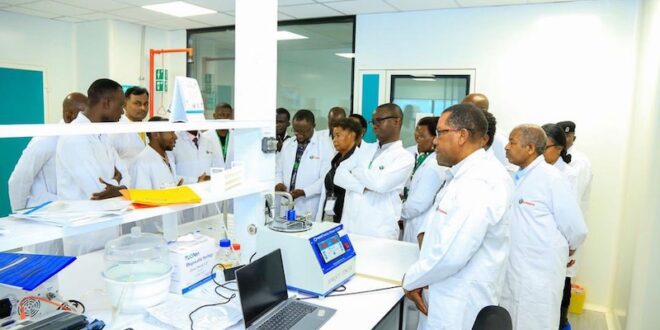
Last week, senior officials from the ministries of Finance and Health visited the Dei BioPharma manufacturing facility in Matugga, Wakiso district, signalling renewed government backing for a project it hopes will strengthen local drug production, reduce the country’s dependence on imports and create thousands of skilled jobs.
The delegation was led by secretary to the Treasury Dr Ramathan Ggoobi and permanent secretary at the ministry of Health Dr Diana Atwine. They were joined by officials from the National Drug Authority and the National Medical Stores to assess the progress of a project in which the government has already invested more than Shs 700 billion, or about US$190 million.
The visit was intended to establish whether the investment is delivering value for money and whether the facility is on course to become a major player in Uganda’s pharmaceutical industry. Dr Ggoobi said he left encouraged by what he saw.
“People ask if Dr Matthias Magoola is serious, if he can actually produce the medicine and medical supplies he talks about,” he said, referring to the company’s founder.
“So far, it is always a good surprise when you come here. We are on the right track as far as emerging sectors in our economy, especially manufacturing and the knowledge economy, are concerned.”
Uganda currently imports much of the medicine used in its health system, a dependence that consumes large amounts of foreign exchange and leaves the country exposed to disruptions in global supply chains.
Dei BioPharma has already begun producing about nine generic medicines, including paracetamol and capsules used in cancer treatment. The company plans to expand into insulin, vaccines and medicines for cardiovascular diseases.
If those plans are realised, Dr Ggoobi believes the company could replace nearly half of Uganda’s medicine imports. That would not only reduce the country’s import bill but also retain more investment at home while creating employment opportunities.
According to government officials, thousands of young Ugandans are already working at the facility. Dr Ggoobi stressed, however, that continued government support will depend on accountability.
“The Auditor General audits the project regularly because the government holds a stake in it as a co-investor,” he said.
He added that a newly appointed panel of about six bankers and scientists, approved by the President, will assess future funding requests before additional public money is released.
The secretary to the Treasury said Uganda’s economic transformation will depend on investing in industries that generate greater value than traditional agriculture alone.
For the ministry of Health, the project represents more than an industrial investment. It is also part of a broader effort to improve access to medicines produced within Uganda. Dr Atwine pledged that her ministry would buy medicines manufactured by Dei BioPharma alongside those produced by other local companies under the Buy Uganda, Build Uganda policy.
That commitment could provide the company with a stable domestic market as it expands production. She said, however, that approval by Uganda’s National Drug Authority should be viewed as only the beginning.
The longer-term objective is to secure prequalification from the World Health Organization and approval from other international regulators, allowing the company’s products to be sold across Africa and international markets.
Dr Atwine cautioned that the factory is still in its early stages of development. She said the company still needs to expand its workforce, secure approvals for additional products, manufacture active pharmaceutical ingredients locally and strengthen research and development capacity.
Company founder Dr Matthias Magoola says the business is investing heavily in research. According to him, more than 100 patent applications have been filed with the United States Patent and Trademark Office covering treatments for cancer, HIV, malaria, tuberculosis, sickle cell disease, diabetes and Alzheimer’s disease.
Among them is a cancer immunotherapy patent published in February, which the company says targets genetic mutations shared across different tumour types rather than tailoring treatment to an individual patient’s genes.
The company says that approach could eventually reduce treatment costs to below US$100, compared with more than US$500,000 for some existing therapies. Despite the optimism, major infrastructure challenges remain.
Dr Magoola said the factory can currently operate only three or four of its eight completed production blocks because electricity supplies are inadequate. Running the facility at full capacity will require as much as 80 megawatts of power.
Water is another obstacle. The plant consumes up to two million litres of water each day and demand is expected to increase, yet it is still not connected to the National Water and Sewerage Corporation network.
Related
, https://observer.ug/news/atwine-government-will-buy-dei-medicines/