 pressug.com News 24 7

Related Articles

Queer Ugandans call on Canada to do more to protect human rights
A Canadian parliamentary committee held a hearing on March 9 to study the situation of members of the LGBTQI+ community in Uganda, where queer Ugandans and representatives from leading human rights organizations shared their experiences and called on the Canadian government to do more to stand up for queer Ugandans.
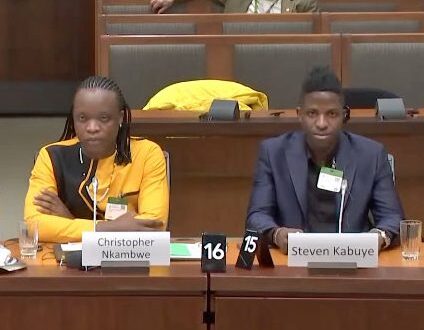
The Ugandans who testified before the Subcommittee on International Human Rights were Steven Kabuye, Meddie Ssentongo and Christopher Nkambwe, founder of the African Centre for Refugees in Ontario, Canada.
Kabuye, a survivor of homophobic violence who is now a resident of Canada, described the situation for LGBTQI+ people in Uganda as “a state-sanctioned nightmare.”
“Every day, activists and ordinary people live in fear of arbitrary arrest or violent attack,” Kabuye told committee members, noting that the Ugandan regime under the cover of the Anti-Homosexuality Act (AHA) 2023 has effectively weaponized both the police and the public against its own citizens.
“Survival is now an act of defiance,” said Kabuye.
He also described the horrific homophobic attack that nearly killed him.
“On the morning of January 3, 2024, I was walking to work when two men on a motorcycle ambushed me. They slashed my arm and then stabbed my stomach, shouting, ‘Die, you homosexual,’ as they left me bleeding on the ground. By some miracle, I was alive. I recorded a video of my wounds as proof of our reality in case I did not survive.
“Instead of being protected by the police, I was treated like a criminal. While I lay in the hospital, the authorities sought to charge me with treason. My home was raided, and the colleague who rushed me to hospital, Eugene Ntambi, was himself arrested and tortured. I survived, thanks to God and the swift action of fellow activists. I am deeply grateful to be here safely in Canada today. I owe my life to the unwavering solidarity of fellow human rights defenders, organizations like Rainbow Railroad and the people of Canada, who stood by me at the most dangerous moment.
“However, I speak today not only for myself but for the millions of Ugandans who have no microphone, for those who are trapped and still fighting simply to exist.”
Kabuye revealed that unlike a few lucky ones like himself who have found safety outside Ugandan borders, the nightmare continues for many Ugandan LGBTQI+ people who fled Uganda.
“Many flee to refugee camps in neighbouring countries—for example, Kakuma in Kenya—only to find that camps are not sanctuaries but alternative prisons,” he told the committee.
Meddie Ssentongo is one of the many Ugandans who lived in Kakuma Refugee camp.
“I had been in Kakuma for three years and had completely lost hope that I would ever get help, especially after seeing other refugees who are not queer being processed by the UNHCR. Nothing changed for me until we met our private sponsors through Mr. Horst Backé, the President of Reaching Out Assisting Refugees. That’s when we started feeling hope again, although getting an exit permit was still a problem,” Ssentongo said.
Ssentengo said that like other LGBTQI+ refugees in Kakuma, he was threatened and often assaulted, but no complaint was followed up on, even after reporting it to the police.
“There was never any hope that the police would follow up on any complaints. No one was arrested, even after LGBTQ+ refugees were killed or our shelters were burned,” he said.
He also spoke of long processing delays, saying that some people have waited for resettlement for over nine years and are still waiting.
In South Sudan for example, Ssentongo said the situation is dire due to that country’s ongoing civil strife.
“Resettlement opportunities are decreasing. Many friends I know who were on the U.S. list were disappointed when their resettlement was cancelled. Canada has also reduced the number of resettlement opportunities for refugees.”
Ssentongo was later resettled in Canada and he believes Canada can and should bring in more Ugandan LGBTQI+ refugees.
Christopher Nkambwe, another Ugandan now living in Canada also testified. She fled the country in May 2019 and is now a legal permanent resident in Toronto.
Nkambwe told members of the committee that in Uganda, “homophobia and transphobia are the order of the day” following the enactment of AHA.
She urged the Canadian leadership to increase funding and slots under the government-assisted refugees program for resettlement pathways for high-risk Ugandan LGBTQI+ refugees in Kenya and South Sudan. She also called for an increase funding to the national LGBTQI+ organizations and their programs, which she says are critical in creating a welcoming environment for LGBTQI+ individuals from around the world and from Uganda.
“I am in Canada because of the compassion of the Canadian government. The individuals currently stranded in the camps and cities across East Africa need that compassion today. Canada’s leadership, applied through existing mechanisms and informed by on-the-ground expertise, can create the pathways to protection that LGBTIQ+ Ugandans need,” Nkambwe.
She further called upon the Canadian government to exert diplomatic pressure on the government of Uganda to repeal the repressive Anti-Homosexuality Act of 2023 and to protect its citizens from hate-motivated violence, no matter their sexual orientation or gender identity.
The Canadian government did not mince its words in its condemnation of the enactment of AHA in May 2023.
Mélanie Joly, the Minister of Foreign Affairs said at the time:
“Canada is deeply concerned by Uganda’s assent of the 2023 Anti-Homosexuality Act and firmly condemns its legislation. This Act is a blatant violation of the human rights and fundamental freedoms of LGBTQ+ Ugandans. It exposes them to systematic persecution, oppression, violence, including the possibility of life terms in prison and the death penalty.
“The reversal of human rights that this law represents is deeply concerning and we are disturbed by the heinous forms of violence it legalizes against a segment of Uganda’s population, only because of who they are and who they love. Canada unequivocally opposes the use of the death penalty in all cases, everywhere. This form of punishment is incompatible with international human rights laws and human dignity.
“Canada stands with the LGBTQ+ community in Uganda and around the world and calls on the Government of Uganda to revoke this law. We are committed to working with partners in the region that have experience supporting communities in situation of vulnerability and persecution.”
But Horst Backé, President of Reaching Out Assisting Refugees, told the committee that Canada’s legacy as a human rights leader is defined not by the statements it issues but by the measures it takes to protect the persecuted.
“We have the legislative and advocacy tools. We now need the political will to use them,” Horst said.
Horst described Kenya as a choke point for LGBTQI+ people fleeing homophobia and transphobia in Uganda and other countries in the region.
“When people flee, they’re going to a place where, hopefully, there is safety for them. Of course, when you’re fleeing a country in East Africa, there’s no nearby safe country to flee to. You’re going into a homophobic country.
“Kenya was at one point the only country accepting queer refugees, and they still do, strangely, but they’re not processing them. That’s a huge issue. They’re creating a choke point. They’ve been collecting people over many years—hundreds of people—and they’re not being allowed to leave,” Horst said.
He said the issue has been compounded by the extreme violence that queer refugees are facing in Kenya and South Sudan, where queer people are killed and subjected to daily physical and verbal assaults, as well as being pushed to the back of the line for health services.
Canada is already a safe home for several Ugandan LGBTQI+ people, but Tigere Chagutah, the Regional Director for East and Southern Africa at Amnesty International, says as things stand now, the Canadian government can and should do more both in terms of funding and diplomatic leverage.
“We urge you to establish, across all Canadian high commissions, a permanent rapid response mechanism for queer people facing emergencies,” he said.
Tigere’s position was also echoed by the Human Rights Watch’s Senior Researcher Oryem Nyeko.