 pressug.com News 24 7

Related Articles


Kampala — The Constitutional Court of Uganda has struck down the Computer Misuse (Amendment) Act, 2022, declaring it invalid on grounds that Parliament of Uganda failed to follow mandatory constitutional procedures during its enactment.
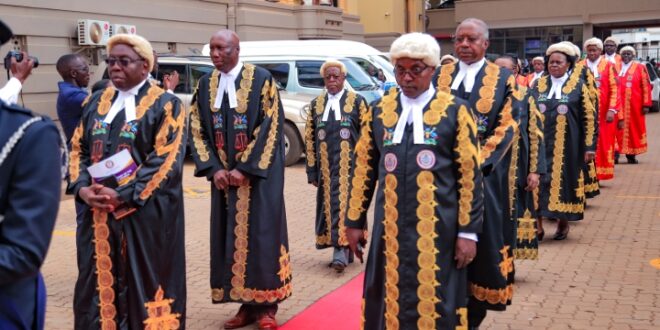
In the lead judgment of Justice Irene Mulyagonja which was later agreed upon unanimously by four other justices namely; Ketrah Kitariisibwa Katunguka, Mike Musisi, Jesse Byaruhanga Ruryema, and Esta Nambayo, the court ruled that the law was passed without proof of the required quorum, rendering it null and void.
The case arose from consolidated petitions filed by a broad coalition of civil society actors, journalists, lawyers, and political figures, including the Chapter Four Uganda , African Center for Media Excellence, Uganda Law society, Human Rights Network for Journalists-Uganda, Center for Constitutional Governance and others , had the Attorney General of Uganda as the respondent.
Failure to Meet Legal Thresholds
Central to the court’s decision was Parliament’s failure to demonstrate compliance with quorum requirements at the time the bill was passed. Relying on the official Hansard of September 8, 2022, the judges noted the absence of any record confirming that the Speaker verified attendance or that a sufficient number of Members of Parliament were present to lawfully vote.
The court faulted the parliamentary practice of recording decisions in vague terms such as “question put and agreed to,” saying it obscures transparency and makes it impossible to confirm adherence to constitutional standards.
As a result, the judges found that the enactment process violated Rule 24(1) of Parliament’s Rules of Procedure, as well as Articles 88 and 89 of the Constitution, which govern quorum and voting.
Law Declared Invalid in Entirety
Because of these procedural defects, the court ruled that the entire Act is void, emphasizing that a law passed in contravention of constitutional requirements cannot stand. The justices further noted that there was no need to examine the substance of the law once its enactment was found to be fundamentally flawed.
Injunction Against Enforcement
In a concurring opinion, Justice Kitariisibwa Katunguka issued a permanent injunction prohibiting the government and its agencies from enforcing the invalidated provisions. She also directed that the state covers 30 percent of the petitioners’ legal costs.
Criminal Libel Provision Overturned
In the same ruling, the court also nullified Section 162 of the Penal Code Act, which criminalizes libel. The judges held that the provision infringes on freedom of expression and is inconsistent with Uganda’s obligations under international human rights instruments such as the African Charter and the ICCPR.
The court further criticized the law for being vague and overly punitive, noting that civil defamation remedies already exist and are less restrictive than criminal penalties.