 pressug.com News 24 7

Related Articles



As the storm rages inside the Electricity Regulatory Authority, a fresh and potentially explosive allegation has emerged — one that strikes at the heart of national economic policy.
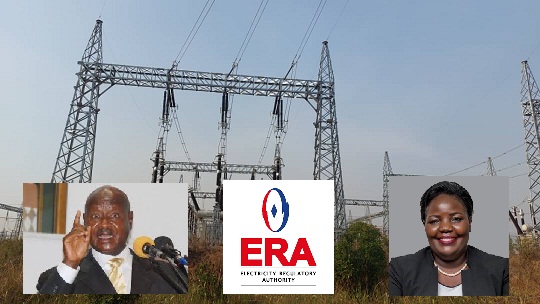
Sources now claim that the CEO, Eng. Ziria Tibalwa Waako, has allegedly misguided the Head of State into believing that industrial customers can immediately be charged as low as 5 US cents per unit of electricity.
On the surface, the promise sounds like music to manufacturers’ ears. Uganda has long battled high power tariffs that investors say undermine competitiveness. A 5-cent tariff would position Uganda among the cheapest industrial power markets in the region.
But insiders warn the reality is far more complicated — and potentially unlawful.
Energy economists within the sector say such a tariff cannot be implemented in the immediate term without either violating existing tariff-setting laws or forcing domestic consumers to shoulder the burden through cross-subsidization. The only alternative, they argue, would be a massive and unsustainable government subsidy.
“You cannot just wake up and declare 5 cents per unit without restructuring the entire tariff framework,” one senior technocrat explained. “Either households end up paying more to subsidize industries, or the Treasury writes a cheque every month. There is no magic.”
Under Uganda’s electricity regulatory framework, tariffs are cost-reflective. That means each consumer category — domestic, commercial and industrial — must largely pay according to the actual cost of supply, including generation, transmission and distribution.
Slashing industrial tariffs to 5 cents immediately would create a gap between actual supply cost and revenue collected. That gap must be filled somewhere.
“If domestic consumers are made to cover that gap, it becomes socially and politically explosive,” another source warned. “You would effectively be taxing ordinary Ugandans to finance industrialists.”
Alternatively, government would have to provide a direct subsidy to bridge the shortfall. But with competing fiscal pressures — health, education, infrastructure and debt servicing — insiders describe such a subsidy as fiscally reckless in the long term.
“It would be unsustainable,” an analyst said bluntly. “You cannot promise cheap power today and mortgage the national budget tomorrow.”
What has raised eyebrows further is the allegation that, despite being the leading technocrat in the electricity sector, the CEO has not explicitly laid out these legal and financial implications to the line minister and President Museveni.
As the chief executive of the regulator, she is expected to provide comprehensive technical advice to both the minister and the Head of State on what is feasible within the law.
“If the President was told 5 cents is immediately achievable without the full context, that is dangerous,” a sector insider argued. “Policy must be based on facts, not optimism.”
Industrial tariff reduction is not a new debate. Government has long sought ways to make electricity affordable for manufacturers to spur industrialization under Vision 2040. However, previous reforms have required detailed modeling, stakeholder consultations and phased implementation to avoid destabilizing the sector.
“There is a difference between long-term structural reduction and instant political promises,” one energy economist emphasized.
Critics argue that positioning a 5-cent tariff as immediately implementable could create unrealistic expectations among investors and manufacturers. If the policy later proves unworkable, it risks eroding confidence in regulatory credibility.
“Investors need predictability,” a power sector consultant said. “If you announce something and then backtrack because it cannot legally or financially stand, that hurts the country’s reputation.”
The matter is further complicated by the ongoing transition in the electricity distribution landscape, energy surplus challenges and rising transmission losses highlighted in recent audit reports. Any abrupt tariff intervention without structural reforms could ripple across the value chain — from generators to distributors to consumers.
Domestic consumers, already grappling with cost-of-living pressures, could react sharply to any perception that they are subsidizing large industrial players.
“Electricity is politically sensitive,” an observer noted. “You touch household tariffs and you light a fuse.”
Supporters of the 5-cent proposal argue that cheaper industrial power would stimulate manufacturing, create jobs and expand the tax base, potentially offsetting subsidy costs over time. However, insiders caution that such gains would not materialize overnight and cannot legally justify bypassing established tariff methodologies.
The Electricity Act requires transparent tariff determination processes grounded in data and public interest considerations. Any deviation risks legal challenge from stakeholders.
“If implemented outside the law, it can be challenged in court,” a legal expert warned. “The regulator must act within its mandate.”
The bigger question now haunting the sector is whether full and candid technical advice has reached the highest levels of government.
As the leading technocrat, Eng. Waako’s role is to present not only attractive scenarios but also constraints, risks and trade-offs. Allegations that the downsides were not explicitly communicated to the line minister have intensified scrutiny of her leadership.
“If you are the chief regulator, your duty is to protect the integrity of the sector,” one insider said. “That includes telling uncomfortable truths.”
With succession battles already simmering inside ERA and governance concerns mounting, the 5-cent electricity pledge has added another layer of controversy. Her contract ends March next year.
Uganda’s industrial ambitions hinge on affordable, reliable power. But affordability achieved through legal shortcuts or fiscal strain could backfire spectacularly.
As one veteran sector player put it, “Cheap power is good. But unsustainable cheap power is a ticking time bomb.”
Whether the 5-cent promise was misunderstood, oversimplified or inadequately contextualized remains to be publicly clarified. What is certain is that the stakes are enormous — for domestic consumers, industrialists, the national budget and the credibility of the regulator itself.
The question lingering in policy circles is stark: Was the Head of State given the full picture? Or is Uganda staring at a power policy gamble that could shake the sector to its core?
The CEO also continues to face harsh criticism.
On sector performance, electricity connections have reportedly fallen from highs of 170,000 annually in 2017 with no backlog to under 50,000 per year now, with a backlog exceeding 250,000 connections.
Investor confidence in ERA is also said to be at its lowest since 2005 as lenders and development partners are frustrated with regulatory decisions which have seen some power generators fail to service their loans and other reputable investors fail to close financing for power projects.
“In a meeting between ERA and investors that financed and constructed the Achwa 1 and 11 plants in Northern Uganda held on 28/10/2021, the investors were not shy to communicate their frustration and loss of confidence in ERA. They further highlighted to the CEO that the regulatory reputation that has been worked for since 2000 over the years by previous CEOs is fast and quickly being eroded by the current administration. This frustration came from the fact that over 80MW Achwa dam had no evacuation line and ERA was not facilitating a frame work on payments to enable the developer service their obligations. This frustration is shared by many more developers and licensee in the sector,” insiders allege.
“She has failed to advise government properly on electricity connections and sector realities,” an analyst said. “The focus is internal power, not national power.”
GOT A HOT STORY? EMAIL: redpeppertips@gmail.
SOURCE PROTECTION/CONFIDENTIALITY IS OUR NO.1 PRIORITY.