 pressug.com News 24 7

Related Articles



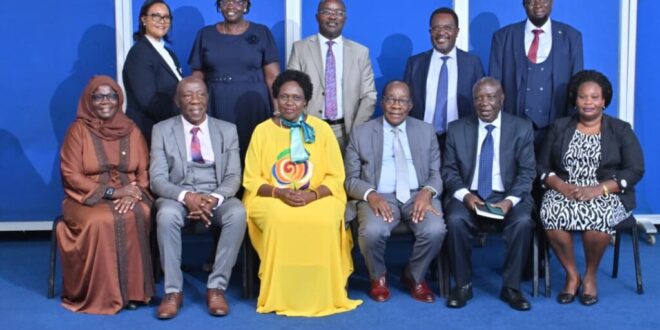
The National Water and Sewerage Corporation (NWSC) has unveiled a new Board of Directors, ushering in fresh faces.
At the centre of the shake-up is the departure of Racheal Kiconco, daughter of former Prime Minister Amama Mbabazi. Kiconco exits alongside Sarah Onyiru, Rtd. Col. Stephen Basaliza, and George Runge, closing a chapter that began in 2019—despite Mbabazi’s highly publicised fallout with President Yoweri Museveni during the 2016 elections.
Replacing the outgoing members is a board stacked with heavyweight names and controversy, led by Prof. Henry Alinaitwe Mwanaki, a Makerere University don widely regarded as Gen. Salim Saleh’s blue-eyed academic, who takes over as Board Chairperson.
Another eye-catching entrant is Eng. John Twinomujuni, Commissioner for Urban Water Supply and Sewerage Services at the Ministry of Water and Environment—a man who has rarely been out of the news headlines.
Eng. Twinomujuni’s appointment comes as legal clouds still hover over his career. When he turned 60 on July 13, 2025, colleagues expected him to retire as required by law. Instead, he went behind the scenes, lobbied relentlessly, and eventually secured a three-year contract extension—a move that sparked murmurs within the ministry and is still being challenged in court. The controversy doesn’t end there.
His wife, Loyda, recently won the Mbarara District Woman MP seat amid allegations from rivals that she “lacks academic qualifications.” Much of the anger from opposing camps was directed at Twinomujuni himself, accused of exerting undue influence and allegedly directing water projects to his wife’s area to boost her political fortunes. A legal showdown is looming.
Despite joining the NWSC board, Twinomujuni’s relationship with NWSC Managing Director Dr. Eng. Silver Mugisha has not always been smooth. Sources reveal that two years ago, Twinomujuni intensely lobbied for Mugisha’s job, a move Mugisha reportedly viewed as outright betrayal.
Although Mugisha’s contract was later renewed—and sources say the two have since buried the hatchet—the history adds another layer of intrigue to Twinomujuni’s new role.
Other new board members include Annette Akiror, Jane Aciro, Robert Wambedde, Peter Rwakifaari Kibondo, and Mariam Mutalaga.
They join continuing members Prof. Eng. Dr. Badru Kiggundu, Daniel Kidega, and Canon Kasya Josephine.
The NWSC Board is the corporation’s governing body, tasked with ensuring compliance with Corporate Governance Performance Standards. It is composed of nine directors—eight Non-Executive Directors and one Executive Director—appointed by the Minister of Water and Environment for a renewable three-year term.
The newly inaugurated board was officially charged on Friday, January 30, at the International Resource Centre (IRC) in Bugolobi, by Minister of State for Water and Environment Betty Anywar, through her representative Sam Cheptoris.
Anywar is still nursing her January 15 election loss and uncertain about her cabinet future.
“This is not merely an honour; it is a call to serve the nation at a critical moment when access to safe water and sanitation remains central to public health, economic growth, and sustainable development,” Anywar said in her speech read by Cheptoris.
She warned that rapid urbanisation, climate change, and rising demand are placing enormous pressure on Uganda’s water infrastructure and urged the board to embrace new technologies and cost-effective solutions, aligned with Vision 2040 and the Sustainable Development Goals.
She further stressed strict adherence to government performance standards, prudent financial management, and the protection of water sources from pollution and encroachment, adding that climate resilience must be embedded in all infrastructure planning, including safeguarding wetlands and catchment areas.
Outgoing Board Chairperson Eng. Dr. Badru Kiggundu presented a glowing performance brief for 2020–2025, noting that NWSC recorded significant operational and financial growth, even through the COVID-19 pandemic.
According to Kiggundu, water connections increased by 39%, surpassing one million customers, villages served rose by 54%, from 7,192 to 11,088, annual revenue collections jumped 59% to UGX 620 billion, and profit before depreciation closed at UGX 161 billion. He attributed the gains to the mobilisation of UGX 160 billion for major projects such as the Katosi Drinking Water Treatment Plant and the Nakivubo Wastewater Treatment Plant.
However, he admitted that non-revenue water remains high at 34.4%, largely due to illegal connections, vandalism, and ageing infrastructure.
NWSC Managing Director Dr. Eng. Silver Mugisha reported that the utility posted its highest-ever operating surplus of UGX 162 billion in the 2024/25 financial year, up from UGX 142 billion the previous year.
He highlighted flagship engineering milestones, including the 70-kilometre Karuma–Gulu project, now supplying River Nile water to Gulu City, and the Kagera Water Project, serving communities in the cattle corridor.
Mugisha also announced a planned UGX 660 billion investment programme, jointly financed by the Government of Uganda and NWSC, aimed at expanding water and sanitation services nationwide.
Beyond pipes and plants, he said NWSC is investing in competence-based training, research and development, and improved staff welfare, including tailored medical and provident funds.
The event, witnessed by Paul Gadenya Wolimbwa, also heard concerns from Permanent Secretary Alfred Okot Okiidi, who criticised unpaid government water bills, calling the situation unfair to a performing public utility. He revealed that the ministry has already submitted recommendations to Parliament to address the arrears.
Taking the reins, Prof. Henry Alinaitwe Mwanaki pledged continuity and cooperation.
He promised to build on the existing foundation, work closely with management, improve efficiency and customer service, and push forward the “water for all” agenda.