 pressug.com News 24 7

Related Articles



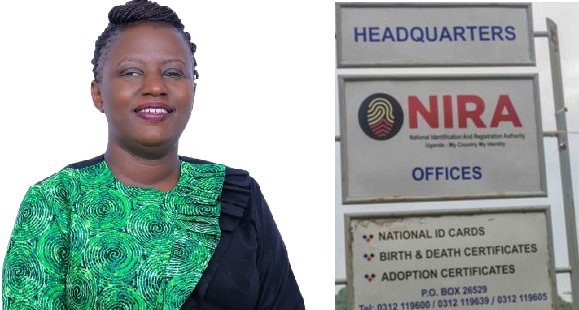
The National Identification and Registration Authority (NIRA), the very institution entrusted with defining the identity of every Ugandan, is now itself facing an identity crisis after a bombshell Auditor General’s report exposed a trail of inefficiencies, delays, system failures and internal chaos that have left millions of citizens stranded without national IDs.
At the centre of the storm is Executive Director Rosemary Kisembo, who took over on May 14, 2021, riding on her strong ICT background from UNRA and replacing Judy Obitra Gama, whose exit followed a string of failures that ultimately cost her job. Now, barely five years into her tenure, history appears to be knocking again — and the question on everyone’s lips is chillingly familiar: will she survive the axe, or is it déjà vu all over again?
Kisembo contract expires in May this year.
“She came in as the technocrat to fix things,” an insider whispered to Red Pepper. “But now the system is exposing her. The pressure is unbearable.”
The Auditor General’s findings are nothing short of devastating.
Despite handling one of the most critical national functions, NIRA is drowning in domestic arrears amounting to UGX 6.075 billion — an increase from UGX 6.025 billion the previous year. While the increment may appear small, insiders say it reflects a deeper problem of financial strain and poor planning.
But the real crisis is in staffing.
Out of an approved structure of 571 positions, only 422 are filled, leaving a gaping 26 percent vacancy rate. Critical departments are operating on life support — Internal Audit is short by 67 percent, Communication and Public Relations is equally understaffed by 67 percent, ICT is missing nearly half its workforce, while Civil Registration Services and Legal Affairs are severely depleted.
“How do you run a national identity system without people?” a frustrated insider asked. “This is not just a gap — it’s a collapse.”
Shockingly, NIRA does not even have a permanent head office. The authority is operating from temporary premises at Kololo Independence Grounds, a situation critics say undermines both efficiency and public confidence. Worse still, there is no front desk or customer care officer at the headquarters to guide the thousands of Ugandans who show up daily in search of services.
“You go there and it’s confusion,” one citizen complained. “No direction, no help, just queues and frustration.”
Inside procurement, the cracks are just as glaring. The entity failed to indicate procurements reserved for registered associations, meaning no contracts were awarded to them as required by guidelines. The Procurement and Disposal Unit itself is understaffed, underfunded, and undertrained — operating with only two out of three required staff and conducting just one training out of four planned.
“This is a system limping from one mistake to another,” a source revealed.
Asset management is equally chaotic. While NIRA has a transport policy, it lacks any framework for managing other critical assets like ICT equipment and furniture. There are no maintenance logs, no tracking systems, and no clear accountability.
“It’s like running a digital authority with analogue thinking,” an analyst scoffed.
The strategic direction of the institution is also in disarray.
A funding shortfall of UGX 69.72 billion — about 9 percent of the planned UGX 751.9 billion — has crippled implementation, leaving key interventions either partially done or not done at all. Even more embarrassing, NIRA failed to finalize its new strategic plan aligned to national priorities by the July 2025 deadline, effectively operating without a clear roadmap.
Performance is equally underwhelming. The National Planning Authority rated NIRA’s budget compliance at just 63.2 percent, while performance indicators used to measure success were described as vague, generic, and in some cases completely inappropriate.
“It’s like they are measuring shadows,” a policy expert remarked.
But it is in service delivery where the full scale of the crisis explodes into view.
The mass enrolment and ID renewal exercise — one of NIRA’s flagship projects under Kisembo — is struggling under the weight of funding gaps, staffing shortages, and operational inefficiencies. Out of UGX 666.85 billion budgeted over three years, only UGX 410.05 billion was received, leaving a massive shortfall of UGX 256.8 billion.
Even the funds that were available were not fully utilised, with UGX 15.24 billion left unspent in the 2024/2025 financial year.
“They don’t have enough money, and the little they have, they don’t use properly,” an insider said bluntly.
The human resource crisis has crippled operations further. Out of 13,787 temporary staff planned for the mass enrolment exercise, only 9,809 were deployed — a shortfall of nearly 4,000 workers that has slowed the entire process.
The result? A national nightmare.
As of October 2025, over 11.5 million Ugandans had applied for ID renewals, but only 45 percent had been cleared for printing. For first-time applicants, the situation is even worse — a shocking 0.2 percent had been approved for printing.
“That is basically zero,” an analyst noted. “It means the system is not working.”
Even among those approved, only 41 percent of ID cards had actually been printed, leaving a massive backlog. And in what may be the most alarming revelation of all, out of 4.3 million new applications for National Identification Numbers (NINs), not a single one had been allocated.
Let that sink in — millions applied, and none received.
By late October 2025, a staggering 17 million applicants were still waiting for their national IDs.
“This is not just delay,” a source said. “It is a complete system failure.”
The cracks extend into other core functions. Marriage registration systems are plagued by ICT gaps and weak data security. Birth and death registration processes are riddled with delays. The National Security Information System (NSIS), the backbone of NIRA’s operations, cannot even register births and deaths, is not integrated with third-party systems, and suffers from data migration delays and incomplete modules.
“There is nothing ‘national’ about a system that cannot talk to itself,” an ICT expert observed.
To make matters worse, NIRA has no business continuity site — meaning in the event of a disaster, the entire identity system could collapse.
“This is a national security risk,” a senior official warned.
As if that is not enough, inconsistencies in data records, weaknesses in issuing death certificates, and delays across all civil registration services paint a picture of an institution struggling to fulfil its core mandate.
Oversight has also come into question. Out of eleven recommendations from Parliament’s Public Accounts Committee, only two were fully implemented, with the rest either partially addressed or completely ignored.
At the top, Board Chairman Joseph N. Biribonwa now faces mounting pressure over governance, while insiders describe a toxic environment of internal fights, leaks, and backdoor lobbying.
“There is a war going on,” a source revealed. “People are feeding information to State House, trying to influence what happens next.”
And what happens next could define not just careers, but the future of Uganda’s identity system.
Sources say Kisembo is fighting hard to secure a second term, reportedly focusing more on lobbying than fixing the deep-rooted issues exposed in the audit.
“It’s squeaky bum time,” an insider said bluntly. “Every move now is about survival.”
The shadow of her predecessor looms large. Judy Obitra Gama also fought to retain her position — and lost.
Now, as President Yoweri Museveni weighs his options, the parallels are impossible to ignore. Kisembo’s contract expires in May this year.
“Yes, she has achievements,” a senior observer admitted. “The ID renewal process did start. Systems were introduced. But leadership is judged on outcomes — and right now, the outcomes are deeply troubling.”
The question now is brutally simple: has Rosemary Kisembo done enough to earn another five years, or is NIRA in desperate need of a fresh start?
For millions of Ugandans still waiting for their identity cards, the answer cannot come soon enough.
GOT A HOT STORY? EMAIL: redpeppertips@gmail.
SOURCE PROTECTION/CONFIDENTIALITY IS OUR NO.1 PRIORITY.