 pressug.com News 24 7

Related Articles



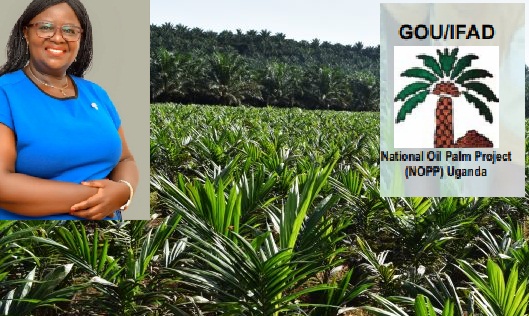
The National Oil Palm Project (NOPP), once hailed as a transformative agro-industrial lifeline for Uganda’s rural farmers, is now sinking under the weight of delays, underperformance and questionable management, after the Auditor General’s December 2025 report exposed deep cracks in one of government’s most ambitious agricultural ventures.
Implemented under the Ministry of Agriculture, Animal Industry and Fisheries, the 10-year project backed by a USD 75.82 million loan and USD 1.21 million grant was designed to uplift smallholder farmers across Kalangala, Buvuma, Mayuge, Masaka and Mukono hubs through sustainable oil palm development. But what was meant to be a model of agro-industrialisation is now being described by insiders as “a slow-moving disaster.”
At the centre of the storm is Project Manager Connie Magomu Masaba, who has been steering the project from the ministry headquarters since 2012. Having spent years at the helm and seen the project through its formative phases, questions are now being asked in corridors of power: has she outlived her usefulness?
“She has been there long enough to know every problem,” a source at the ministry revealed to Red Pepper. “So if things are still going wrong at this scale, then who takes responsibility?”
The Auditor General’s findings are brutal.
Land acquisition and compensation — the backbone of the entire project — has been plagued by shocking delays. In Kachanga village, Buvuma, compensation valued in 2023 was only paid in 2025, a staggering 17 months later. In several other cases, affected persons are still waiting.
“This is how projects lose public trust,” an insider admitted. “People give up their land and then wait endlessly. It breeds anger and resistance.”
The delays are not just administrative inconveniences — they are costly. As land values continue to rise, the government risks paying even more for delayed compensation, further straining already stretched resources.
And even where land has been acquired, the story gets worse.
By the end of the 2024/2025 financial year, 4,371.84 hectares had been secured, but only 2,650.43 hectares — just 60.6 percent — had actually been planted. The rest lies idle, raising serious doubts about capacity and coordination.
“You pay for land, you hand it over, and then it just sits there?” a frustrated observer asked. “That is not inefficiency — that is waste.”
Even more troubling, 629 hectares of land expected to be handed over to Oil Palm Buvuma Limited (OPBL) had not been delivered, years after the original 2019/2020 target.
“This project is operating in slow motion,” a source said bluntly.
At the heart of the project’s economic engine — the crude palm oil processing mill — the situation is equally dire. Originally scheduled for completion in the 2024/2025 financial year, the mill has now been pushed to 2027, with the investor citing lack of viability while the plantation remains below 5,000 hectares.
The delay has real consequences for farmers.
Without a local processing facility, farmers in Buvuma are forced to transport fresh oil palm fruit all the way to Kalangala for processing — a costly and inefficient exercise that eats into their profits.
“How do you talk about improving livelihoods when farmers are spending more just to process their harvest?” a sector analyst questioned.
Procurement processes within the project are also painfully slow. Out of 26 procurements reviewed worth UGX 10.38 billion, more than half took an average of 15 months from initiation to contract signing, while some contracts had not even been signed.
“This is paralysis,” an insider said. “By the time you sign the contract, the need may have already changed.”
Financial management raises even more red flags.
Out of UGX 231.94 billion expected from the IFAD loan, grants and other funding, only UGX 137.48 billion — 59 percent — had been disbursed by mid-2025, leaving UGX 94.46 billion untouched. And even the funds that were disbursed were not fully utilised, with UGX 24.02 billion sitting idle.
“They cry about lack of funds, yet billions are just parked,” a source revealed.
From the IFAD funds alone, UGX 57.92 billion was available, but only UGX 40.62 billion was spent, leaving UGX 17.30 billion unused. Government contributions tell a similar story — out of UGX 6.05 billion provided, only UGX 1.96 billion was spent on project activities, while UGX 4.09 billion was diverted to other ministry operations.
“That is a betrayal of purpose,” an insider said angrily. “Money meant for farmers is being used elsewhere.”
Even loan recovery is raising eyebrows. Out of UGX 53.9 billion disbursed as principal, UGX 51.9 billion had been recovered — but without interest, in direct contradiction of requirements that 70 percent of interest earned should be returned to government.
The performance of the project over seven years is perhaps the most damning statistic of all.
Out of 49 planned activities, only seven have been fully implemented. A staggering 42 — representing 86 percent — remain incomplete.
“That is not underperformance,” a policy expert said. “That is systemic failure.”
At the technical level, officials like Alex Lwakuba, Commissioner Crop Production, and Charles Sembatya, Project Agronomist, are now under pressure to explain the slow pace of agronomic implementation, while researchers led by Dr. Gabriel Damulira at NARO continue to push for scientific backing in a project that appears to be lagging behind its own ambitions.
But insiders insist the real battle is at the top.
“There are quiet tensions,” a source revealed. “People are asking hard questions about leadership, direction, and accountability.”
With the project struggling to meet its targets and farmers losing patience, attention is inevitably turning to Masaba’s long stay in office.
“Yes, she has achievements,” a senior official conceded. “The project exists because of years of groundwork. But the environment has changed. The expectations are higher now.”
As Uganda pushes for agro-industrialisation and rural transformation, the stakes have never been higher. A project of this magnitude cannot afford to drift.
“Sometimes continuity becomes complacency,” an insider remarked. “And when that happens, fresh thinking becomes necessary.”
For now, the National Oil Palm Project stands at a crossroads — weighed down by delays, underutilised resources and missed opportunities. Whether it can recover may depend on one critical decision: stick with the old guard, or bring in new leadership to salvage what remains of a once-promising vision.
GOT A HOT STORY? EMAIL: redpeppertips@gmail.
SOURCE PROTECTION/CONFIDENTIALITY IS OUR NO.1 PRIORITY.