 pressug.com News 24 7

Related Articles



Uganda Development Corporation was created to be the State’s industrial engine, the strategic investor that would put public money into commercially viable ventures and drive Uganda’s transformation. Instead, the latest Auditor General’s report paints a troubling picture of a corporation pouring trillions into companies that are barely staying afloat.
As a state enterprise, UDC is mandated “to promote and facilitate industrial and economic development by investing in commercially viable projects that align with the National Development Goals.” That is the law and the expectation. But the numbers emerging from the December 2025 audit tell a very different story.
Over the last ten years, UDC has invested a staggering UGX 1.3 trillion in 22 companies through various modalities. That is taxpayers’ money intended to spark industrial growth, create jobs, strengthen exports and anchor Uganda’s manufacturing base.
Yet when the Auditor General assessed just 10 active companies that provided documentation, the findings were alarming. Eight out of ten companies recorded net losses for at least two consecutive years. In simple terms, the majority of the sampled investments are bleeding.
One company, Kaaro-Koffi Ltd, remains non-operational four years after UDC injected UGX 3.1 billion into it. Four years later, the company is still not running despite the public investment.
Then comes the issue of loans. Eight companies that were loaned UGX 23 billion by UDC have not adhered to the agreed repayment terms. They have neither paid principal nor interest. Not a coin back.
“What kind of investment management allows companies to default without servicing either principal or interest? Where is the enforcement? Where is the risk control? Where is the commercial discipline expected of a state investment arm?” wonders an investment expert.
Perhaps the most shocking figure in the entire report is the return on investment. UDC’s investment income for the year was a paltry UGX 1.4 billion against a UGX 1.3 trillion investment. That translates into a return on investment of 0.09 percent.
Zero point zero nine percent.
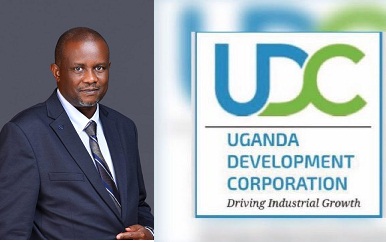
Patrick Birungi is the Executive Director UDC.
The Auditor General concludes bluntly that “the above analysis shows that the investment decisions made for UDC are not yielding returns.” In business language, that is underperformance. In public finance terms, that is deeply worrying.
The structural problem may lie partly in how UDC is funded, the report ‘diplomatically’ exonerates it. Although it is expected to operate with a degree of independence, it is financed through project-specific funding. Government releases funds that are already earmarked for specific projects, “leaving UDC with no space to conduct proper investment appraisal.”
For investment experts, in other words, UDC is often handed projects to invest in, rather than independently identifying and rigorously vetting commercially viable ventures.
“If capital comes pre-tied to particular entities, how robust is the due diligence? How objective is the appraisal? How free is UDC to say no?
“This raises serious questions about competence and advisory strength. Is UDC providing candid, commercially grounded advice to government before funds are committed? Is it warning when projects are not viable? Is it insisting on bankable models, strong governance and realistic timelines? Or is it simply processing investments decided elsewhere and carrying the financial consequences?”
The Accounting Officer defended the corporation by pointing to UDC’s Strategic Plan 2020–2030, which envisages impact measured through high-level outcomes such as job creation, utilization of local raw materials, improving the trade balance, development of local entrepreneurship and balanced regional development. The report notes contributions in job creation and retention, utilization of local raw materials, improving the trade balance position, contribution to import substitution, development of local entrepreneurship and commitment to balanced regional development.
“These are noble goals. But noble goals do not cancel out financial reality,” adds another economist, and adds:
“A development corporation cannot sustainably drive industrialisation if its portfolio is dominated by loss-making companies, non-operational investments and unpaid loans. Industrial policy and commercial prudence are not enemies. They must go hand in hand. If UDC is to invest in national priority projects that have high development impact but low returns or long gestation periods, then that must be transparently structured.”
The report notes that Government will consider financing a Fund to support such investments “to free UDC capitalization for investment in entities that provide good returns on investment.”
That statement alone suggests recognition that the current structure is constraining UDC’s effectiveness.
The Auditor General advised the PS/ST “to consider providing capital funding to UDC and then demand an expected return on investment.”
“That is a critical point. Capital should come with accountability. Independence should come with performance targets. Development impact should not become an excuse for financial indiscipline,” observes an investment expert.
“The hard questions now confront policymakers. Is UDC equipped with the right commercial expertise to appraise and manage complex industrial investments? Does it have strong risk management systems? Is it assertive enough to advise government when projects are not bankable? Is its board exercising sufficient oversight? Are underperforming investments being restructured or exited decisively?”
With the Auditor General’s findings now in the public domain, pressure is mounting. For a corporation entrusted with Uganda’s industrial future, the time may have come not just for reflection, but maybe, for a firm corrective action at the top.