 pressug.com News 24 7

Related Articles

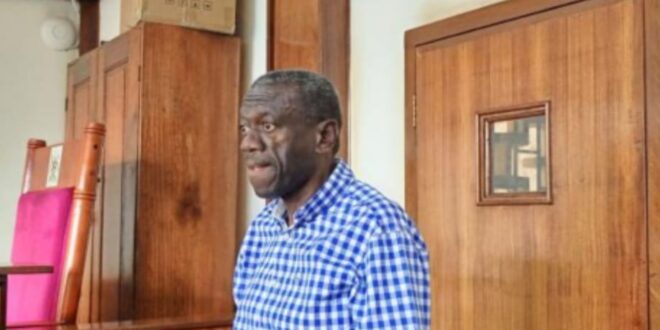
KAMPALA – The High Court in Kampala trying Rtd Col Kizza Kifefe Besigye, Captain Denis Oola and Obed Lutaale on treason charges is yet to pronounce itself on a contested application by the Directorate of Public Prosecutions (DPP) to conceal the identities of six key witnesses. In that application, the State proposed to be granted an order to use pseudonyms and for their witnesses to testify under aliases A, B, C, D, E, F.
A pseudonym is a fictitious name or title adopted by an individual to replace their real name, often for privacy or to conceal their true identity with the guidance of the prosecution. This gives confidence to a willing prosecution witness to testify in a high-profile case, freely without fear of harassment, threats, or intimidation.
The defense however has opposed the application as a violation of the right to a fair hearing, by cross-examination of the State Attorney who swore the affidavit in support. What the state has not made clear is the basis of the fear mongering as none of the accused persons has a history of going after people who give evidence against them.
With the exception of the other two accused, there is no one else in Uganda who has been arrested, detained and prosecuted on tramped up charges like Besigye. In the 2005-2006 rape case brought against him, six witnesses were produced by the prosecution without the need for witness protection. If a witness is willing to testify and to tell the truth, why do they want to hide from public scrutiny?
In the rape case, the witnesses were Joanita Kyakuwa–alleged rape victim, Aisha Nakiguli– Besigye’s former housekeeper,Elizabeth Kuteesa-the then-Director CID, John Musinguzi, a conduit of the rape scheme and Moses Kigongo– a former soldier and driver to Besigye. The case was eventually dismissed but there is not a single record that Besigye pursued his tormentors in a court of law for perjury or in a heat of passion for revenge.
We all know that most prosecutions usually commence with the recording of statements from the would-be witnesses. These statements usually bear the name, age, address, telephone numbers, profession and tribe of the witness. In the instant case, we can safely assume that most of the statements if not all were extracted from people who were close associates of the accused persons unless they are mercenaries or former FDC colleagues.
It is not the first-time the prosecution is seeking concealment orders in high profile cases to keep their witnesses anonymous. In the terrorism case against Rwenzururu King Charles Wesley Mumbere, the International Crimes Division of the High Court, led by Lady Justice Alice Komuhangigranted a concealment order for 70 state witnesses. However, the procedure of concealment was not tested as the state dropped the charges prematurely.
Unfortunately, there is not a single legislation in Uganda on Witness Protection leaving the High Court to invoke its inherent powers to entertain the application on a case-by-case basis. These measures often include concealing material details, providing evidence in summary form, and holding in-camera proceedings so that the witnesses are not identified.
It is also true that a court can grant a concealment order to the prosecution when the safety of a witness or the integrity of the investigation is at risk, outweighing the accused’s right to know the identity of their accuser. In this case, it appears to me that the State is using the application to justify a smooth exit to drop the charges aware that they are incapable of proving any of the ingredients of treason for which the trio were charged.
Supposing the application is rejected, would the state want to appeal in order to keep Besigye in prison or the dismissal will be a justification to drop the charges saying they cannot risk the lives of their witnesses. If for example one of the prosecution witnesses is Sam Mugumya, will Besigye or his lawyers fail to recognize him?
The primary disadvantage of concealment revolves around compromising the accused’s right to a fair trial, undermining the ability to test evidence, and limiting the court’s capacity to assess credibility. If a witness is anonymous as the prosecution want to do in this case, the defense cannot investigate their background for potential biases, ulterior motives (such as framing the accused), or previous dishonest behavior.
Concealment also limits the ability to effectively challenge the evidence, particularly if the anonymous witness is crucial to the case. When a witness is hidden, the judge and the assessors cannot fully observe their demeanor, body language, or reactions to questions. This makes it difficult to determine if the witness is telling the truth or not.
If the Courts continue to rely on its discretion to grantconcealment orders, the DPP will abuse that precedent until it loses its taste. Desperate to secure a conviction, the prosecution can act maliciously like they did in the 2006 Kiza Besigye rape case, where a lady witness was dressed up with a head gear connected with gadgets to coach her on what to say in Court.
Besides, unless the prosecution wants to render their evidence hearsay, they are by law expected to provide witnesses with direct evidence or eye witness testimony. The prosecution seems to have forgotten that beyond simply listening to the verbal testimony, courts extensively observe a witness’s demeanor, consistency, and behavioral to assess credibility and truthfulness.
While Article 120 of the Constitution of Uganda 1995 gives the DPP the mandate to oversee criminal proceedings, witness protection has been primarily handled through administrative measures internal guidelines as a tentative measure in the absence of a substantive legislation since the so-called guidelines lack the full force of law.
Left powerless, the DPP tends to rely on Article 28 on fair trial, to accommodate protection measures within the court’s discretion. They also refer to Article 27 on the right to privacy often used to protect witnesses during criminal proceedings, including holding cases in camera. This however does not save them. Concealment in whichever form is not intended to protect the witness but the testimony they have short of which they are on their own.
In the case of Re-Officer L (2007) UKHL, 36 Paras 19-29, cited with approval in the ruling of the Hon. lady Justice Lydia Mugambe in Misc Cause No. 87 of 2014– Uganda Court Reporters Association Ltd Vs Attorney General on page 40, Lord Caswell explained ‘that all claims of public interest immunity must be objectively verified and justified as court cannot grant any public interest immunity on the basis of subjective fears alone.
We all appreciate the fact that some witnesses deserve some form of protection to express themselves freely but Uganda being what it is, it is too early to set such a precedent. While both measures (concealment and hiding identity) aim at ensuring safety, they differ in scope, application, and permanence. Sadly, the DPP’s prayer will be granted and if denied, Besigye is set to be released from prison immediately after swearing in the President.
The writer, Wadada Rogers is a commentator on political, legal and social issues. [email protected]
Related
, https://pmldaily.com/oped/2026/04/why-is-the-prosecution-insisting-on-concealing-the-identity-of-some-witnesses-in-the-kiza-besigye-treason-case-no-335-of-2025.html