 pressug.com News 24 7

Related Articles



Viewers: 90,004
By Spy Uganda
The Ministry of Health has mounted a firm defence of a controversial policy requiring medical students to complete six years of training before graduation, arguing that the move is critical to protecting patient safety and restoring confidence in the country’s healthcare system.
Appearing before Parliament’s Health Committee on April 10, 2026, Health Minister Ruth Aceng said the policy shift was informed by alarming cases of graduates repeatedly failing internship assessments, yet still holding medical degrees.
“The challenge we have is interns graduating and being called medical doctors while still undergoing internship,” Aceng told MPs. “Some have failed internship three or four times, yet they already hold certificates. We must safeguard our population.”
Under the proposed reforms, internship will become a mandatory component of training before graduation, effectively extending the course duration from five to six years. The policy, endorsed by an inter-ministerial committee, seeks to ensure that only candidates who successfully complete supervised clinical practice qualify as doctors.
“This is about life and death,” Aceng emphasized. “We must be sure that anyone graduating as a doctor is fully competent to handle patients.”
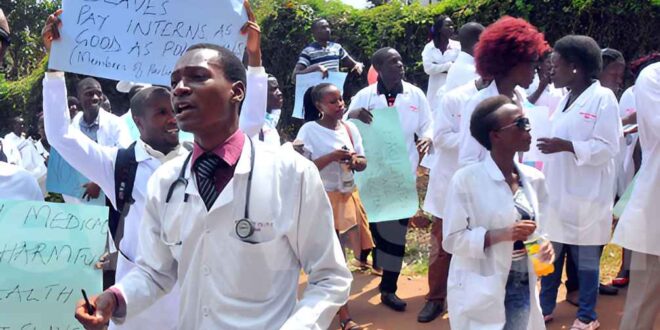
However, the policy has triggered strong resistance from the Federation for Uganda Medical Interns, which petitioned Parliament seeking urgent intervention over welfare concerns and the proposed changes.
In a memorandum to the Health Committee, the interns revealed that many have gone unpaid since August 2025, raising concerns about financial hardship and professional dignity.
“Medical interns must retain their status as pre-registered healthcare professionals, not students,” the association argued. “If you are not a student, you must be paid.”
The group is demanding a shift to a predictable monthly payment system, as well as immediate clearance of outstanding arrears. They also called for improved working conditions, including on-site accommodation and better-equipped hospitals to ensure both intern welfare and patient safety.
The interns further urged Parliament to ensure that any policy reforms are developed through transparent consultations to avoid industrial unrest in a sector already under strain.
Lawmakers raised concerns about the practical implications of the new policy, particularly its financial burden on students and families.
Bukomansimbi North MP Christine Nandagire questioned whether the additional year would require students to continue paying tuition, an issue she said has caused widespread confusion.
“Parents and students signed up for a five-year program,” she noted. “Now they are being told it is six years. Will they pay extra fees? Will they be paid during internship?”
Nandagire also highlighted the intense workload faced by interns, citing high patient-to-doctor ratios in public hospitals. “You know how hard internship is,” she told the Minister. “Why not fight for them to be paid at least UGX1 million and complete their studies within the agreed timeline?”
Defending the policy, Aceng pointed to systemic challenges facing Uganda’s medical training pipeline, including the rapid expansion of training institutions.
Uganda now has more than 30 medical schools, most of which fall under the supervision of the Ministry of Education rather than the Health Ministry. This, she argued, has complicated efforts to maintain uniform training standards.
“With over 30 training institutions, the number of interns released each year has grown significantly,” she said. “Gone are the days when we had about 200 interns annually. Managing these numbers is not easy.”
Health sector analysts say the surge in student numbers, combined with limited internship placements and funding constraints, has strained the system, raising legitimate concerns about both quality and capacity.
The policy debate reflects a broader dilemma facing Uganda’s health sector: how to expand the workforce while maintaining professional standards.
Uganda’s doctor-to-patient ratio remains far below the World Health Organization’s recommended threshold, contributing to heavy workloads for existing staff and long waiting times for patients.
While tightening training requirements could improve quality, critics warn it may also slow the pipeline of new doctors unless accompanied by increased investment in training infrastructure and internship funding.
“There is a real risk of creating a bottleneck,” a public health expert observed. “If you extend training without addressing capacity, you may worsen staffing shortages in the short term.”
The issue has also drawn attention to Parliament’s oversight role in resource allocation. Funding for intern allowances, hospital infrastructure, and training capacity falls within the broader health budget approved annually by legislators.
MPs on the Health Committee signaled that they will scrutinize the Ministry’s budget proposals to ensure that policy changes are matched by adequate financing.
“The policy cannot succeed without resources,” one committee member noted. “We must ensure that interns are supported and that training facilities are equipped.”
The committee session also touched on broader health and social policy issues, including a proposal to fund the distribution of sanitary pads in schools and prisons.
While some MPs argued that menstrual hygiene is a critical public health concern requiring government support, Aceng rejected the proposal, stating that it falls outside the Health Ministry’s mandate.
“It is not a disease or a health condition,” she said. “It is a normal physiological process and should be handled by the education and gender sectors.”
The response sparked debate over how government defines health priorities, particularly in areas that intersect with education and social welfare.
As the policy undergoes further scrutiny, Parliament faces a delicate balancing act: ensuring that reforms strengthen healthcare quality without undermining the welfare of medical trainees or exacerbating workforce shortages.
For interns, the immediate concern remains unpaid allowances and uncertain professional status. For government, the priority is restoring confidence in the competence of graduating doctors.
What is clear, however, is that the debate goes beyond the length of training. It strikes at the core of Uganda’s healthcare system, its standards, its workforce, and its capacity to deliver safe and effective care to a growing population.
, https://www.spyuganda.com/no-internship-no-degree-govt-tightens-rules-on-medical-students-with-6yr-training-plan/