The moral integrity of Thomas Tayebwa has come under intense public scrutiny following his endorsement by the ruling National Resistance Movement (NRM) to continue serving as deputy speaker in the 12th parliament.
Tayebwa, who served as deputy speaker in the 11th parliament under the embattled outgoing speaker Anita Annet Among (AAA), was endorsed on Sunday evening during a meeting of the NRM Central Executive Committee (CEC) in Entebbe.
The CEC also endorsed Jacob Marksons Oboth-Oboth as the party’s flag bearer for speaker of the 12th parliament after Among was seemingly pushed out of the race amid allegations of corruption and illicit wealth accumulation. The decision was later unanimously adopted by NRM legislators.
The endorsement effectively positions Oboth-Oboth, the MP for West Budama South and former Defence minister, and Tayebwa, the outgoing deputy speaker and Ruhinda North MP, as overwhelming favourites in Monday’s election of parliamentary presiding officers, given the NRM’s commanding majority in parliament.
However, Tayebwa’s endorsement has attracted the most criticism due to his closeness to Among and alleged complicity in what critics describe as the looting of public resources at parliament.
According to reports, at least 18 MPs who had expressed interest in contesting for speaker and deputy speaker stepped down before the caucus vote, paving the way for a consensus endorsement.
Critics argue that Tayebwa served as deputy speaker throughout the tenure of the 11th parliament under Among and therefore cannot be insulated from the alleged abuse of public resources that dogged the outgoing parliamentary leadership.
While Oboth-Oboth’s endorsement has largely attracted broad acceptance within NRM circles, the backing of Tayebwa for another term as deputy speaker has triggered intense debate on social media.
A section of commentators argue that the NRM’s choices reflect a pragmatic effort to preserve institutional continuity while distancing parliament from the controversies that engulfed the outgoing leadership.
Among’s political troubles escalated in recent days amid investigations and scrutiny over alleged illicit wealth accumulation, eventually leading to her withdrawal from the speakership race. Several commentators have questioned why Tayebwa appears to have emerged politically unscathed despite having worked closely with Among for four years.
Among those weighing into the debate is Ronald Amanyire, the interdicted principal road safety officer at the ministry of Works and Transport, who argued that the contrasting treatment of the two leaders has fuelled perceptions of selective accountability.
“It is difficult for any independent observer to ignore the regional undertones in the NRM’s decision,” Amanyire wrote on X.
He argued that the speaker and deputy speaker operate as a constitutional team and questioned the logic of treating one office holder as detached from practices that allegedly characterised parliamentary leadership during their joint tenure.
Thomas Tayebwa (C) at Kololo
Amanyire further contended that if lifestyle audits are not considered a central anti-corruption tool, as President Museveni previously suggested, then scrutiny of Among’s lifestyle while leaving other public officials untouched creates perceptions of unequal enforcement.
“The pattern of selective scrutiny is unmistakable,” he wrote, adding that such developments risk reinforcing public perceptions that anti-corruption efforts are influenced by political and regional considerations rather than uniform principles.
The controversy surrounding Tayebwa has also drawn in prominent public figures, including former Makerere University vice chancellor Prof Venansius Baryamureeba, who has been actively commenting on the unfolding parliamentary leadership contest on X.
Baryamureeba said Tayebwa is equally as corrupt as Among and has managed to build and surround himself with a corruption network in which he has strategically placed allies and loyalists in key government entities such as the Uganda Communications Commission (UCC) and National Information Technology Authority – Uganda (NITA-U).
“Hon. Tayebwa right from his Makerere University days to now in parliament, he is someone who has perfectly practiced network corruption. He covers his tracks. His corruption hands are all over MDAs. In short, Hon Tayebwa is 100 times more corrupt than Hon. Anite Among,” said Baryamureeba.
For weeks now, Among’s properties, including luxury cars and homes in Nakasero, Kigo, Ntinda and Bukedea, have been probed by detectives. Baryamureeba said Tayebwa should not escape similar scrutiny.
Journalist and Agora Centre for Research activist Agather Atuhaire said Tayebwa was and remains part of the parliamentary leadership behind what she described as the “parliamentary heist.” Agora has for years, been at the forefront of exposing alleged abuse of public funds at parliament.
“Also, let me reshare what we have shared about him. Every thing Among stole, Tayebwa had a share. When they increased per diem, his was also increased from $850 to $3,500, when they decided to give themselves money to furnish their homes, Tayebwa got UGX 890M, when they gave themselves generators for their residences, Tayebwa also got, when they gave themselves annual vacations with their spouses paid for by tax payers, Tayebwa also got, when they increased their office budgets, donations and entertainment, Tayebwa also got. When they were sharing the budget through reallocations, Mitooma was also a beneficiary each FY. And we have written all this! “ she wrote on X.
Like the speaker’s budget, the deputy speaker’s budget has grown sharply over the years, increasing by more than 423 per cent from Shs 2.76 billion in FY 2020/21 to Shs 14.4 billion in FY 2024/25.
Critics have questioned the justification for some of the increments, including the introduction of Shs 3.8 billion in donations under the deputy speaker’s office, especially amid deteriorating service delivery across the country.
Baryamureeba argued that if the fight against corruption is not to be perceived as selective, then Tayebwa’s assets should also be scrutinised.
“Within the MDA relatives or royalists are given key positions like chairperson of the board to ensure the funds are siphoned out through various channels including staged inflated procurements, grants, donations etc 3. Those who benefit from no. 2 above bring cash to the operatives in the MDA,” said Baryamureeba.
“The so-called King Censor Mulenga owns King Caesar University.. Mulenga appoints Hon. Chris Baryomunsi Chairperson University Council. Mulenga appoints Hon. Tayebwa chairperson of Board of Trustees at King Caesar University. Hon. Baryomunsi appoints Mulenga’s wife (Dr. Basaza) Chairperson UCC and her sister (Dr Hibanka) boat member of NITA-U. Hon. Baryomunsi appoints Hon. Tayebwa’s brother (Kibandama) Chairperson NITA-U. This is a corruption network. Someone may wonder how King Censor University acts as a centre of the corruption network… You can fill in dots for details.”
“But I can tell you billions of government funds gets siphoned through such networks undetected. These kinds of networks are all over the place. You will see for example someone pushing for a budget increase for NITA-U in parliament or officials in a ministry fighting with the minister over control of projects in an authority like NITA-U? But it makes sense when you know of the existence of a corruption network,” added Baryamureeba.
President Yoweri Museveni welcomed the endorsement of Oboth-Oboth and Tayebwa, saying the decision was guided by ideology rather than personalities.
“Since the inception of the NRM, we have rejected bad politics. When choosing leaders, we must first ask what needs to be done for the people before asking who should do it,” Museveni said.
He added that politics should reject “identity, religion, tribalism and gender chauvinism” and instead focus on wealth creation and socio-economic transformation through agriculture, services, artisanship and information technology.
Oboth-Oboth, a lawyer and long-serving legislator representing West Budama Constituency, was first endorsed by the Patriotic League of Uganda (PLU), a political pressure group chaired by the Chief of Defence Forces (CDF) and President Museveni’s son, Gen Muhoozi Kainerugaba.
PLU also later endorsed Tayebwa for deputy speaker after initially dropping him alongside Among amid corruption allegations. Tayebwa has served in the role since 2022 following the death of Jacob Oulanyah and the subsequent reorganisation of parliamentary leadership.
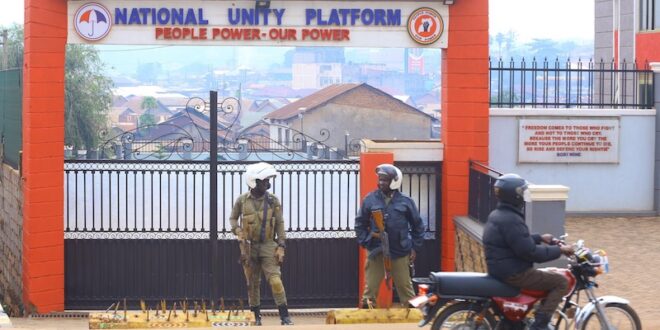
Attention will now shift to the formal election of the Speaker and deputy speaker when the 12th Parliament convenes for its inaugural sitting at Kololo Ceremonial Grounds. Oboth-Oboth will face Democratic Party president Norbert Mao and National Unity Platform’s Paul Mwiru, who is also the opposition candidate.
The NRM caucus endorsement followed a dramatic consolidation of support within the ruling party after all other aspirants for both positions reportedly withdrew from the races. Party insiders said the caucus adopted recommendations earlier made by the CEC.
Among those who had sought the speakership was Persis Namuganza, while several MPs had expressed interest in the deputy speakership.
Following the endorsement, some former aspirants, including Persis Namuganza, Dennis Namara and Susan Nsambu, took to social media to congratulate Oboth-Oboth and Tayebwa while explaining their decisions to withdraw and rally support behind the party position.
The debate has also intersected with broader concerns raised in recent days by women’s rights advocates and female politicians who had pushed for gender balance in Parliament’s top leadership following Among’s withdrawal from the race.
Museveni’s message to legislators focused less on individual personalities and more on what he described as the movement’s long-standing ideological principle of prioritising national interests over personal ambitions.
With the caucus now firmly behind Oboth-Oboth and Tayebwa, attention shifts to Monday’s parliamentary sitting at Kololo Ceremonial Grounds, where MPs will formally elect the Speaker and deputy speaker and set the tone for the next five years of legislative politics in Uganda.
The National Unity Platform (NUP) has fronted Paul Mwiru as the opposition candidate, while Democratic Party president Norbert Mao is seen by some analysts as leveraging the DP-NRM Cooperation Agreement of 2022 in his bid to lead Parliament.
After the endorsement, Tayebwa apologised to Ugandans for the excesses associated with the 11th Parliament, where he served as deputy speaker.
Related
, https://observer.ug/news/tayebwa-endorsement-sparks-corruption-debate/
pressug.com News 24 7