 pressug.com News 24 7

Related Articles
By Ben Musanje
The Uganda Law Society (ULS) has established a special committee and an international solidarity programme to protect advocates from what it describes as growing militarization, intimidation and political interference in the practice of law.
The new body, known as the Section 3(c) Committee, was created under an executive order signed by ULS President Isaac K. Ssemakadde and Acting Secretary Ssali Babu following approval by the Society’s Governing Council.
The committee draws its mandate from Section 3(c) of the Uganda Law Society Act, which requires the Society to represent, protect and assist members of the legal profession in matters affecting their practice.
In the executive order, the Ssemakadde says the initiative is a response to recent incidents involving the abduction, detention, reported torture and prosecution of lawyers, as well as increasing interference with legal practice, which it argues threaten the independence of the legal profession and access to justice.
Ssemakadde says the committee will provide structured and proactive responses to what it characterizes as emerging threats, particularly military involvement in civilian justice processes and the growing use of legislation against advocates.
The order defines a broad range of threats facing lawyers, including arrests, enforced disappearances, assaults, restrictions on access to clients and detention facilities, seizure of legal files and electronic devices, cyberattacks, surveillance, judicial intimidation, administrative harassment and the prosecution of civilians before military tribunals.
It also identifies what the Society terms the “weaponisation” of laws such as the Anti-Money Laundering Act, Anti-Terrorism Act, Penal Code Act and the Protection of Sovereignty Act, 2026. According to the ULS, these laws could be used to designate lawyers or their clients as foreign agents, freeze bank accounts, restrict international funding or criminalize legal representation and advocacy.
Under the order, the committee will provide emergency legal assistance to advocates facing threats, coordinate rapid legal interventions, document violations against lawyers and monitor patterns of interference with legal practice.
Among its responsibilities will be operating a 24-hour emergency hotline, filing urgent habeas corpus and bail applications, maintaining a confidential register of incidents affecting advocates and publishing quarterly reports on trends within the profession.
The committee will also produce legal rights guides, digital security protocols and emergency preparedness materials for lawyers and their families while monitoring courts and detention facilities for alleged violations of fair trial rights and denial of access to legal counsel.
In addition, it will monitor and challenge what the Society considers the misuse of financial crime, terrorism and national security laws against advocates through litigation, petitions and advocacy.
As part of the initiative, the Society has also created an International Solidarity Programme (ISP) to coordinate support from regional and international legal organisations.
The programme will seek temporary relocation and emergency shelter for lawyers facing imminent danger, coordinate exchanges with foreign bar associations and mobilise international advocacy through organisations including the International Commission of Jurists, Lawyers for Lawyers and relevant United Nations human rights mechanisms.
It will also seek international funding and pro bono legal assistance for advocates facing criminal prosecution or financial restrictions linked to their work and submit anonymised information on attacks against lawyers to international human rights bodies.
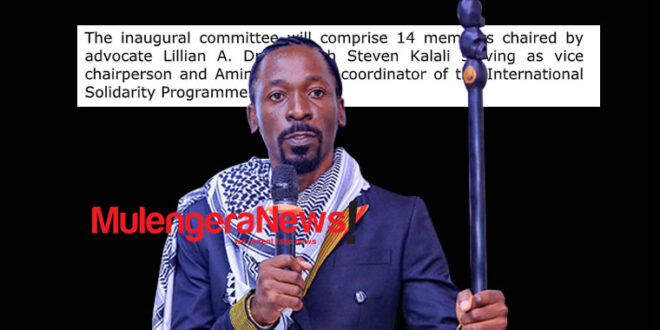
The inaugural committee will comprise 14 members chaired by advocate Lillian A. Drabo, with Steven Kalali serving as vice chairperson and Amina Acola as coordinator of the International Solidarity Programme.
Other members include David Oluka, Arnold Musinguzi, Rebecca Ayesiga, Geoffrey Mishele, Yasin Ssentumbwe Munagomba, Calvin Kilama, Joy Moureen Adiru, Isaac Ronald Olanya, Abdallah Abdurahman Mujoma and Spinoza Achom. Acting ULS Secretary Ssali Babu will serve as an ex-officio member.
The committee has been granted powers to demand access to detained advocates and clients in accordance with Article 23(5) of the Constitution, issue public statements defending the legal profession, instruct counsel in urgent constitutional litigation, request information from public bodies and administer emergency legal assistance funds.
It will meet at least once every month but may convene emergency meetings within two hours of any critical incident affecting members of the Bar. The committee will also establish specialist teams responsible for rapid response, documentation and monitoring the use of legislation against lawyers.
According to the executive order, the committee will publish quarterly reports and submit an annual assessment of conditions affecting legal practice to the Governing Council every January.
The order takes immediate effect and forms part of the Uganda Law Society’s efforts as it marks 70 years since its establishment in 1956. (For comments on this story, get back to us on 0705579994 [WhatsApp line], 0779411734 & 041 4674611 or email us at mulengeranews@gmail.com).
Post Views: 679
, https://mulengeranews.com/ssemakadde-sets-up-emergency-committee-to-protect-lawyers-amid-rising-security-crackdown/