 pressug.com News 24 7

Related Articles


Russia’s brutal crackdown on LGBTQ people has seen multiple arrests
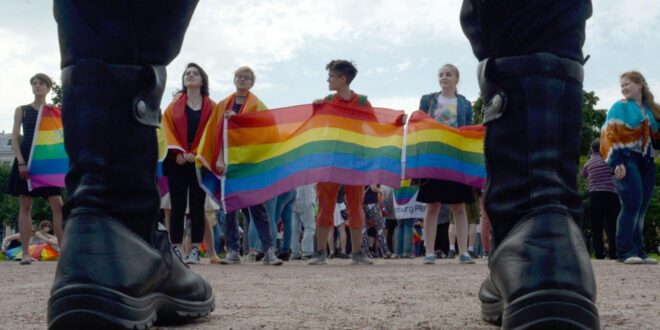
Homophobia is far from new in Russia, but recent repression means that demonstrations like this 2017 LGBT rights protest are no longer seen.
Russia’s deepening crackdown on LGBTQ people and advocacy, which has seen a wave of arrests leading to fines and prison sentences has forced Russia’s queer people to watch their backs and self-censor as they face daily harassment and official repression, according to a new report from the Coming Out and Sphere Foundation organizations, which surveyed 6,000 queer people from across Russia.
Below are excerpts from an article by the Inter Press Service news agency:
Systematic Vilification of Russian LGBTQ+ Community Pushes Them Underground
LGBTQ+ people in Russia are being forced to increasingly use self-censoring strategies in their daily lives as they struggle with systemic vulnerability, one of the largest surveys of the LGBTQ+ community in the country has shown.…
[H]omophobic political discourse has become increasingly normalised, as the Kremlin has looked to promote ‘traditional family values’ in society and cast LGBTQ+ activism as a product of a degenerate West and a threat to Russia.
This has fuelled a growingly virulent and often violent rejection of LGBTQ+ people in large parts of society and has left many in the community fearing for their physical and mental health.
Grigory*, an LGBTQ+ student from a major city in Russia, said they were selective in revealing their sexuality and gender identity and that while they do not live in permanent fear of physical attacks, they have adjusted their behaviour to avoid certain locations.
“Sometimes in the evenings I avoid certain places because I could be considered stereotypically gay, perhaps because of my voice or the way I walk. I don’t hide my sexuality in public, but I don’t manifest it either,” they said, adding that this was easier for them than for some other members of the LGBTQ+ community.
“Transgender people suffer the worst problems. It must be very hard for someone to be transgender in Russia. They are so brave and strong. I’m astonished they can keep going,” they said.
The Coming Out and Sphere Foundation showed the situation for transgender people in the vast majority of indicators for quality of life, including specific measures of discrimination and well-being, was worse than for other members of the LGBTQ+ community. Notably, they were significantly more likely to face physical threats and experience actual physical violence, including sexual and domestic violence, more frequently than other LGBTQ+ people.
“A lot of trans people right now live their whole lives at home without even going outside to the shops if they have access to courier services or some relatives or friends who can help them buy what they need. We’re seeing this more and more,” said Denis Oleinik, executive director at Coming Out.
Grigory said they felt, along with many others in the community, if not fear of physical attacks, a specific sense of aggression towards them.
“I feel it indirectly. It comes through government narratives in the media and in the public sphere, or in something an acquaintance might say. Queerphobia in Russia is mainly government-induced. Of course it existed before all these awful laws, but it wasn’t that strong. The laws have made it much worse,” they said.
LGBTQ+ rights campaigners say the patterns of behaviour among the community in Russia described in the report are unsurprising given the years of growing repression against them.
“When marginalisation and criminalisation on any grounds are a long-term feature of daily life, people develop ways of managing their daily exposure to harm,” Anastasia Smirnova, Deputy Director and Director of Programmes at rights group ILGA-Europe, told IPS.
She added, though, that LGBTQ+ people in Russia were facing a very specific challenge, as the Russian state has, through increasingly harsh legislation and stigmatising rhetoric, systematically worked to isolate LGBTQ+ human rights defenders and then LGBTQ+ people from each other and from everyone around them as part of a broader dismantling of the conditions for free association and dissent.
“This is what makes it different from social prejudice: it is not a reflection of society, it is a project of the state, and its target is civic life. For many people living through this, the daily acts of self-censorship described in the report are the lived reality of that project,” Smirnova said.
The potential harms of such actions on individuals and the wider community are severe, with impacts on both mental and physical health as individuals are left isolated and in some cases afraid to access healthcare.
“The impact on children is particularly severe. State propaganda targeting schools, the absence of age-appropriate relationship and sex education, and the climate of fear surrounding LGBTI topics leave young people exposed to extreme harm and isolation, especially children who are themselves LGBTI or have LGBTI family members, but also any child who might be perceived as LGBTI,” said Smirnova.
While the report did not show a significant deterioration in a number of indicators compared to previous years – in fact there was a slight improvement in some areas – its authors warn this could be misleading, highlighting that the report relied on the willingness of respondents to “share sensitive information in an increasingly oppressive environment” and that real levels of discrimination and violence could be higher.
Whatever the true levels of discrimination against the community are in Russia, many people are suffering gravely in the current environment.
Grigory said they are currently in therapy, partly to help them deal with the challenges of being LGBTQ+ in Russia.
They said that among the community, “thoughts of killing oneself and suicide attempts are pretty common.”
LGBTQ+ people and activists in touch or working directly with members of the community who spoke to IPS said substance abuse, or self-medication through unsupervised use of anti-depressants, was not uncommon either.
See Also
Trying to get help for such problems is difficult though amid mistrust of state health institutions because of widespread homo- and transphobia and concerns over staff potentially breaching patient confidentiality about sexuality.
As the pressure on LGBTQ+ people continues, many feel they have had no choice but to leave the country.
The annual report included responses from hundreds of people who had emigrated, both in 2025 and in the last few years before that.
Severe anxiety and psychological discomfort were the most commonly cited reasons for emigration (66%), while other major reasons included intensified censorship (59%), personal safety risk (57%), and increased homophobia and transphobia in Russian society (57%).
Tellingly, the majority of participants who had emigrated (63%) did not consider returning to Russia an option – a rise of 8 percentage points on the previous year.
This is perhaps unsurprising, given that many in the community see little or no prospect of the situation in Russia improving for many years.
“Many things have changed in the last few years, not just in Russia but all around the world – the far right is winning everywhere, and LGBTQ rights are under attack all over the world. I’m not expecting anything good to happen inside Russia in the next five to ten years,” said Oleinik.
But others say that despite, or perhaps because of, the report’s findings, there is an even greater need now for LGBTQ+ people in Russia and groups both inside and outside the country to do whatever they can to resist the state’s ongoing repression of the community.
“There is an important distinction to draw between acknowledging that a democratic reversal in Russia is not on the near horizon and concluding that nothing can or should be done in the meantime. The power of the Russian state, backed by resource wealth and a willingness to use every available instrument of repression, is real and cannot be minimised. And yet what we see from our position, working in support of human rights organisations, defenders, organisers, and activists, is not resignation, but realism paired with determination,” said Smirnova.
“People are continuing to organise, even though the time horizons are long and murky and the measures of ‘value’ of the organising are different from what they might be somewhere else. But keeping the lights on for the possible forms of civic engagement, critical thought, and solidarity is a form of resistance that does have long-term value,” she added.
Oleinik vowed his organisation would not be giving up on LGBTQ+ people in Russia.
“We need to continue our work, our support, because we know that LGBTQ+ people in Russia need us. Right now it might look like there is little hope of positive change, but that does not mean we should stop what we are doing,” he said.
*Name changed for security reasons
, https://76crimes.com/2026/07/16/russian-lgbtq-community-underground/