 pressug.com News 24 7

Related Articles



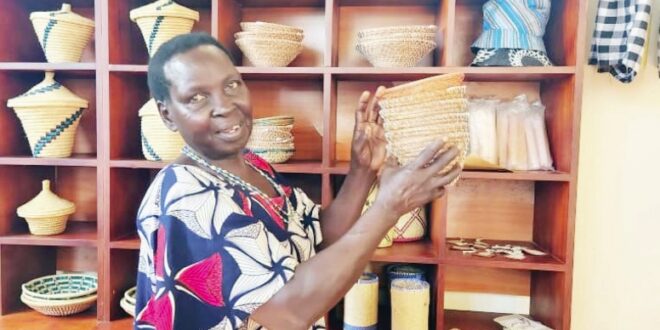
In Masindi district, what began as a modest women’s craft group more than two decades ago has steadily evolved into a platform for income generation, skills development and community support driven largely by the persistence of its founder, Edna Byabalemi.
Byabalemi, now chairman of the group, traces its origins to November 1999, when she mobilised 10 women to form a new association after becoming disillusioned with an earlier initiative that had failed to take off.
She had previously served as secretary of Asera Zora, a group formed in 1998 but which later collapsed due to what she describes as lack of commitment among members.
“I used to attend trainings in Kampala and return to share the knowledge, but members were not interested. I realised I was wasting time. That is when I decided to start a new group,” she recalls.
Starting out, Byabalemi rented a small space in Masindi town where members could display and sell handmade crafts. Early progress was modest, but a breakthrough came through collaboration with the Uganda Community Tourism Association, which provided a reliable market for their products.
Through this partnership, Byabalemi regularly transported crafts to Kampala, returning with proceeds that were distributed among members, an arrangement that gradually built confidence in the group’s viability.
The group’s technical capacity was further strengthened in 2004 when the then Masindi Woman Member of Parliament, Bintu Lukumu Ngonzi Abwooli Jalia, facilitated training for several groups in making handmade bedcovers.
This skill has since become one of the group’s main income-generating activities. Over time, external exposure also played a role in shaping the group’s outlook. Between 2009 and 2010, the group hosted international volunteers, an experience Byabalemi says introduced new ideas around product development and organisation.
Her exposure extended beyond Uganda. In 2001, she travelled to the United States, where she demonstrated basket weaving alongside other Ugandan artisans, while in 2011 she visited Denmark to train women in craft-making techniques.
Back home, the group has grown into a small but sustained network of artisans. From the original 10 members, it now comprises 16 active women, while also functioning as a training hub for others from surrounding districts. For many members, craft-making has provided an alternative to subsistence farming, offering a more predictable, albeit modest, income stream.
“Life was difficult. You could farm, but there was no guarantee of getting money. With weaving, we started earning something small but consistent,” Byabalemi says.
This income, she explains, has been critical in meeting basic household needs, particularly education. Women often have the ability to quickly produce items to cover school fees, offering them a level of financial flexibility that was previously unattainable.
Beyond individual livelihoods, the group has also taken on a community support role. Since 2013, members have pooled resources to support vulnerable children, particularly those at risk of dropping out of school or early marriage.
The high number of girls leaving school after Primary Seven prompted the initiative, according to Byabalemi. Between 2013 and 2018, the group supported at least six students through secondary education, with some beneficiaries later securing employment.
The initiative has since expanded to include younger children, supported through informal sponsorship arrangements facilitated by the group and its partners. Partnerships have also enabled the group to extend its impact beyond Masindi.
Working with organisations such as the Cross- Cultural Foundation of Uganda, members have trained other community groups in districts including Kakumiro and Muhorro, promoting craftsmanship as a viable income-generating activity.
However, the group’s progress has not been without setbacks. The COVID-19 pandemic significantly disrupted markets, reducing demand and affecting members’ incomes.
“People were not buying, and many women lost hope. Some stopped coming because they could not sell their products,” Byabalemi said.
Although activity has since resumed, she notes that the market is inconsistent, with most sales concentrated around exhibitions and organised events. Access to raw materials has also become a growing challenge.
The group relies on natural resources such as papyrus, which are increasingly scarce due to environmental degradation and wetland encroachment. Limited access to land has constrained their efforts to cultivate their own materials. In response, the group has sought to innovate.
With support from development partners, members have diversified into new products, including jewellery made from sisal and recycled materials, while also acquiring equipment to improve production quality. Looking ahead, Byabalemi sees potential in emerging economic opportunities linked to Uganda’s oil and gas developments, particularly in accessing new markets for crafts.
“We want to find where these visitors stay and see if we can display our products there. If we access that market, it can change our lives,” she says.
For Byabalemi, however, the motivation remains rooted in community.
“I would rather not see others suffer. This is why we continue to train and support more women, enabling them to become self- sufficient,” she says.
Her journey reflects a broader story of grassroots resilience where traditional skills, when organised and sustained, can evolve into tools for both economic empowerment and social change.
Related
, https://observer.ug/uncategorized/two-decades-on-a-crafts-initiative-reshapes-rural-incomes-in-masindi/