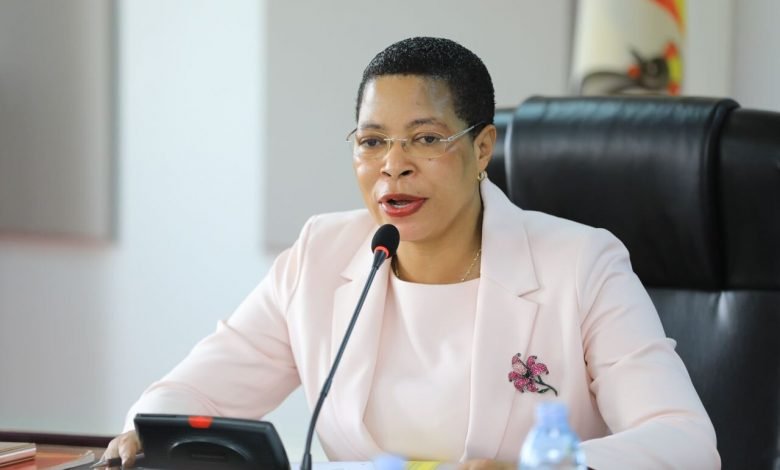
Kampala, Uganda — The decision by former Speaker of Uganda’s 11th Parliament, Anita Annet Among, to withdraw from the race for Speaker of the 12th Parliament marks one of the most politically consequential developments within the ruling National Resistance Movement (NRM) ahead of the new parliamentary term. While officially framed as a move intended to preserve “harmony and clarity” within the party, the timing and circumstances surrounding the announcement point to a deeper convergence of political survival, institutional pressure, and internal party recalibration.
In a statement published on her verified X account, Among announced that following “wide consultations and deep introspection,” she would not offer herself for the Speakership contest and would instead support candidates endorsed by President Yoweri Kaguta Museveni and the ruling National Resistance Movement. She further pledged cooperation with ongoing investigations into allegations that have increasingly shadowed her final months in office. The language of the statement was measured, disciplined, and politically careful. Yet beneath its conciliatory tone lies a far more significant reality: the Speakership race had evolved into a high-risk political contest unfolding under the weight of active state investigations, public scrutiny over alleged wealth accumulation, and growing pressure within sections of the ruling establishment to manage institutional reputational damage ahead of the 12th Parliament.
For months, Among’s leadership had become intertwined with broader national debates around public expenditure, accountability, and the concentration of political influence within parliamentary structures. Allegations surrounding irregular wealth accumulation, procurement controversies, and the conduct of individuals associated with the Speaker’s office had already attracted public criticism and intensified scrutiny from state agencies. Several associates linked to the investigations have reportedly been arrested or summoned to record statements. Against that backdrop, her withdrawal increasingly appears less like a routine political decision and more like a strategic containment measure designed to prevent the Speakership race from becoming a referendum on ongoing investigations.
Within Uganda’s political architecture, the office of Speaker occupies a uniquely sensitive position. Although constitutionally distinct from the Executive, the Speakership remains deeply embedded within the broader power equilibrium of the ruling party. Historically, major parliamentary leadership contests within the NRM are rarely resolved purely through open competition; they are often shaped by internal consultations, strategic endorsements, and calculations tied to political stability and institutional control. This explains why Among’s withdrawal carries significance beyond individual political ambition. Had she remained in the race, the contest risked producing visible fractures within the ruling establishment at a politically delicate moment as what unfolded the last week. It could also have transformed Parliament’s leadership election into a highly polarised public battle centred not on legislative direction, but on corruption allegations and institutional credibility.
The timing is particularly important because Uganda is entering a period where questions surrounding her previous governance, public trust, and state accountability are becoming increasingly central to political discourse. Public frustration over economic pressures, youth unemployment, service delivery gaps, and perceptions of elite privilege has steadily intensified in recent years. In such an environment, any leadership contest perceived to be overshadowed by unresolved investigations would likely have amplified public criticism toward both Parliament and the ruling party. Her withdrawal therefore appears to have achieved multiple political objectives simultaneously: lowering internal tensions within the NRM, reducing media attention around the investigations during the Speakership process, and allowing the party leadership greater control over succession management.
The earlier entry of Justice and Constitutional Affairs Minister Norbert Mao into the Speakership discussions had initially introduced an unexpected dimension to the race. However, political observers increasingly interpreted Mao’s visibility less as a fully consolidated candidacy and more as an early signal that broader negotiations and strategic positioning were already underway behind the scenes. His emergence effectively opened political space before alternative names where announced quietly gaining traction within party circles. What remains particularly revealing is how quickly the centre of gravity shifted away from open contestation toward consensus building and endorsements. This reflected the enduring reality that within Uganda’s dominant-party political system, institutional continuity often takes precedence over prolonged internal competition especially where sensitive investigations intersect with high office.
Yet the withdrawal also raises wider questions about accountability mechanisms within public institutions. While Among has pledged cooperation with investigators, the long-term credibility of the process will ultimately depend on whether investigations are perceived as thorough, impartial, and insulated from factional political interests. In Uganda, as in many emerging democracies, anti-corruption processes frequently carry dual interpretations: legitimate accountability efforts on one hand, and instruments of political management on the other. For Parliament itself, the episode has exposed the growing challenge of balancing political authority with public legitimacy. The institution increasingly operates under heightened citizen scrutiny, particularly among younger Ugandans demanding greater transparency and institutional integrity from public leaders.
Ultimately, Anita Among’s withdrawal is not simply the story of one politician stepping aside from a leadership race. It reflects a broader moment of recalibration within Uganda’s political establishment one shaped by investigations, image management, succession calculations, and the evolving pressures confronting institutions in an era of rising public accountability. he immediate political storm may now ease but the deeper questions surrounding governance, institutional trust, and political responsibility are unlikely to disappear with a single withdrawal statement.