 pressug.com News 24 7

Related Articles



Viewers: 200,002
By Andrew Irumba Katusabe
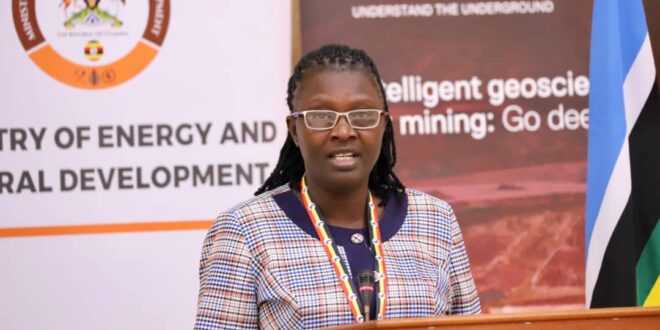
Uganda’s mining sector, long characterised by underutilisation, informality and regulatory gaps, is steadily transforming into a structured, investment-attractive and revenue-generating pillar of the economy. While the Ministry of Energy and Mineral Development (MEMD) continues to navigate institutional and operational headwinds, the trajectory of the Mines Department under Commissioner Agnes Alaba reflects a sector gaining coherence, credibility and measurable growth.
At the centre of this transformation is a deliberate shift from fragmented, manual systems to a modernised, policy-driven and digitally anchored mining ecosystem—one in which Alaba’s leadership has become increasingly visible, even within a broader institutional framework.
Digital Revolution And Regulatory Overhaul: Laying The Foundation
One of the most consequential reforms under the Mines Department has been the transition from a manual licensing regime to a fully digitised mineral licensing system. Introduced around 2019 and continuously upgraded, the system now places Uganda among a select group of African countries where mineral processes are fully conducted online. This reform has not only enhanced transparency and efficiency but has also drawn benchmarking interest from countries such as Botswana, Namibia and Kenya.
Complementing this digital leap is an extensive legal and regulatory overhaul. The enactment of the Mining and Minerals Act, 2022, replacing the outdated 2003 law, marked a structural reset for the sector. This has since been operationalised through the Mining and Minerals Regulations, 2023 and a series of specialised regulations governing exports, artisanal mining, mineral purity standards and international compliance frameworks.
Under Alaba’s stewardship, the regulatory architecture has expanded to include stringent export standards, such as 99.99% purity for refined gold and 99.85% for tin, signalling Uganda’s intent to compete on quality in global mineral markets.
Production Surge And Revenue Growth: Numbers That Tell The Story
Beyond policy, the sector’s performance indicators reveal tangible growth:
Iron ore production, for instance, surged dramatically from 15,000 tonnes in FY 2020/21 to 328,566 tonnes in FY 2024/25, underscoring a more than twenty-fold increase within just four years. This sharp rise reflects both increased investment and improved regulatory clarity.
Equally significant is the growth in Non-Tax Revenue (NTR) from the mining sector, which climbed from UGX 12 billion in FY 2020/21 to UGX 39 billion in FY 2024/25. This near tripling of revenue highlights the sector’s expanding contribution to national coffers, positioning mining as an increasingly strategic fiscal component.
While these figures do not yet place mining among Uganda’s top revenue earners, they mark a decisive departure from its historically marginal role.
Value Addition Drive: Ending The Era Of Raw Exports
A defining policy thrust under the current leadership has been the aggressive promotion of mineral value addition. Recognising that raw mineral exports yield limited economic benefit, the Ministry has championed downstream processing across a range of minerals including gold, tin, limestone, marble and iron ore.
This shift is already visible in several flagship projects:
The Wagagai gold refinery in Busia, capable of processing 5,000 tonnes of ore daily and producing up to 1.2 tonnes of refined gold annually at 99.9% purity.
Tin smelting by Woodcross Resources in Mbarara, producing up to 1,000 tonnes of high-grade tin annually, with over 230 tonnes already exported at 99.85% purity.
Expansion of cement manufacturing capacity from just two plants to six clinker and cement plants across the country.
Steel production initiatives by Tembo Steel and Abyssinia Group, transforming local iron ore into finished products for domestic use and export.
Through these initiatives, the sector is gradually embedding itself into Uganda’s broader industrialisation agenda—a process Alaba has consistently emphasised through policy guidance and regulatory enforcement.
Institutional Innovations: Building For The Future
Perhaps one of the most strategic developments is the establishment of the Uganda National Mining Company (UNMC), designed to give government up to a 15% equity stake in major mining operations. This move signals a shift towards resource nationalism balanced with investor participation.
In parallel, the Ministry has invested in mineral beneficiation and training centres in Ntungamo and Kabarole, aimed at equipping artisanal miners with value addition skills while formalising operations closer to the grassroots.
The formalisation of artisanal and small-scale mining (ASM) has also gained momentum, with over 8,300 miners biometrically registered. This not only enhances traceability but also integrates a previously informal segment into the formal economy.
Enforcement And Sector Discipline: Restoring Order
A critical, though less celebrated, aspect of the sector’s progress has been the tightening of compliance and enforcement. Through the Mineral Protection Police Unit and targeted operations, the Ministry has intensified its crackdown on illegal mining and smuggling.
In FY 2024/25 alone, over 20 individuals—including foreign nationals—were prosecuted, with equipment confiscated. Such actions, while controversial in some quarters, are part of a broader effort to sanitise the sector and build investor confidence.
Attracting Global Confidence: From Obscurity To Opportunity
The cumulative effect of these reforms is a growing level of international trust in Uganda’s mining sector. The country is increasingly attracting reputable global players and initiatives such as PanAfGeo, a pan-African geoscience programme, which signals renewed confidence in Uganda’s geological data systems and governance frameworks.
This marks a stark contrast to earlier years, when regulatory opacity and weak enforcement deterred serious investors.
Today, Uganda is positioning itself not merely as a mineral-rich country, but as a reliable mining jurisdiction—a transformation that owes much to consistent institutional leadership within the Mines Department.
Challenges And The Road Ahead
Despite these gains, challenges persist, most notably inadequate funding for critical infrastructure, monitoring systems and sector-wide inspections. The ambitious pipeline of reforms, including a national mineral database, digital production monitoring systems and regulated mineral markets, will require sustained financial and political support.
Yet, even within these constraints, the sector’s direction is unmistakable.
While the achievements of Uganda’s mining sector are undeniably institutional, Commissioner Agnes Alaba’s role in steering policy implementation, regulatory expansion and operational reforms has been central.
Her leadership, together with her robust team of experts, reflects a blend of technocratic precision and strategic vision—visible not in isolation, but through the coherence and momentum of the sector itself.
From a largely informal and underperforming industry to an emerging contributor to national revenue and industrial growth, Uganda’s mining sector is no longer on the periphery. It is, increasingly, at the core of the country’s economic future.
Winston Churchill was right, Uganda 🇺🇬, is indeed, the Pearl of Africa. Whenever you turn your eyes, you see wealth that’s yet to be tapped to fullest.
, https://www.spyuganda.com/from-turbulence-to-traction-how-commissioner-agnes-alaba-is-steering-ugandas-mining-sector-into-a-new-era-of-growth/