Kampala, Uganda — For several years, the Ministry of Energy and Mineral Development (MEMD) has consistently assured the public of fuel price stability, citing improved supply chains, regional cooperation, and regulatory oversight. In urban centres such as Kampala, these assurances often appear credible, with pump prices fluctuating within a relatively predictable range. Yet beyond the capital, particularly in secondary towns and rural trading centres, a different narrative is unfolding one that raises critical questions about distribution equity, market conduct, and regulatory enforcement.
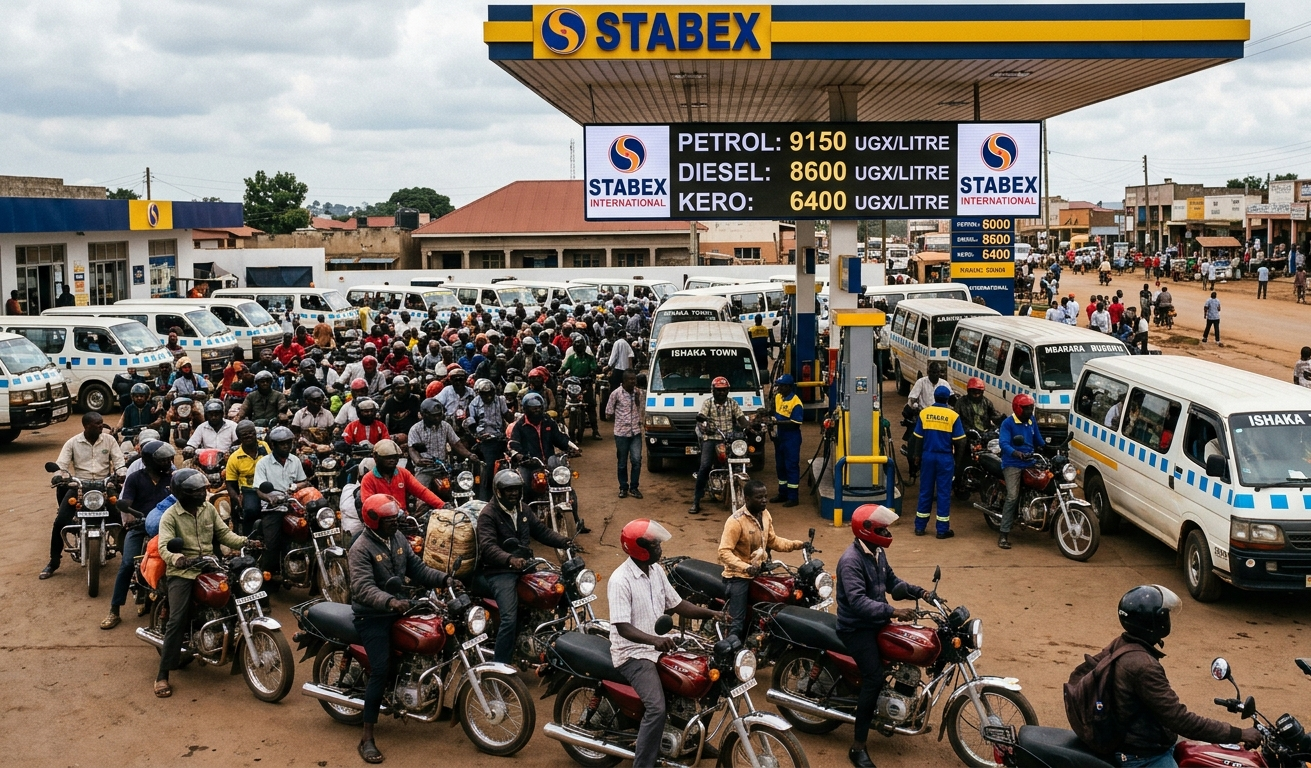
In Ishaka, a growing commercial hub in western Uganda, fuel prices tell a more complex story. At several stations surveyed, pump prices reportedly range between UGX 6,000 and UGX 10,000 per litre, depending on location and operator. This variation is not only significant but also difficult to reconcile with official messaging around price stability. For transport operators, particularly boda boda riders who rely on daily fuel purchases, such unpredictability directly affects livelihoods, fares, and mobility within the local economy.
Observations from the ground further complicate the picture. At one fuel station, a visibly inactive display board while pumps continued to operate suggested a lack of transparency in pricing. Long queues of motorcycles, commonly known as boda bodas, formed at the station, indicating either a localized shortage or anticipation of one. In such environments, consumer behavior often shifts from routine purchasing to urgency-driven demand, amplifying pressure on already constrained supply points. Globally, fuel pricing remains sensitive to geopolitical developments. The recent tensions involving Iran, for instance, prompted forecasts of rising global oil prices due to supply disruptions. While some markets experienced temporary increases, others stabilized following ceasefire developments. However, Uganda’s experience illustrates a familiar structural challenge: global price movements do not always translate uniformly at the local level. Instead, domestic factors logistics, storage capacity, and market practices play a decisive role in determining what consumers ultimately pay.
One concern raised by market observers is the possibility of artificial scarcity. In loosely regulated environments, some distributors may withhold supply to create the perception of shortage, thereby justifying price increases. While such practices are difficult to verify without formal investigation, their impact on public confidence is immediate. When consumers perceive that prices are influenced not only by global trends but also by opportunistic behavior, trust in the market begins to erode. The issue, therefore, extends beyond price fluctuations. It speaks to the broader question of how effectively regulatory frameworks are enforced across the country. MEMD, alongside other relevant agencies, has the mandate to ensure fair pricing, consistent supply, and transparency in fuel distribution. Yet disparities between urban and rural markets suggest that enforcement may be uneven, allowing localized distortions to persist.
Infrastructure also plays a role. Transportation costs, distance from supply depots, and road conditions can legitimately influence pump prices in remote areas. However, when price differences become excessive or erratic, they signal the need for closer scrutiny. A well-functioning fuel market should reflect both global realities and domestic efficiencies not unpredictable variations that disadvantage certain regions.
For policymakers, this moment presents an opportunity to strengthen oversight mechanisms. Enhanced monitoring of fuel stations, real-time price tracking systems, and clearer communication channels with consumers could help bridge the information gap. Equally important is collaboration with private sector actors to ensure that distribution networks operate transparently and competitively. For citizens, particularly those outside major cities, the issue is not abstract. Fuel prices shape the cost of transport, goods, and essential services. When prices rise unpredictably, the ripple effects are felt across households and small businesses, reinforcing regional inequalities.
Uganda’s aspiration for economic stability and inclusive growth depends, in part, on how such everyday challenges are addressed. Fuel, as a critical input in nearly every sector, occupies a central place in that equation. Ensuring its affordability and accessibility is not merely a technical task it is a governance imperative. As the country continues to navigate global energy dynamics and domestic market pressures, consistency between policy promises and lived realities will remain key. Because in the end, stability is not measured in statements it is measured at the pump.