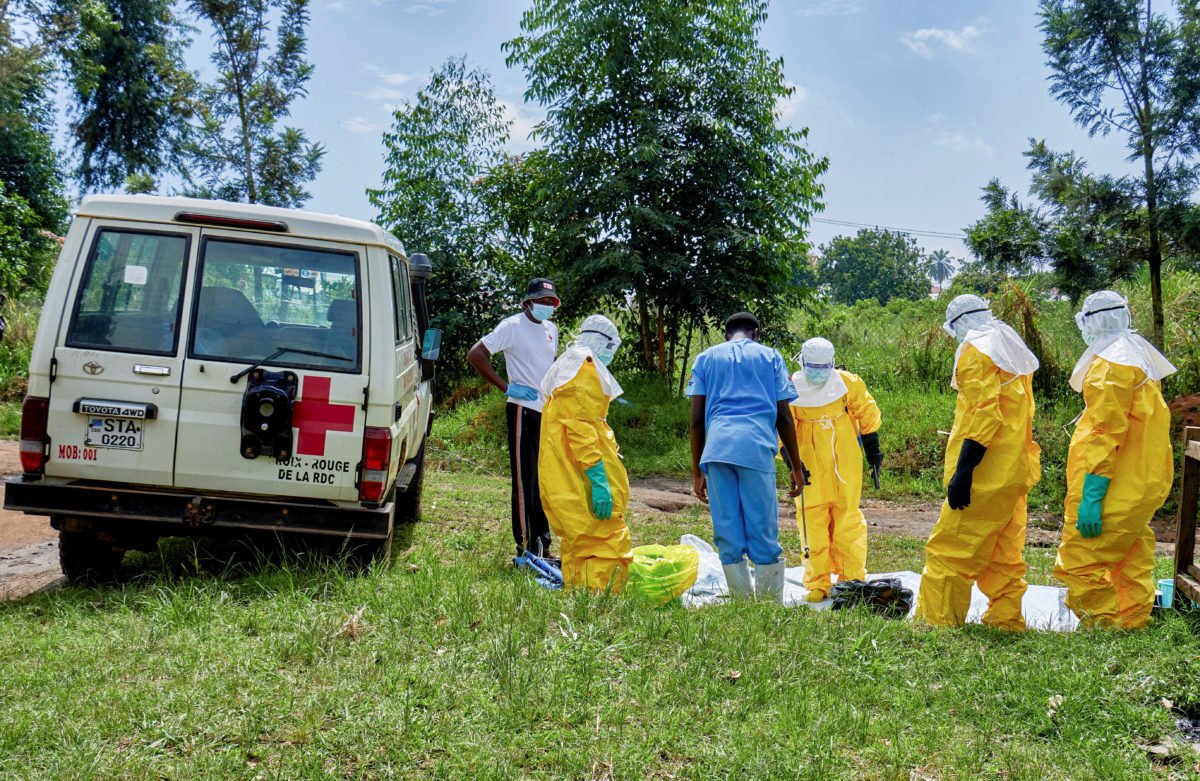
Red Cross workers prepare to handle the body of a person who died of Ebola, as aid agencies intensify efforts to contain a new Ebola outbreak involving the Bundibugyo strain, at the Centre Medical Evangelique (CME) in Hoho commune of Bunia, Ituri province, Democratic Republic of Congo, May 21, 2026. REUTERS/Gradel Muyisa Mumbere
Ituri & North Kivu, DR Congo — As health authorities continue efforts to contain the Ebola outbreak in eastern Democratic Republic of Congo, residents in the heavily affected provinces of Ituri and North Kivu say the crisis is being compounded not only by delayed response systems, but also by the rapid spread of misinformation and growing public complacency toward preventive health measures.
Across several communities, local concerns increasingly point to a dangerous combination of fear, confusion, and distrust that is undermining containment efforts at a critical stage of the outbreak. While medical teams continue surveillance, treatment, and awareness campaigns, many residents report that false information circulating within communities has weakened public cooperation and contributed to resistance toward health guidelines. Health workers operating in outbreak zones say misinformation surrounding Ebola symptoms, treatment procedures, vaccines, and prevention measures remains one of the most persistent barriers to effective response. Rumours shared through informal networks, local conversations, and digital platforms have in some cases fueled suspicion toward healthcare workers and reinforced misconceptions about how the virus spreads.
In parallel, community leaders and residents report declining adherence to basic preventive practices, including consistent use of face masks and avoidance of high-risk contact. In crowded markets, transport hubs, and public gathering spaces, enforcement of precautionary measures appears increasingly inconsistent as sections of the population grow fatigued by prolonged health restrictions and recurring outbreaks. The situation reflects a broader challenge confronting many fragile health systems globally: epidemic management depends not only on medical infrastructure, but also on sustained public trust and behavioural cooperation. In regions where communities already face insecurity, poverty, displacement, and weak access to healthcare, maintaining confidence in official health messaging becomes significantly more difficult.
Eastern DR Congo has for years remained vulnerable to overlapping humanitarian crises, including armed conflict, population displacement, food insecurity, and limited public infrastructure. These pressures have contributed to deep institutional mistrust in some communities, creating fertile ground for misinformation during health emergencies. The public fatigue is becoming an increasingly important dimension of outbreak management. After repeated exposure to epidemics, conflict, and emergency interventions, sections of the population may begin normalising risk or disengaging from prevention campaigns altogether. In such environments, compliance with public health measures often weakens over time, especially where daily survival pressures take precedence over long-term health concerns.
The challenge is particularly complex in densely populated and economically vulnerable communities where informal economic activity dominates everyday life. For many residents, avoiding crowded spaces or limiting physical interaction is often impractical due to dependence on local markets, transport systems, and face-to-face trade for income generation. At the same time, inconsistent messaging from different actors can further erode public confidence. Health communication specialists have repeatedly emphasized that outbreak response strategies must prioritize clarity, cultural sensitivity, and community engagement rather than relying solely on top-down directives. Where communication gaps persist, misinformation frequently fills the vacuum.
The concerns emerging from Ituri and North Kivu also highlight the growing influence of digital misinformation during public health crises across Africa. False claims regarding disease origins, vaccines, or treatment protocols can spread rapidly through social media and local communication networks, often outpacing verified information from official institutions. Public health experts argue that combating misinformation now requires approaches extending beyond traditional awareness campaigns. Greater investment is increasingly needed in local-language communication, grassroots engagement, trusted community ambassadors, and partnerships with religious and civic leaders capable of influencing public behaviour at community level.
Importantly, the Ebola outbreak is unfolding within a region already experiencing security instability, making response coordination even more difficult. Humanitarian workers and medical teams often operate under constrained conditions, balancing disease containment with logistical challenges and safety concerns. The evolving situation in eastern DR Congo therefore serves as a reminder that epidemic response is ultimately as much a social challenge as it is a medical one. Vaccines, treatment centres, and surveillance systems remain essential, but their effectiveness depends heavily on whether communities trust institutions enough to participate fully in prevention efforts.
As authorities continue containment operations, the immediate priority extends beyond reducing infection rates alone. Restoring public confidence, countering misinformation, and rebuilding cooperation between communities and health institutions may prove equally decisive in preventing the outbreak from deepening further. In fragile environments where uncertainty already shapes daily life, public trust becomes one of the most valuable and vulnerable tools in managing any health emergency.