 pressug.com News 24 7

Related Articles
When Yoweri Kaguta Museveni first emerged from the bush in January 1986, Uganda was exhausted by coups, economic collapse and years of violent political instability.
At 41, he looked nothing like the ageing strongmen who dominated African politics at the time. He spoke the language of “fundamental change,” discipline and generational renewal.
To many Western governments, he and Rwandan President Paul Kagame represented part of a “new breed” of African leaders: younger, pragmatic and reform-oriented. Forty years later, the math surrounding Museveni’s presidency tells a profoundly different story.
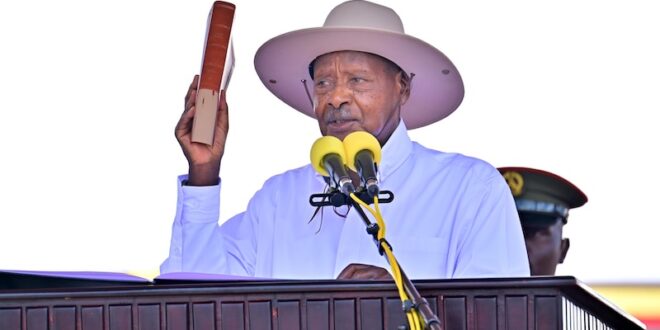
On May 12, 2026, at Kololo Ceremonial Grounds, Museveni took the oath for a seventh elective term at the age of 81 years and nine months. The symbolism of that moment stretches far beyond Uganda’s borders.
It places Museveni among the continent’s oldest-serving leaders and firmly within a shrinking political category often referred to as Africa’s “octogenarian club.” But perhaps the more revealing number is not his age alone.
It is the 65-year gap between Museveni and the median or average Ugandan citizen. Uganda is one of the youngest countries in the world, with a median age of about 16.7 years.
Most Ugandans have lived their entire lives under one president. For millions born after the 1990s, Museveni is not simply a historical figure or liberation leader. He is the permanent fixture of the state itself, the only commander-in-chief, the only dominant political voice, the only national authority they have ever known.
This is what makes the May 12 inauguration more than a ceremonial event. It has become a living study in political longevity, demographic tension and the evolving meaning of power in modern Africa.
The contrast between the Museveni of 1986 and the Museveni of 2026 is striking. Back then, his youth was key to his political identity. Compared to leaders such as Milton Obote and Tito Okello, Museveni represented a generational shift.
Across Africa, many liberation-era presidents were already elderly or deeply entrenched. Museveni, alongside figures like Rwanda’s Paul Kagame, was viewed internationally as part of a younger reformist generation.
Today, Museveni himself belongs to the very category of long-serving rulers he once implicitly challenged. The numbers underline how exceptional his political survival has become.
This May, 2026, Museveni’s uninterrupted rule will stand at 40 years, three months and 13 days. In post-colonial Africa, very few non- monarchical leaders have crossed the four- decade threshold while remaining in office.
Only Cameroon’s Paul Biya and Equatorial Guinea’s Teodoro Obiang currently outrank him among serving African presidents in terms of longevity. Biya, at 93, has ruled for 43 years, while Obiang has been in power for 46 years since seizing office in 1979.
Museveni now occupies third place among Africa’s longest- serving active presidents. That ranking carries both prestige and political unease. For supporters, Museveni’s longevity symbolises continuity, stability and regional experience in a volatile part of Africa. Uganda under Museveni has avoided the military coups and state collapses that devastated parts of the continent over the past four decades.
His government positions him as a strategic regional power broker involved in mediation efforts in South Sudan, eastern Congo and Somalia. There is also a practical argument often advanced by his allies: few African leaders possess Museveni’s institutional memory or geopolitical relationships accumulated across four decades of leadership.
But longevity creates another reality, too. The longer political systems revolve around one individual, the more national institutions begin to mirror that permanence. Succession becomes uncertain. Generational transition slows.
Political competition increasingly centres around continuity versus change rather than ideological alternatives. This is where the demographic gap becomes politically significant. Uganda’s youthful population has grown up in a radically different world from the one that shaped Museveni’s political instincts.
The president belongs to a generation shaped by liberation wars, ideological struggles, and post- independence state collapse. Much of Uganda’s younger population, however, is shaped by urbanisation, digital culture, unemployment pressures and rising demands for representation.
The tension between those two political realities has increasingly defined Uganda’s recent election cycles. This “representation gap,” a widening distance between a young, digitally connected population and a leadership structure rooted in historical liberation legitimacy, is the primary driver of the political friction seen in recent election cycles, as the aspirations.
That tension is no longer abstract. It influences debates around governance, succession, economic opportunity and political participation. It also partly explains why questions surrounding the future of Uganda’s leadership increasingly dominate both domestic and international conversations.
In diplomatic and investor circles, attention is already shifting toward what some analysts describe as “succession math.” The growing visibility of General Muhoozi Kainerugaba, Museveni’s son, has intensified speculation over the long-term direction of Uganda’s political transition.
Yet despite these questions, Museveni’s political resilience remains difficult to dismiss. Few leaders anywhere in the world have managed to maintain authority across such dramatically different historical periods: from Cold War politics to the digital age, from structural adjustment reforms to social media-era opposition movements.
That endurance itself has become one of the defining features of Uganda’s modern political identity. Still, longevity carries philosophical contradictions. One of Museveni’s most quoted statements from 1986 warned that “the problem of Africa in general and Uganda in particular is not the people but leaders who want to overstay in power.”
Four decades later, that quote has returned repeatedly in public debate, often reframed as both prophecy and irony. Whether Uganda’s 40-year milestone is viewed as evidence of stability or as a delayed political transition depends heavily on perspective, generation and political alignment.
But one reality is increasingly undeniable. Museveni is no longer simply a participant in Uganda’s history. He has become one of the central structures through which that history itself is now understood.
And for a country where most citizens are too young to remember any life before his presidency, the deeper national question may no longer be how Museveni shaped Uganda, but how Uganda eventually imagines itself beyond him.
Related
, https://observer.ug/news/museveni-at-81-ugandas-40-year-political-paradox/