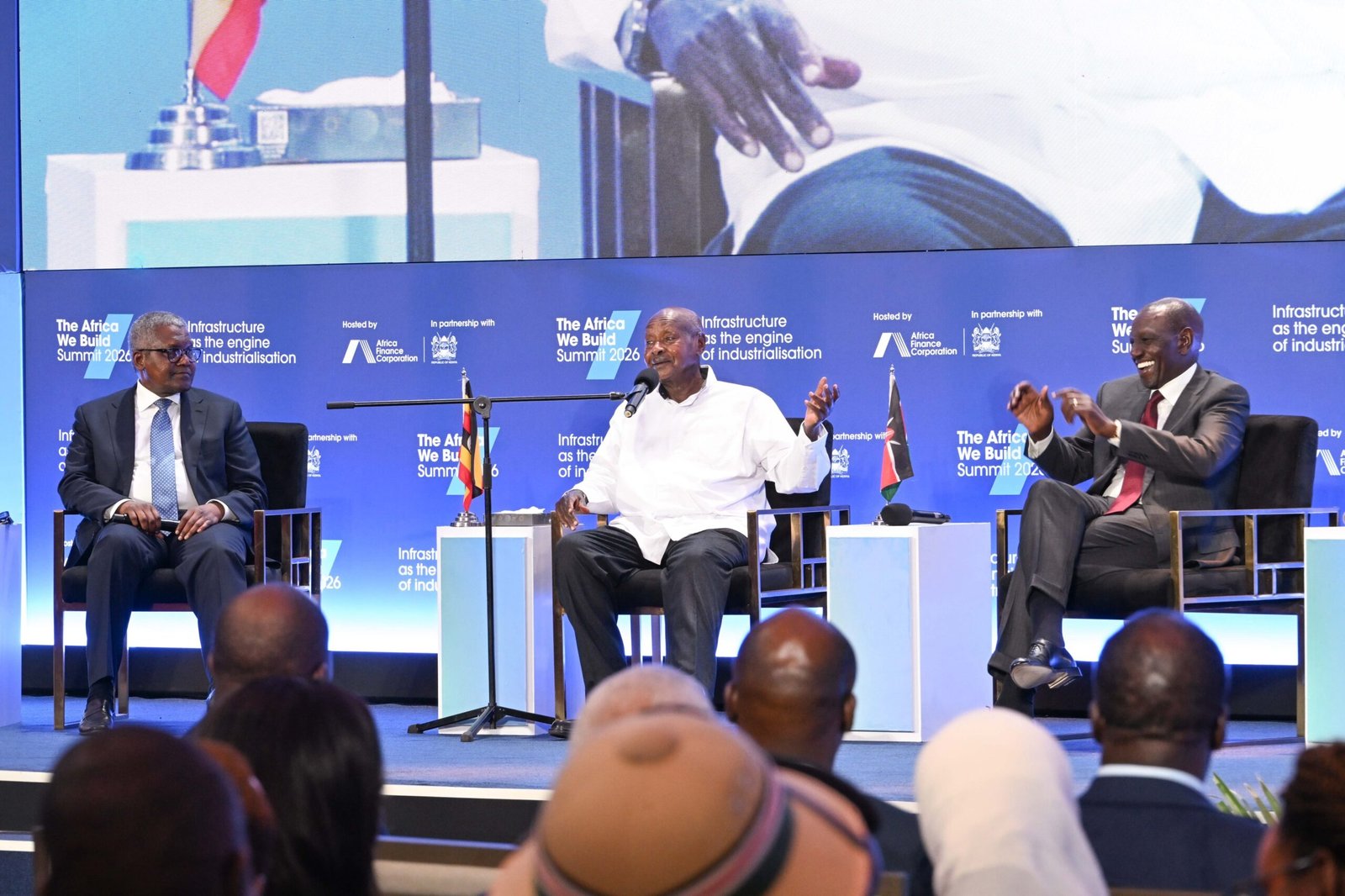
Nairobi, Kenya — President Yoweri Kaguta Museveni has called for a fundamental shift in Africa’s development approach, urging leaders to confront what he described as the continent’s “ideological disorientation” as a primary barrier to transformation. Speaking upon arrival in Nairobi for the Africa We Build Summit 2026, Museveni framed Africa’s challenges not as a shortage of capital, but as a question of strategic clarity and coordinated action.
The summit, convened with support from the Africa Finance Corporation and hosted under the leadership of William Ruto, has drawn policymakers, investors, and private sector leaders from across the continent and beyond. Its focus is practical: shifting Africa’s infrastructure agenda from planning to execution, and unlocking pathways for sustainable socio-economic growth.
In his remarks, Museveni expressed appreciation to both President Ruto and the Africa Finance Corporation for what he described as “speaking the language of revolution” a reference to a development philosophy grounded in structural transformation rather than incremental change. He noted that while Africa’s combined GDP stands at approximately $3.6 trillion, the figure does not reflect the continent’s vast natural resources, youthful population, and strategic potential.
Drawing comparisons with countries such as China, Museveni argued that historical poverty does not predetermine future outcomes. Instead, he pointed to discipline, ideological consistency, and long-term investment as the drivers behind successful economic transitions. For Africa, he suggested, the path forward lies in addressing systemic constraints that continue to limit growth and integration. Central to his argument was the need to move beyond fragmented national approaches. Museveni emphasized that many African economies continue to operate in isolation, despite shared challenges and opportunities. This fragmentation, he noted, weakens bargaining power, limits market size, and slows industrialization. Regional cooperation frameworks, particularly those under the East African Community, were highlighted as critical platforms for building larger, more competitive economic blocs.
He identified several strategic bottlenecks that must be addressed collectively: ideological misalignment, weak state institutions, limited value addition, inadequate infrastructure, and gaps in human capital development. Without resolving these interconnected issues, he cautioned, Africa risks underutilizing its potential despite ongoing investments. Infrastructure development featured prominently in his intervention. From transport corridors and energy systems to digital connectivity, Museveni stressed that infrastructure is not merely a support function but a catalyst for industrial growth and regional integration. However, he underscored that infrastructure must be linked to production, particularly in sectors such as agriculture, manufacturing, and mineral processing, to generate sustainable value.
The Africa We Build Summit provides a platform for aligning these priorities with financing and implementation mechanisms. Discussions are expected to focus on public-private partnerships, innovative financing models, and policy reforms aimed at accelerating project delivery. For many participants, the challenge is not identifying priorities, but ensuring that projects move beyond feasibility studies into tangible outcomes. Museveni’s participation reflects Uganda’s broader commitment to economic and commercial diplomacy, where infrastructure, trade, and investment are positioned as pillars of national and regional transformation. His call for ideological clarity resonates within a wider continental debate about how Africa defines its development trajectory in a rapidly changing global economy.
As engagements at the summit continue, the emphasis is likely to remain on collaboration between governments, financial institutions, and private investors. The convergence of these actors signals a growing recognition that Africa’s development challenges require coordinated, cross-sector solutions. For Museveni, the message is consistent: Africa’s future will not be determined solely by resources or external support, but by the choices its leaders make in aligning vision with action. If the continent can overcome fragmentation and invest strategically in its people and infrastructure, he suggested, it holds the capacity to redefine its position in the global economy. The summit in Nairobi, therefore, is not only a meeting of stakeholders, but a test of whether Africa can translate ambition into implementation and rhetoric into results.