 pressug.com News 24 7

Related Articles



Viewers: 120,003
By Andrew Irumba
Kampala: SpekeResort Munyonyo is hosting a high-level Kampala Mineral Markets Consultative Workshop where the Ministry of Energy and Mineral Development (MEMD) unveiled sweeping reforms targeting Uganda’s lucrative but largely informal mineral trade sector, including proposals to criminalise mineral negotiations and gold transactions conducted in hotels, balconies and other ungazetted locations.
The two-day consultative engagement, organised by the Mines Department under MEMD, started Thursday and ends tomorrow Friday, bringing together mineral dealers, investors, refiners, exporters, policymakers and sector regulators to deliberate on the draft Mining and Minerals Regulations 2026.
The workshop follows a similar engagement held last week in Busia, one of Uganda’s busiest mineral trading corridors.
The consultative meeting was officiated by the Permanent Secretary of MEMD, Eng. Irene Pauline Bateebe, who underscored government’s determination to formalise Uganda’s mineral trade chain and restore investor confidence amid escalating cases of mineral fraud.
Under the proposed reforms, government seeks to establish gazetted mineral markets and mineral buying centres where all mineral transactions, negotiations and exports will legally occur under state supervision.
Officials revealed that if the proposed regulations are passed into law, conducting mineral business negotiations outside designated government-approved centres could become a criminal offence.
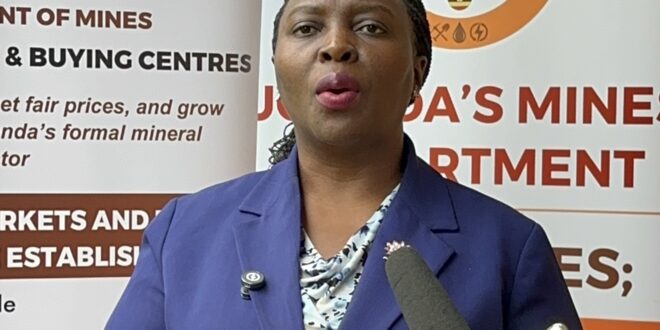
According to Loyola Karobwa, MEMD’s Senior legal officer, informal hotel-based gold negotiations have increasingly become hotspots for fake gold scams, money laundering, illicit mineral exports and investor fraud.
Several foreign investors have reportedly lost millions of dollars through fraudulent gold transactions orchestrated in hotels, apartments and ungazetted trading spaces across Kampala and border towns.
MEMD officials say the proposed mineral markets are intended to create transparent, traceable and secure trading environments.
One of the presentation slides seen during the workshop indicated that the mineral market framework seeks to:
• Attract investment through fair pricing, transparency and reduced fraud risks.
• Protect miners, traders and investors from exploitation and illicit financial flows.
• Promote predictable mineral markets, local processing and value addition to increase national economic benefits.
Another draft provision defines a “mineral market” as a designated area established for buying, selling and formal trading of minerals strategically located near refineries, export points and industrial zones.
The proposed mineral buying centres, meanwhile, would be established closer to mining sites to streamline mineral collection, traceability and compliance monitoring.
Government also intends to integrate traceability systems aligned with regional and international standards, including ICGLR regulations and OECD due diligence guidelines.
Uganda’s Mining Sector Expanding Rapidly
The reforms come at a time when Uganda’s mining sector is witnessing accelerated growth, particularly in gold exports.
According to Bank of Uganda and Ministry of Finance data, mineral exports surpassed USD 3 billion in the Financial Year 2023/2024, with gold accounting for the overwhelming share of export earnings.
The mining and quarrying sector currently contributes between 2% and 3% to Uganda’s Gross Domestic Product (GDP), although analysts believe the actual contribution could be much higher due to widespread informal operations and unregulated exports.
Government geological surveys estimate that Uganda possesses over 27 million metric tonnes of gold ore deposits and approximately 320 million metric tonnes of iron ore reserves, alongside commercially viable deposits of copper, cobalt, phosphates, rare earth elements, limestone, wolfram and tin.
The sector supports hundreds of thousands of livelihoods, especially among artisanal and small-scale miners operating in districts such as Mubende, Kassanda, Busia, Karamoja, Buhweju and Namayingo.
Despite its vast potential, officials say Uganda continues to lose substantial revenues through smuggling, under-declaration and illicit mineral trade networks.
Participants at the Munyonyo workshop heard that the proposed mineral markets and buying centres are expected to enhance revenue mobilisation, improve mineral traceability, strengthen compliance enforcement and curb financial leakages.
The ongoing consultations are part of efforts to operationalise the Mining and Minerals Act 2022 through detailed regulations expected to take effect in 2026.
While some stakeholders welcomed the reforms as long overdue, others raised concerns regarding accessibility of the proposed buying centres and the possible impact on small-scale traders.
Nevertheless, MEMD insists that formalisation is essential if Uganda is to position itself as a credible and globally competitive mineral trading hub free from fraud, illicit transactions and investor exploitation.
, https://www.spyuganda.com/speke-resort-hosts-high-level-kampala-mineral-markets-consultative-workshop-as-govt-moves-to-ban-hotel-gold-deals/