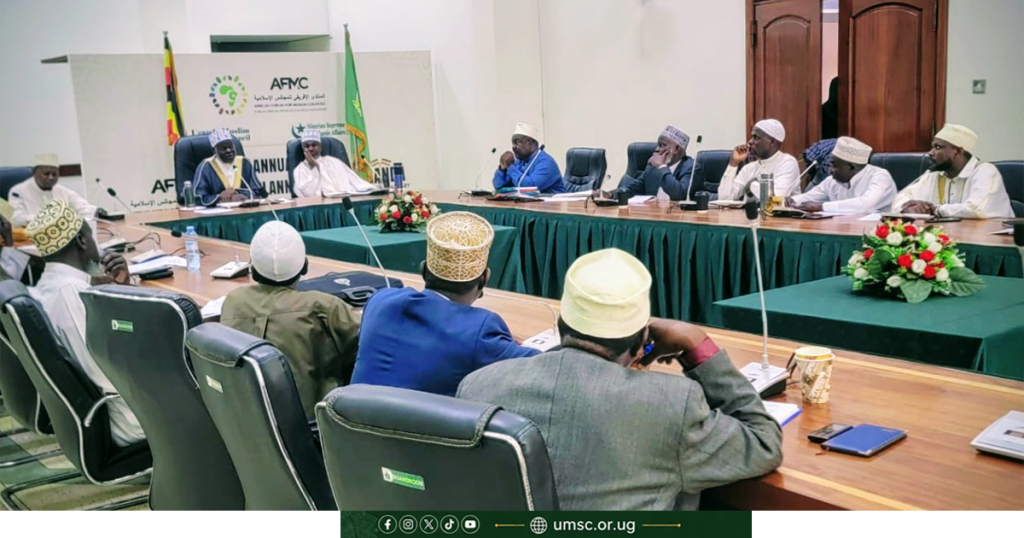
Kampala, Uganda — The Uganda Muslim Supreme Council (UMSC) has taken decisive administrative and policy steps following a Joint Session that brought together its Executive Committee and the Majlis Al-Ulaam, setting the stage for governance reforms and institutional continuity ahead of the forthcoming General Assembly. The high-level meeting, held on Sunday, May 3, 2026, at the UMSC Headquarters in Old Kampala, resolved to fill critical vacancies, approve strategic transfers within the religious administrative structure, and define priority agenda items for deliberation at the next sitting of the General Assembly the Council’s supreme legislative organ.
At the core of the Joint Session’s resolutions was the imperative to ensure continuity in leadership and operational efficiency. The session formally acknowledged the cessation of membership of Hon. Hussein Lukyamuzi from the Executive Committee due to prolonged absence since 2022, in accordance with governance expectations on participation and accountability. To address existing gaps, the session approved key appointments within the Majlis Al-Ulaam. Isa Twahir Walugumba was appointed to succeed the late Sheikh Hussein Walugumba as a representative of Busoga, while Saad Habib Kaweesi was appointed to replace the late Sheikh Twaha Tamale as Kampala’s representative. These appointments reflect a structured approach to leadership succession, ensuring that regional representation within the Council remains intact while preserving institutional memory.
Beyond leadership replacements, the Joint Session approved a series of transfers affecting Regional Assistants to the Mufti (RAMs) and District Kadhis. The reassignments, both across Muslim regions and within districts, are designed to enhance service delivery, improve administrative coordination, and respond to evolving community needs. In policy terms, such transfers signal a shift toward a more dynamic and responsive governance model within UMSC one that prioritizes efficiency, equity in service provision, and optimal utilization of human capital across regions. Importantly, the session also resolved to mandate the Mufti to appoint qualified Sheikhs to serve as Kadhis in districts where such capacity is lacking. This decision, grounded in the provisions of the UMSC Constitution, addresses long-standing gaps in judicial and religious leadership at the grassroots level.
The resolutions of the Joint Session are anchored in the broader framework of the UMSC Constitution, reinforcing the Council’s commitment to rule-based governance. By adhering to constitutional provisions in appointments and administrative restructuring, UMSC strengthens institutional legitimacy while minimizing governance disputes. The decisions are, however, subject to ratification by the General Assembly an inclusive body representing Muslim communities across all ten regions of Uganda. This layered approval process reflects a governance model that balances executive efficiency with representative oversight.
The session was chaired by Hon. Haj Muzamir Abon, Deputy National Chairperson, who represented the National Chairperson, Muhammad Lubega Kisambira. The Chairperson was reportedly engaged in attending to a family medical emergency. Also in attendance were senior religious and administrative leaders, including His Eminence Shaban Ramadhan Mubaje, the Mufti of Uganda; His Eminence Muhammad Ali Waiswa; and His Eminence Hafiz Muhammad Harunah Bukenya, alongside the Secretary General, Abbas Muluubya Ssekyanzi, and other key officials. Their presence underscored the institutional weight of the meeting and the importance attached to the resolutions passed.
The outcomes of the Joint Session carry broader implications for religious governance and institutional management within Uganda. By prioritizing structured appointments, strategic transfers, and constitutional compliance, UMSC is reinforcing a governance culture that aligns with modern organizational standards while remaining rooted in faith-based leadership principles. Such reforms are particularly significant in a context where religious institutions play a central role in community cohesion, social service delivery, and moral guidance. Strengthened administrative systems within UMSC can therefore translate into more effective engagement with Muslim communities nationwide.
Attention now shifts to the upcoming General Assembly, where these resolutions will be presented for ratification. The Assembly is expected to deliberate on governance reforms, administrative restructuring, and broader policy directions aimed at strengthening the Council’s institutional capacity. As UMSC advances toward this critical meeting, the Joint Session’s decisions provide a clear indication of its strategic priorities: continuity, accountability, and service delivery. In a rapidly evolving socio-religious landscape, such policy-driven approaches may prove essential in ensuring that the Council remains responsive, representative, and resilient.