 pressug.com News 24 7

Related Articles


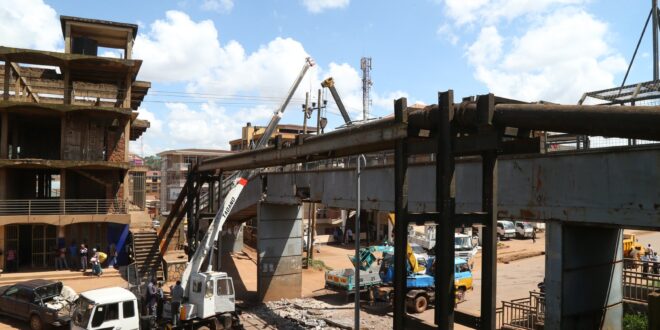
Kampala, Uganda — In fast-growing cities, infrastructure rarely fails all at once. It fades—quietly at first—until the moment it becomes impossible to ignore. The pedestrian footbridge that once spanned Queensway Kampala, linking Katwe to Nsambya, is a case in point. Brought down on 13 May 2018 after being declared structurally unsafe, it had served the public for over two decades. Its removal was justified on safety grounds. Its replacement, however, remains unseen years later. At the time, Kampala Capital City Authority assured the public that a new structure would be installed “as soon as possible.” In the interim, a zebra crossing was announced to be designated to facilitate pedestrian movement, accompanied by guidance under the Traffic and Road Safety Act requiring motorists to slow down. On paper, this was a reasonable contingency. In practice, it has proven insufficient.
Queensway remains one of the city’s busy corridors, carrying a mix of private vehicles, commercial traffic, and public transport. The communities of Katwe, Makindye and Nsambya are densely populated, with residents crossing daily for work, school, trade, and access to services. A painted crossing, however visible, cannot replicate the safety of grade-separated infrastructure in such an environment. The result is a daily negotiation between pedestrians and traffic one where risk is normalized. The persistence of this gap raises a broader question: how should cities manage essential infrastructure when removal becomes necessary? Kampala is not alone in facing such dilemmas, across rapidly urbanizing regions, authorities are often forced to balance immediate safety concerns with long-term planning constraints. Yet what distinguishes resilient cities is not the absence of failure, but the presence of continuity. When infrastructure is removed, alternatives temporary or permanent are expected to follow within a clear, communicated timeline.
In Katwe, that continuity has been less visible, as residents and commuters now ask whether the city was prepared to dismantle aging infrastructure without first securing viable replacements. The concern extends beyond this single location. Other pedestrian crossings, including those in high-traffic areas such as Nakawa, have also shown signs of wear. The question being posed is both practical and urgent: are we waiting for structures to fail before acting, or planning proactively to prevent disruption? Urban mobility cannot function effectively in a cycle of reaction.
A city’s transport system is an ecosystem, roads, crossings, sidewalks, and public transit networks are interdependent. When one element is removed without adequate substitution, pressure shifts to others often in ways that compromise safety. In this case, the burden has shifted to pedestrians, who must navigate high-speed traffic with limited protection. There is also a governance dimension to consider. Infrastructure projects require not only technical design but also budgeting, procurement, and coordination across agencies. Delays can stem from legitimate constraints funding cycles, competing priorities, or regulatory processes. However, the absence of consistent public updates risks eroding trust. When commitments are made without visible follow-through, even well-intentioned decisions come under scrutiny.
What, then, can be done?
First, transparency must become standard practice, if timelines for reconstruction have shifted, authorities should communicate the reasons clearly, alongside revised plans. Public understanding does not eliminate frustration, but it can mitigate uncertainty.
Second, interim solutions should match the scale of the challenge. In high-traffic corridors like Queensway, temporary pedestrian infrastructure such as signalized crossings, traffic calming measures, or modular footbridges could provide safer alternatives while permanent structures are developed.
Third, maintenance and audit systems need strengthening. Regular structural assessments of existing footbridges can identify risks early, allowing for phased rehabilitation rather than abrupt closure. This approach reduces disruption and enables better resource planning.
Finally, urban planning must anticipate growth rather than respond to it. Kampala’s expansion is not a future projection; it is a present reality. Infrastructure strategies must therefore align with projected population increases, traffic volumes, and land-use patterns. The story of the Katwe–Nsambya footbridge is not merely about a missing structure. It reflects a broader tension between urgency and preparedness in urban governance. Cities evolve, and with them, the demands placed on infrastructure. The challenge is to ensure that adaptation is deliberate rather than reactive. For the thousands who cross Queensway each day, the issue is immediate and tangible. It is about safety, time, and dignity in movement. Whether Kampala can address such gaps decisively will shape not only mobility outcomes, but also public confidence in the systems designed to support a growing city.
Post navigation
, https://dailythinkersug.com/when-a-bridge-disappears-what-katwes-missing-footbridge-says-about-urban-mobility-in-kampala/