 pressug.com News 24 7

Related Articles



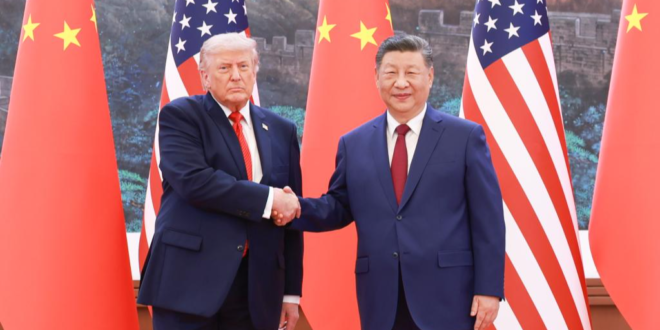
Beijing, China — When U.S. President Donald Trump departed the Chinese capital following high-level meetings with Chinese President Xi Jinping, the atmosphere surrounding the visit reflected a familiar feature of modern US–China diplomacy: carefully choreographed stability masking unresolved strategic rivalry. Held across key state venues in Beijing, including discussions linked to the Great Hall of the People and Zhongnanhai leadership compound engagements, the summit produced warm rhetoric, ceremonial symbolism, and renewed public affirmations of dialogue. Yet beneath the diplomatic optics, many of the structural tensions defining the relationship between the world’s two largest economies remain fundamentally unresolved.
The visit itself carried significant geopolitical weight. It came at a moment of heightened global uncertainty marked by tensions surrounding Taiwan, disruptions linked to the Middle East conflict, supply chain vulnerabilities, artificial intelligence competition, and an increasingly fragmented global economic order. For both Washington and Beijing, the summit was less about producing immediate breakthroughs and more about preventing further deterioration in relations. That objective alone now reflects the realities of contemporary great-power diplomacy. According to international reporting following the summit, both leaders emphasized the importance of maintaining strategic communication and avoiding direct confrontation. Xi described the meetings as a “milestone” in stabilizing bilateral ties, while Trump highlighted what he portrayed as a strong personal relationship with the Chinese leader. However, despite the cordial language, there was little evidence of substantive progress on the core disputes that continue to strain the relationship. Taiwan remains the most sensitive geopolitical flashpoint between the two powers, with Xi reportedly warning that mishandling the issue could lead to “clashes and even conflicts.”
Trade tensions also remain unresolved. Although discussions reportedly included Chinese purchases of Boeing aircraft and agricultural commodities, analysts noted the absence of broader agreements capable of addressing deeper disagreements surrounding tariffs, export controls, rare earth minerals, semiconductor restrictions, and technological competition. This reflects a broader transformation in the nature of US–China relations. The rivalry is no longer confined to trade imbalances or market access disputes alone. Increasingly, it revolves around technological supremacy, strategic influence, military positioning, and competing visions of global governance. For China, the summit offered an opportunity to project diplomatic confidence and reinforce its image as an indispensable global power capable of engaging Washington on equal footing. Some international observers interpreted the meeting as part of Beijing’s long-term effort to normalize the perception of a “G-2” international order in which the United States and China function as the world’s dominant geopolitical actors.
For the Trump administration, meanwhile, the visit appeared aimed at balancing confrontation with economic pragmatism. Despite years of tariff battles and strategic competition, the United States remains deeply economically intertwined with China. American corporations continue to view Chinese markets as commercially significant, even as political tensions intensify. This duality explains why both governments increasingly frame their relationship not in terms of partnership, but managed competition. Within the African context, the implications of the Beijing summit are particularly significant. Africa today sits at the intersection of growing US–China competition, with both powers seeking influence through infrastructure financing, technology partnerships, trade agreements, mineral access, and diplomatic engagement. China’s expanding economic footprint across Africa through the Belt and Road Initiative continues to reshape development conversations, while Washington has sought to reassert its strategic presence through renewed economic and security partnerships.
For African policymakers, the central challenge remains navigating these competing interests without becoming overly dependent on either side. The Beijing meetings therefore matter not only for Washington and Beijing, but also for emerging economies seeking stability within an increasingly polarized international system. Equally important is the symbolism surrounding the summit itself. In global diplomacy, optics often carry strategic meaning. China’s elaborate reception for Trump underscored Beijing’s preference for leader-driven diplomacy and its longstanding emphasis on state ceremony as an instrument of political messaging. Reports described grand receptions, carefully managed engagements, and highly visible demonstrations of mutual respect between the two leaders. Yet the durability of this temporary stabilization remains uncertain, the structural drivers of rivalry between the United States and China—economic competition, military positioning in Asia, technological decoupling, and ideological differences have not disappeared. Rather, they are becoming increasingly institutionalized within both countries’ long-term strategic planning.
What emerged from Beijing was therefore not a diplomatic reset, but a calibrated pause in escalation. In today’s geopolitical climate, that alone may be viewed as a significant outcome. But as both powers continue balancing cooperation with confrontation, the broader international community will be watching closely to see whether diplomatic symbolism can eventually evolve into durable strategic understanding or whether the current stability merely delays a deeper phase of global competition.
Post navigation
, https://dailythinkersug.com/trump-leaves-beijing-with-symbolism-but-strategic-questions-still-define-us-china-relations/