 pressug.com News 24 7

Related Articles



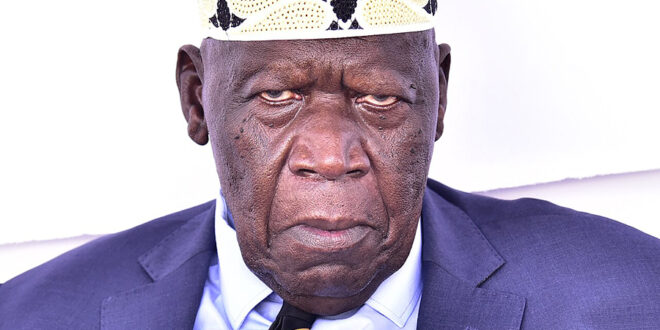
Uganda’s long political journey has produced few figures whose careers have stretched across as many eras as that of General (Rtd) Moses Ali.
A soldier, politician, author, farmer and community leader, General Ali’s life mirrored the country’s own turbulent and transformative history. For more than five decades, he occupied influential positions in the military and government, while maintaining a deep connection with the people of West Nile who regarded him as one of their most prominent sons.
The former Second Deputy Prime Minister and long-serving Member of Parliament for Adjumani West Constituency died at Nakasero Hospital in Kampala on Saturday, Jul 18, aged 87, bringing to an end the remarkable life of a man who moved from childhood hardship to the centre of Uganda’s national affairs.
Close associates confirmed that General Ali breathed his last at 4:25pm.
Njima Bob Bolt, an elder from Adjumani District, announced the death, describing him as a beloved statesman, father, uncle, brother, in-law and friend whose influence stretched beyond politics.
“My dear people of God, I would like to put the rumours straight that our beloved statesman, father, uncle, brother, in-law and friend, Rt. Hon. Alhadji Dr. Gen. (Rtd.) Moses Ali has made his last breath at 4:25pm at Nakasero Hospital Kampala,” Njima wrote.
He prayed for the departed leader, saying: “May his soul rest in the eternal glory of God the Father Almighty.”
From hardship to history
Born on April 5, 1939, in Meliaderi Village, Ataboo Parish, Pakelle Sub-county in present-day Adjumani District, Moses Ali’s early years were defined by struggle.
He lost both his parents, Wani Loke and Dusman Dore, at the age of 11, leaving his future uncertain. His survival and education depended on the support of his maternal uncle, Ramadan Wani, who took him in and ensured that he remained in school.
As a young boy, Ali worked in people’s gardens to raise money for his education. Those experiences shaped the values that would later define his public life — perseverance, self-reliance and determination.
He completed his Primary Leaving Examination at Erepi Church of Uganda Primary School in 1957 before pursuing further studies at Old Kampala Secondary School, where he obtained his General Certificate of Education.
He also studied the Quran at a Madarasa, where he later became a teacher, nurturing the discipline and faith that remained central throughout his life.
General Ali’s first major national role came through the military, where he built a reputation as a disciplined and strategic officer.
He joined the Uganda Army and steadily rose through the ranks. In 1969, he was commissioned as a Second Lieutenant and appointed Officer in Charge of Training at the Uganda Paratrooper School.
By 1971, he had attained the rank of Major and was serving as Commander of the Uganda Paratrooper School before being promoted to Colonel in 1972.
His military career placed him among a generation of officers who played significant roles during one of Uganda’s most challenging political periods.
Beyond the battlefield and military command, Ali would later transition into politics, carrying with him the discipline and organisational skills acquired during his years in uniform.
A lifetime in public service
General Ali became one of Uganda’s longest-serving public figures, holding several senior government positions and representing Adjumani West in Parliament for many years.
He served as Second Deputy Prime Minister and Deputy Leader of Government Business in Parliament, becoming a familiar figure in Uganda’s political landscape.
His longevity in public service allowed him to work with successive generations of leaders while remaining a powerful voice from West Nile.
Those who interacted with him often described him as a calm and measured leader who valued dialogue, respect and national unity.
A devout Muslim, General Ali frequently credited his achievements to faith in Allah, honesty, hard work and discipline.
For General Ali, public service was not only about holding office but also about preserving history.
In 2024, he launched his book, “The Odyssey of the Nubi: From Soldiers of the British Empire to Full Citizens in Uganda”, a work documenting the history and contribution of the Nubian community in Uganda.
The launch, held in Adjumani District, was attended by government officials and guests from Uganda and beyond. The event also marked the laying of the foundation stone for the Nubian Heritage and Cultural Centre — a project aimed at preserving Nubian culture and identity for future generations.
Years earlier, during an interview with this writer, General Ali had spoken about his desire to leave behind a written record of his life and experiences.
“I have plans already in the pipeline to write a book which will act as a legacy so that when I pass on, the young generation can still remember me and my achievements,” he said.
He eventually fulfilled that ambition, ensuring that his story became part of Uganda’s historical record.
Away from politics and military service, General Ali was also a businessman and farmer.
Through Esia Mixed Farm, he invested in agriculture and modern ranching after receiving training in Britain. The farm became an important source of support for his family and helped finance the education of his children.
But his contribution to West Nile went beyond personal enterprise.
At his home in Abiricaku Village, a community borehole drilled in 1976 continued providing water to residents for decades. He also supported schools, mosques, vulnerable families and community initiatives.
His commitment to education was particularly strong. He often described education as his greatest investment and encouraged young people to see learning as a pathway to a better future.
General Ali was survived by four wives and 30 children, many of whom attained higher education.
A legacy remembered
News of his death triggered tributes from political, military and community leaders who described him as a patriot whose contribution to Uganda would remain significant.
Captain Mike Mukula, a close friend and former legislator, mourned him as a courageous soldier, astute leader and elder statesman.
“Innā lillāhi wa innā ilayhi rājiʿūn. Indeed, we belong to Allah, and indeed to Him we shall return,” Mukula said.
He described General Ali as a leader whose life was dedicated to Uganda’s peace, unity and reconstruction.
“General Moses Ali devoted his life to the service of Uganda. His contribution to the struggle for peace, national unity, stability, and reconstruction will forever remain engraved in the history of our nation,” Mukula said.
He added that Uganda had lost one of its finest sons.
“His enduring legacy will continue to inspire future generations to serve with integrity, selflessness, and unwavering love for country,” he said.
From an orphaned child in rural Adjumani to a decorated general, cabinet minister, parliamentarian and author, Moses Ali’s life represented one of Uganda’s most extraordinary journeys.
He leaves behind a legacy built on military discipline, political endurance, community service and a determination to ensure that history would remember him.
, https://nilepost.co.ug/news/357425/the-orphaned-village-boy-who-rose-to-become-a-soldier-statesman-and-guardian-of-history