 pressug.com News 24 7

Related Articles


Viewers: 90,000
By Spy Uganda
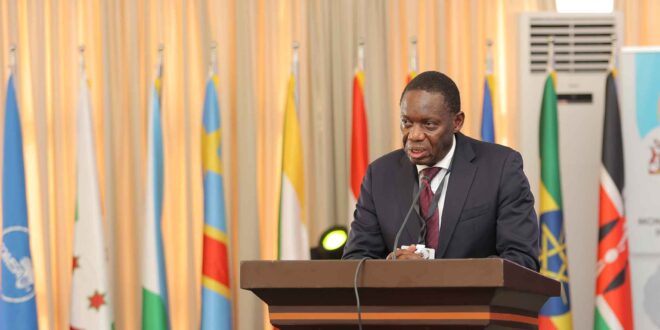
What is billed as a shield for Uganda’s sovereignty may instead rattle its economic foundations, Bank of Uganda Governor Michael Atingi-Ego and Deputy Governor Augustus Niwagaba warned, citing risks of capital flight, reserve depletion, and rising debt costs.
The bill, tabled on April 15 by State Minister for Internal Affairs Gen. David Muhoozi, seeks to regulate “agents of foreigners,” impose registration requirements, criminalize activities deemed to advance foreign interests against Uganda’s, and cap certain foreign funding (notably above UGX 400 million annually without ministerial approval).
While framed as a shield against external interference in politics, civil society, media, and business, the central bank argues its broad provisions could reverse three decades of financial liberalization that have supported growth, reserve accumulation, and macroeconomic stability.
This clash highlights a deeper policy tension: how Uganda balances legitimate national security concerns with the openness essential for attracting investment, servicing debt, and pursuing ambitious goals like a US$500 billion economy. It also spotlights Parliament’s constitutional oversight role amid apparent gaps in executive consultation.
Uganda has liberalized its financial account since the 1990s, moving from a controlled regime to one that facilitated foreign direct investment (FDI), remittances, portfolio flows, and correspondent banking relationships. These inflows have helped finance imports, build foreign exchange reserves (recently near US$6 billion), and support balance of payments surpluses, such as the US$1.5 billion recorded in one recent year.
Non-residents currently hold approximately US$3 billion in Ugandan securities, representing about 12% of the total. This investor base provides a vital financing channel for the government’s fiscal deficit. Uganda’s public debt has grown significantly in recent years, with sustainability hinging on continued access to both domestic and external markets.
The bill’s provisions, including mandatory approvals for foreign funding, parallel reporting requirements that could breach banking secrecy, broad criminal liabilities for directors, and restrictions potentially affecting legitimate economic research or inter-company loans, have raised alarms across stakeholders. The Uganda Bankers’ Association has echoed concerns about a “chilling effect” on investment and disruptions to routine banking activities.
Critics, including Human Rights Watch and ARTICLE 19, view the bill as reminiscent of restrictive “foreign agents” laws elsewhere, potentially threatening civic space, freedom of expression, and association under Article 29 of the Constitution. Proponents maintain it is necessary to safeguard sovereignty from undue external influence in a geopolitically sensitive environment.
Governor Atingi-Ego warned that the bill could force a substantial depreciation of the shilling as imports become relatively more expensive to balance reduced financial inflows against the current account. With fewer excess financial account flows, reserve accumulation would stall, leaving Uganda more vulnerable to external shocks. “A country without reserves is not sovereign,” he stated bluntly.
Specific red flags include the UGX 400 million foreign funding cap, far below tier-1 capital requirements for banks (UGX 150 billion), which could restrict capital injections, liquidity management, and correspondent banking.
Parallel oversight mechanisms that duplicate the Financial Intelligence Authority and undermine banking secrecy.
Potential criminalization of routine economic information sharing, damaging investor confidence and raising borrowing costs.
Risk of driving transactions into informal channels like Hawala systems, eroding the tax base and transparency gains.
If passed unchanged, the Governor indicated the central bank would likely need to tighten monetary policy to contain imported inflation (currently low at around 3%), potentially raising interest rates or accepting higher inflation above the 5% target.
International experiences underscore the risks. Argentina’s repeated use of strict capital and exchange controls has often led to parallel markets, investor exits, and persistent instability. China maintains tight capital controls but pairs them with massive reserves and state-directed investment; smaller open economies like Uganda lack similar buffers.
In contrast, selective, rules-based approaches in countries like India (post-2013 taper tantrum) or Peru have sometimes mitigated volatility without fully closing doors to inflows. Premature or poorly designed controls can accelerate the very capital flight they seek to prevent, as offshore investors exit preemptively upon signals of restriction. Uganda’s offshore holdings in securities make it particularly exposed.
Under Article 79 of the 1995 Constitution, Parliament has the power to make laws for peace, order, development, and good governance, and to protect the Constitution while promoting democratic governance.
Article 90 empowers committees to summon officials, demand evidence, and exercise quasi-judicial powers.The joint committee hearing exemplified this oversight function. MPs such as David Zijan (Butembo County), Jonathan Odur (Erute South), and Abdu Katuntu (Bugweri County) sharply questioned the bill’s origins and the apparent lack of inter-agency consultation.
Governor Atingi-Ego confirmed the central bank was not consulted during drafting, prompting Katuntu to decry the “ugly and confused” position in which Parliament had been placed: government institutions appearing to oppose a bill brought by the Executive.
Zijan went further, arguing that those who drafted the bill in its current form pose the greater sovereignty threat due to foreseeable economic fallout.
This episode tests Parliament’s role in reconciling security imperatives with economic realities and ensuring evidence-based legislation, particularly where bills carry significant fiscal or monetary implications.The Constitution envisions coordinated Executive action before bills reach the floor. The hearing revealed a coordination gap that Parliament is now compelled to address through amendments or redrafting.
Bank of Uganda has proposed targeted refinements: exemptions for regulated financial institutions, redrafting of problematic clauses (e.g., excluding legitimate research and removing excessive director liabilities), and higher or activity-based thresholds.
Policymakers should consider: Independent economic impact assessments integrating central bank, Finance Ministry, and private sector inputs, and phased or pilot implementation with clear monitoring metrics (reserve levels, exchange rate volatility, FDI flows, inflation pass-through).
Strengthened transparency and disclosure rules that enhance accountability without discretionary ministerial bottlenecks and alignment with existing frameworks like the Financial Institutions Act and anti-money laundering rules to avoid parallel structures.
True sovereignty, as Governor Atingi-Ego observed, is built on economic strength and financial independence. As Parliament scrutinizes the bill, the challenge is to craft legislation that fortifies Uganda’s autonomy without compromising the liberalized architecture that has delivered stability and growth.
, https://www.spyuganda.com/bou-sounds-alarm-sovereignty-bill-will-bury-ugandas-economy/
